Saree, What Did You Say?

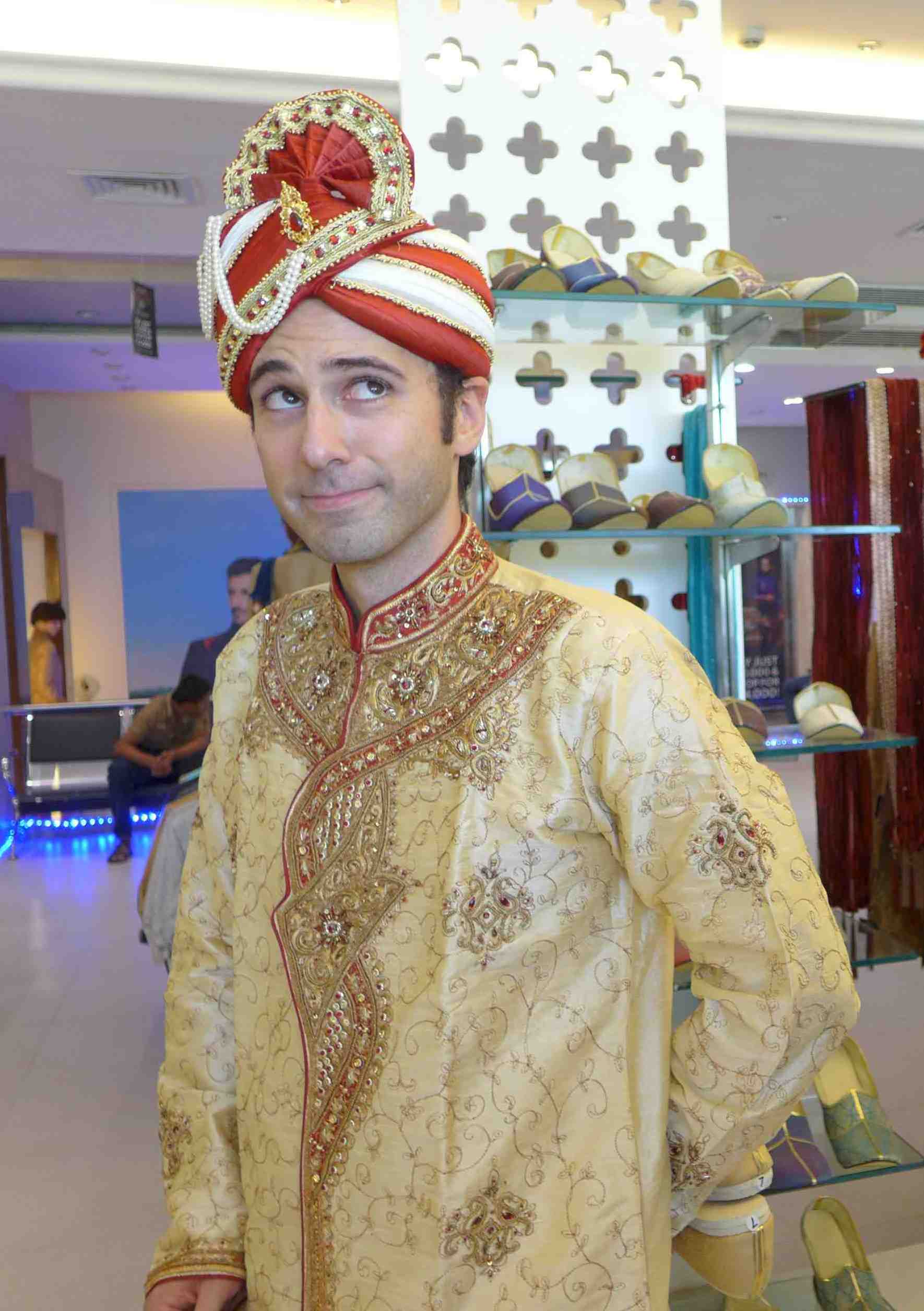
Groom looking skeptical about donning a wedding turban. Got vetoed. Too bad.

Groom looking skeptical about donning a wedding turban. Got vetoed. Too bad.


Once we were settled at the hotel, shopping for the wedding began! The first day we shopped for the men and got them pretty much outfitted in one go. Done and done.

Unbeknownst to the female American contingent, our Indian hosts had purchased wedding sarees, bangles, and matching jewelry for us before we arrived; they were all very beautiful and it was a great honor to receive them as gifts. However, most of us needed to buy additional clothes for the mehndi (moderately formal) and the wedding night dinner reception (evening formal), and the bride needed to buy several sarees for different parts of the wedding. Interestingly, some were later formally presented to her as “gifts” after she chose them–relatives gave money for them in what seems to be in Indian version of the wedding trousseau.

We girls soon discovered we were in for a more labor-intensive shopping experience than the guys. Saree shopping for the bride took us to several different stores, plus shopping in India requires stamina, determination, and the ability to keep calm while surrounded by store personnel….and I do mean surrounded.

Clothing stores in India have more floor personnel than the Apple Store–no exaggeration–and they swarm around new customers, especially those that appear to be looking for high-ticket bridal wear. I got boxed into an aisle by three employees while I was browsing some shawls; that made me a bit claustrophobic and reluctant to do any further shopping for the rest of the trip.

Most of us Westerners felt the same way about this highly attentive approach. I assume this is just employees competing for commissions, but Americans used to some autonomy and space while shopping, so having a salesperson or five on your six felt really high-pressure. This tactic ended up (in our case, anyway) being counterproductive, as most of us backed out of the shopping fray as soon as possible–no income from impulse buys here.
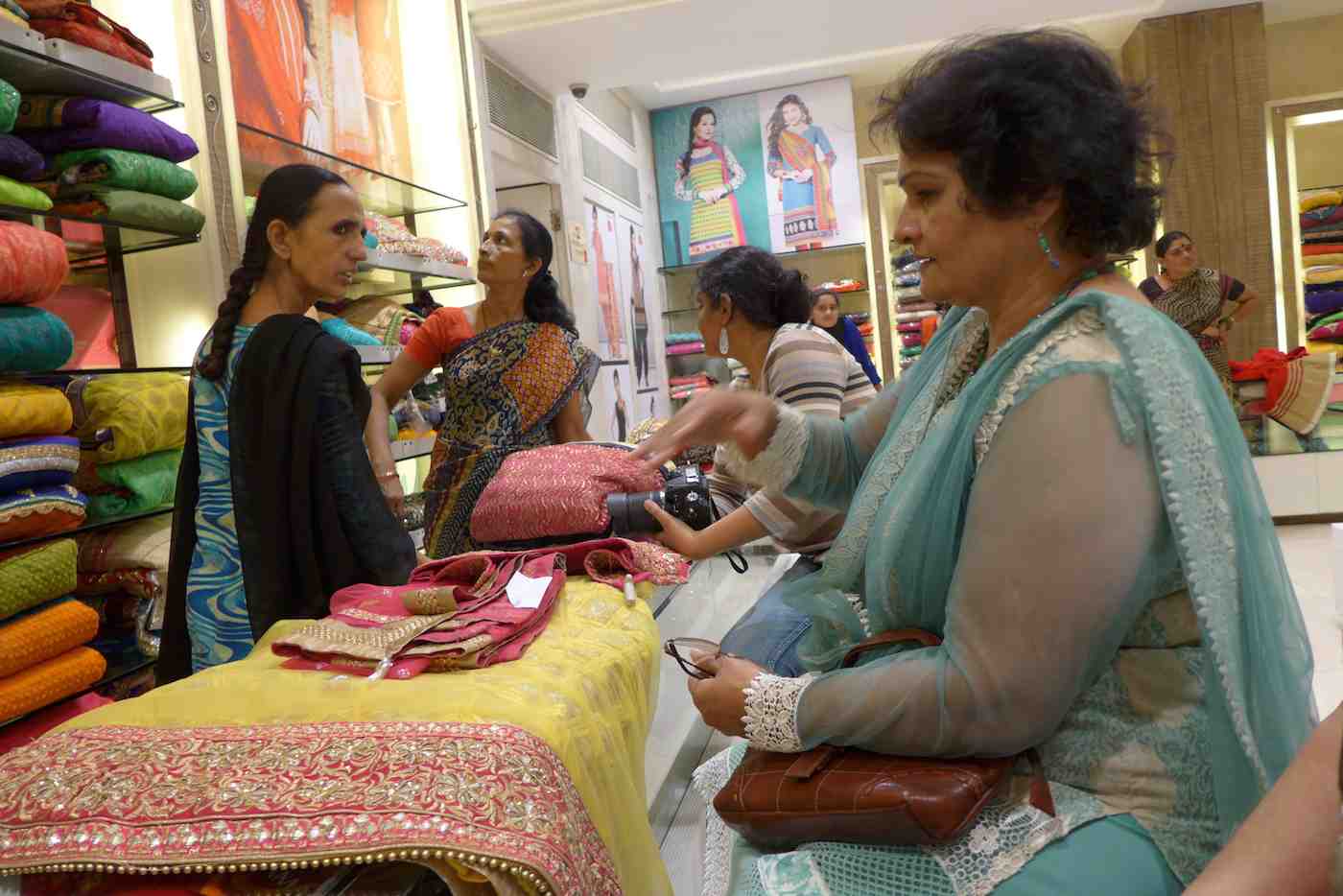
 

Saree Counter @ Kajree Clothing Store, Pune

Saree Counter @ Kajree Clothing Store, Pune


Though you can get “pre-made” sarees, the majority of them are sold as flat layers of fabric, two of which are then tailored or “stitched” into the choli (blouse) and petticoat. These sarees are six yards in length (a traditional Maharastran saree is nine yards–we saw a few older rural women wearing them), with inner layers of different colors and some edging to be stitched into the blouse. The fancy edge on top of the saree is the pallu, which ends up draped over the shoulder.

You can’t just pull sarees down off the shelves yourself and start pawing through the layers, however. Salespeople flock and a flurry of flopping fabric starts filling the counter in front of you. Other employees start folding and reshelving the rejects when the pile gets too high.

Most of the interactions occurred in Marathi so we didn’t understand what was being said, but we could understand the process pretty well. It helps to be an absolute shopping diva like the bride’s mom. I was in awe of her ability to get what she wanted without dithering or fuss. It was clear to me that if you don’t grab the steering wheel of the saree shopping bus, you’ll get run over–or suffocated in a pile of prospective purchases.

At one of the stores we went into a special room to be shown hand-woven silk sarees. These were the most beautiful fabrics I have ever seen. We took off our shoes to enter and sat on the edge of a cushioned mat as saleswomen started pulling sumptuous, luscious iridescent fabrics out of the closet behind them; glorious colors and textures that seemed to glow with a light of their own.
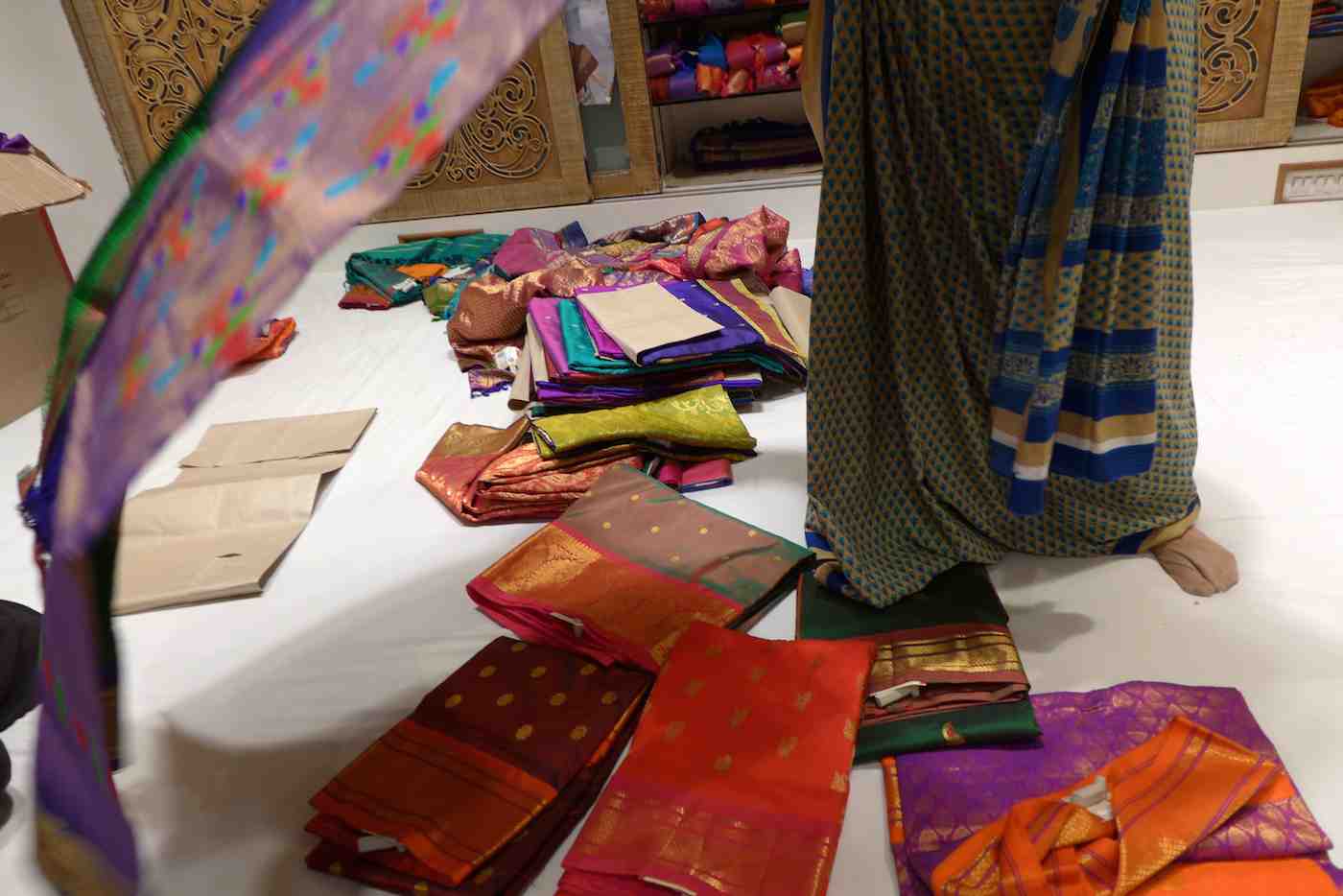
 

Handwoven silk sarees. Yum.
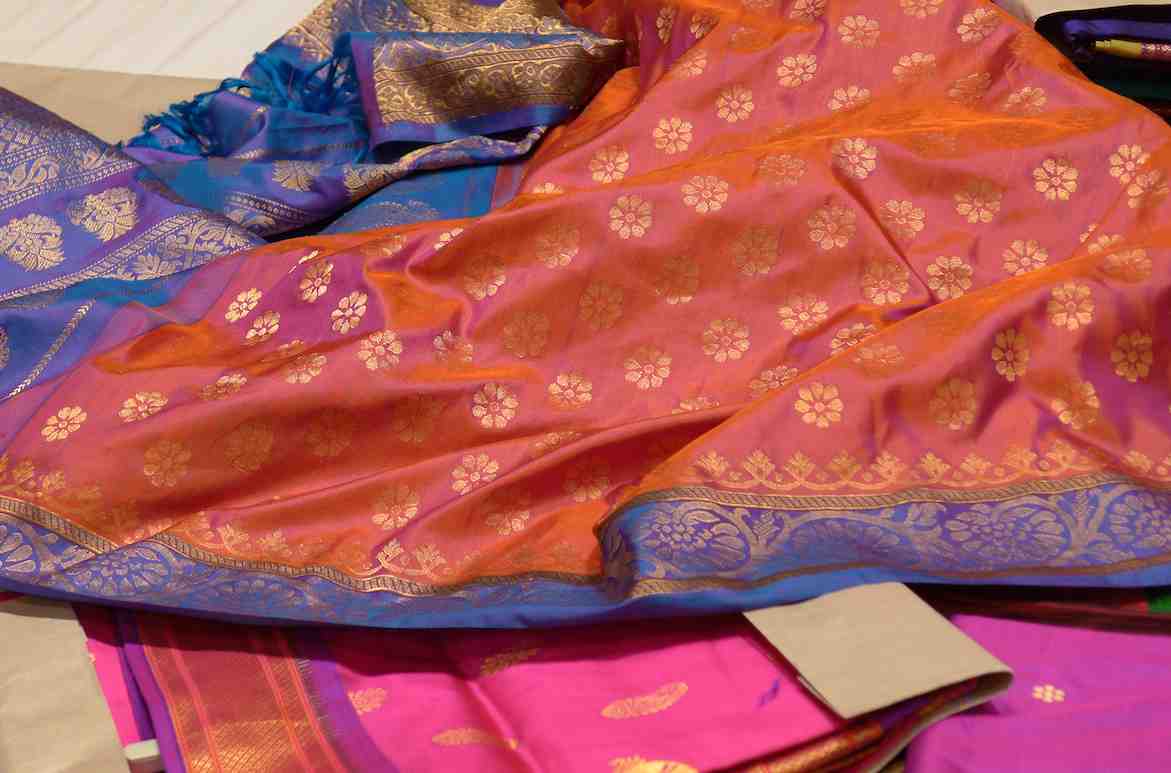
Handwoven silk sarees.

Glorious.

Glorious colors, all changing under the light.
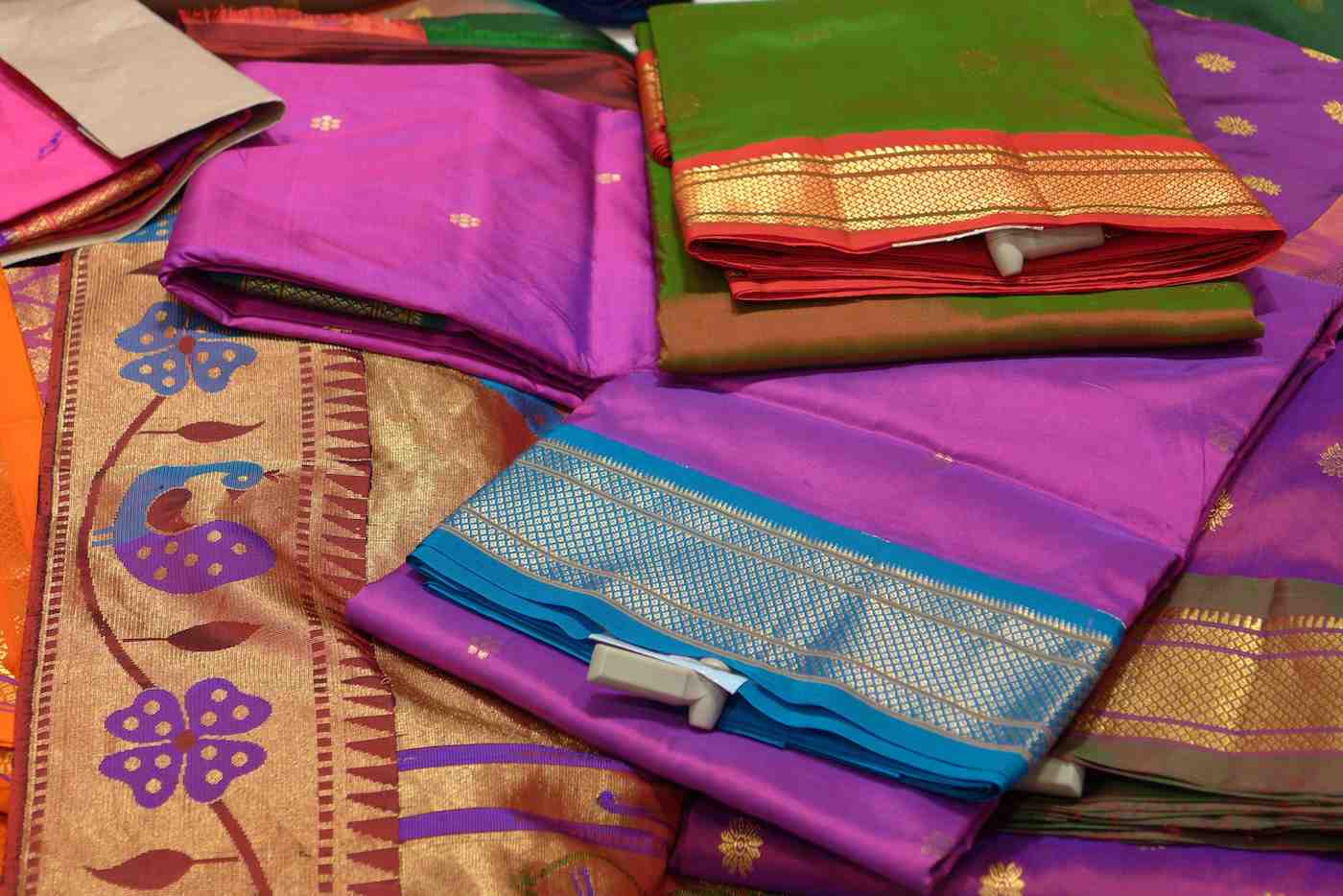
More handwoven silk sarees, all iridescent and finely embroidered.

More handwoven silk sarees, all iridescent and finely embroidered. Peacocks and flowers are popular motifs.
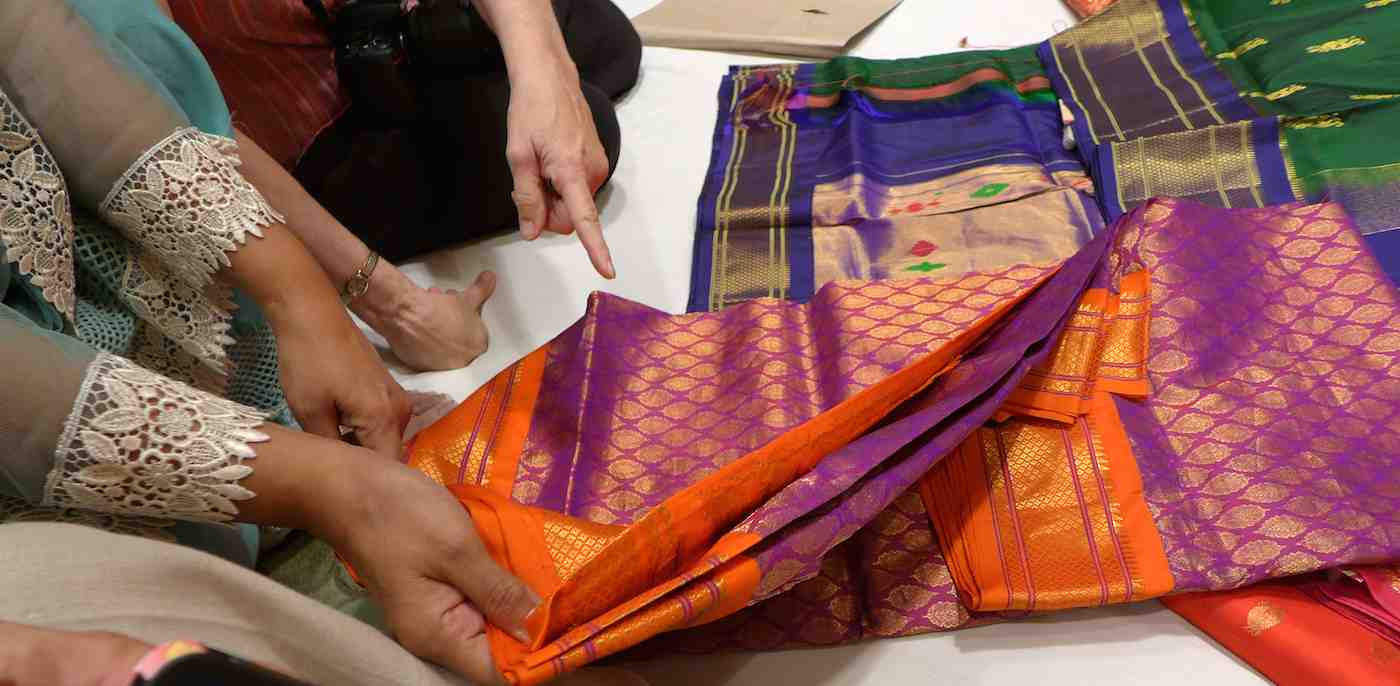
Very hard to choose. I think this one made the cut.

Very hard to choose. I think this one made the cut.


A few days later, we went to the seamstress to be measured so our blouses could be stitched. We were handed pattern catalogs to choose the style we wanted:
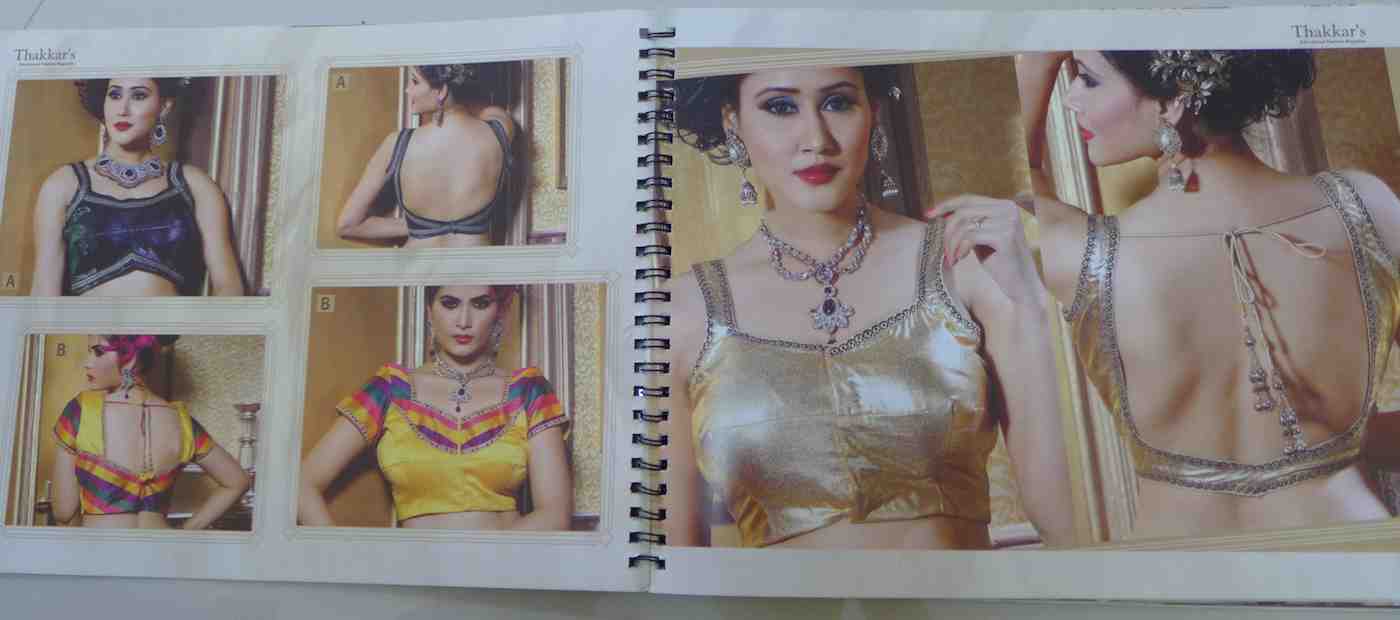
 

Pattern catalog for saree blouses.
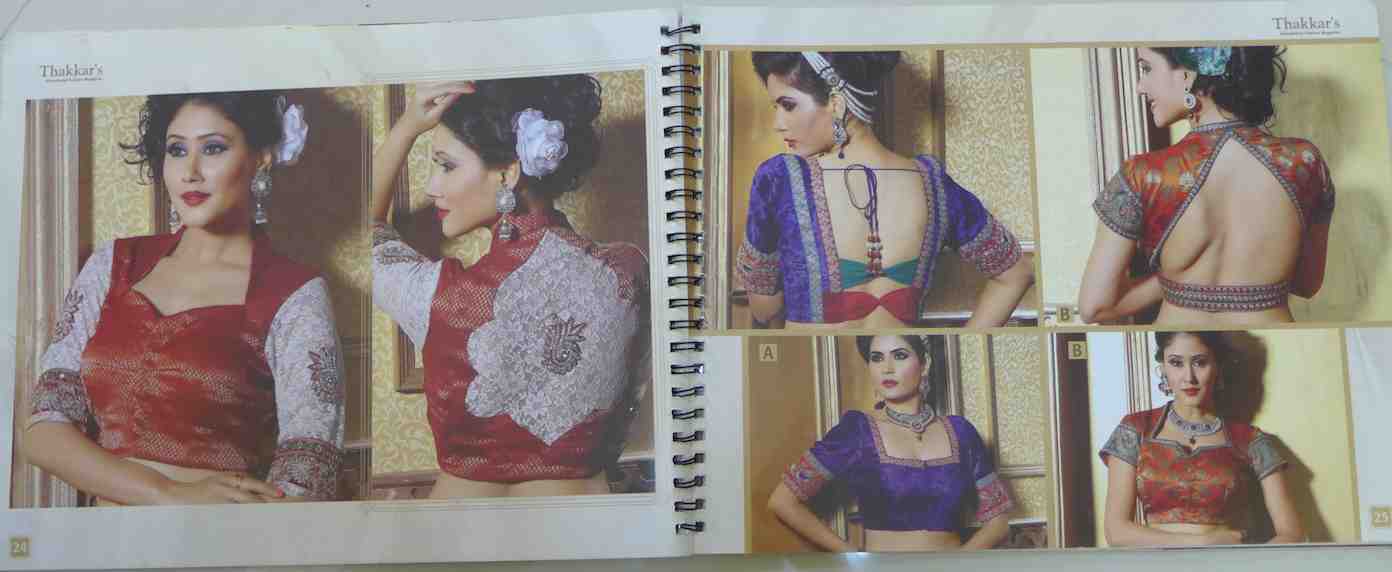
Pattern catalog for saree blouses.


More blouse patterns.

More blouse patterns.


Most of us older guests wanted the longest blouse with the most coverage possible. It took some looking, and we only had a couple days for many blouses to be stitched so we were urged to choose simpler designs (which was fine by us).
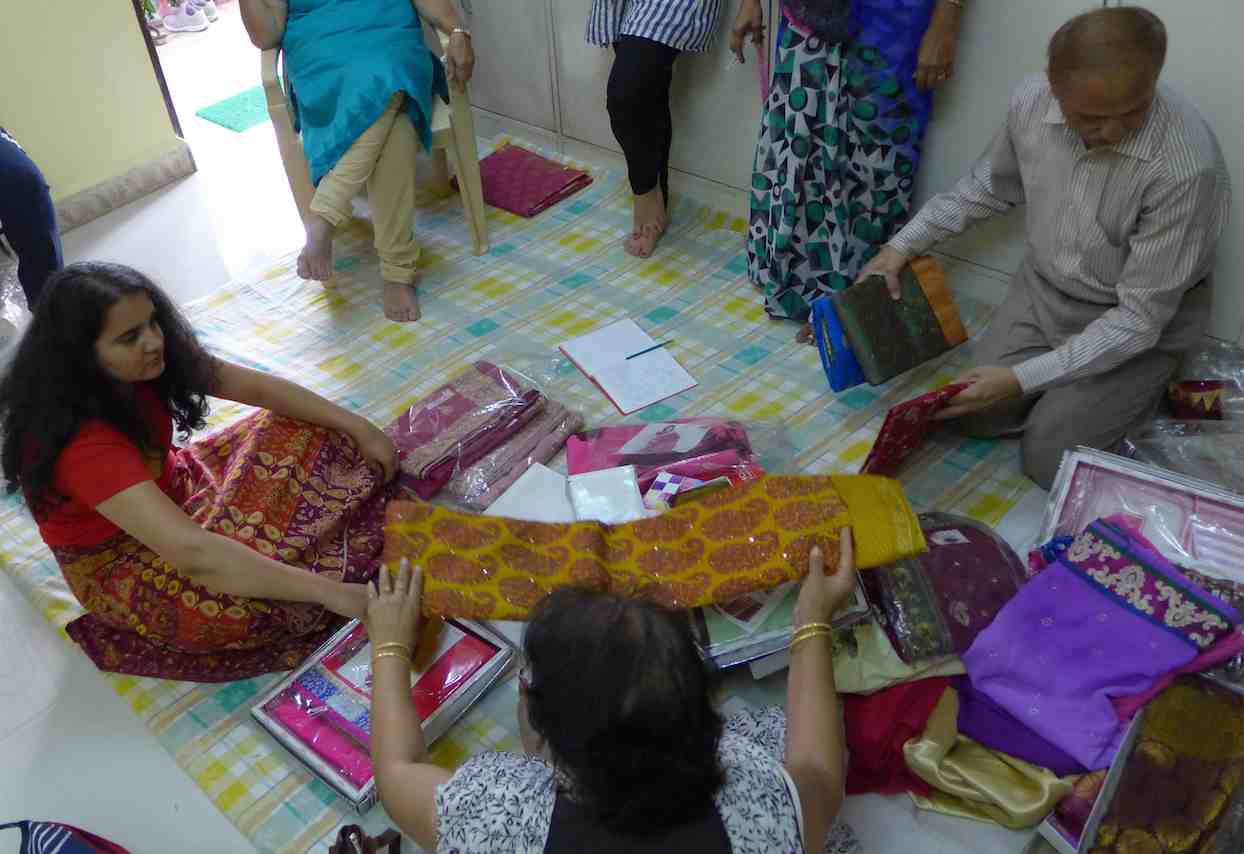
 

At the seamstress, looking at sarees before measurements were taken.

At the seamstress, looking at sarees before measurements were taken.


A day or two before the wedding we tried on our blouses, but we didn’t get to try on our full ensembles until the wedding day. Saree wrapping is a little complicated and there are many styles, but thankfully some of the female relatives volunteered to help get us USians dressed.

Though the positioning of the pallu is critical to the look it was explained to me that the pleats in the front were the most important part–the most difficult to fold and also the hardest to maintain all day. I was admonished to tie my petticoat very tight so the pleats would stay tucked in. During the day I kept hitching them up so I wouldn’t walk on them, and various female Indian family members would stop to pull them down. You wear these things right down to the floor–no ankles allowed–and have to be mindful to lift the pleats when you go up and down stairs so you don’t step on and unravel them.

And yes, it’s fair play to use safety pins. I am told Indian women use them too.

Unfortunately Samuel wasn’t around to film my wrapping process and I couldn’t call him (don’t even get me started about the multiple SIM card comedies that beset our group all through the wedding week) but if you want to see how complex it is to properly wrap a saree, this video may give you a clue:


I know you’re dying to see the final result. Here it is:
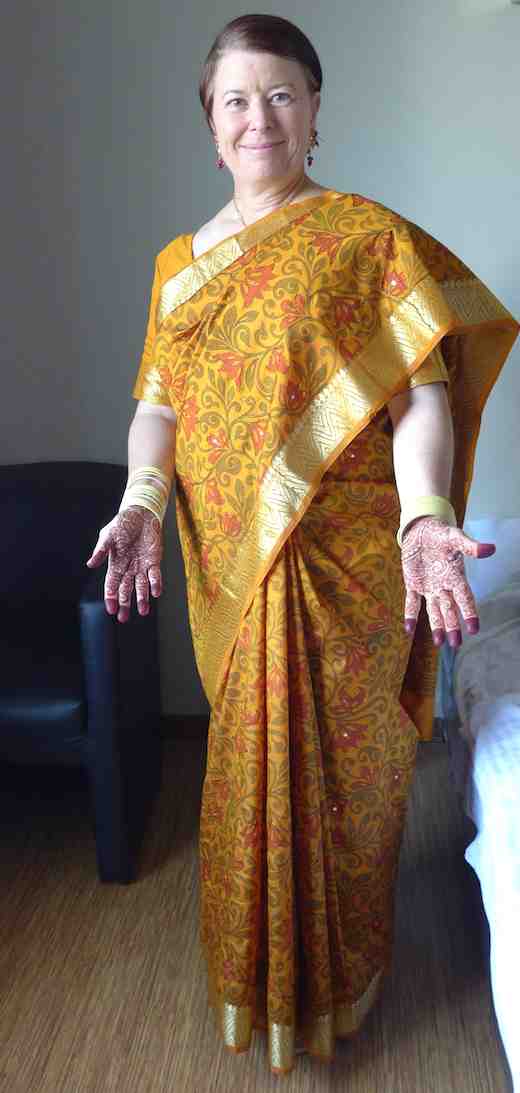
 

Pleats, pallu, mehndi, bindi.
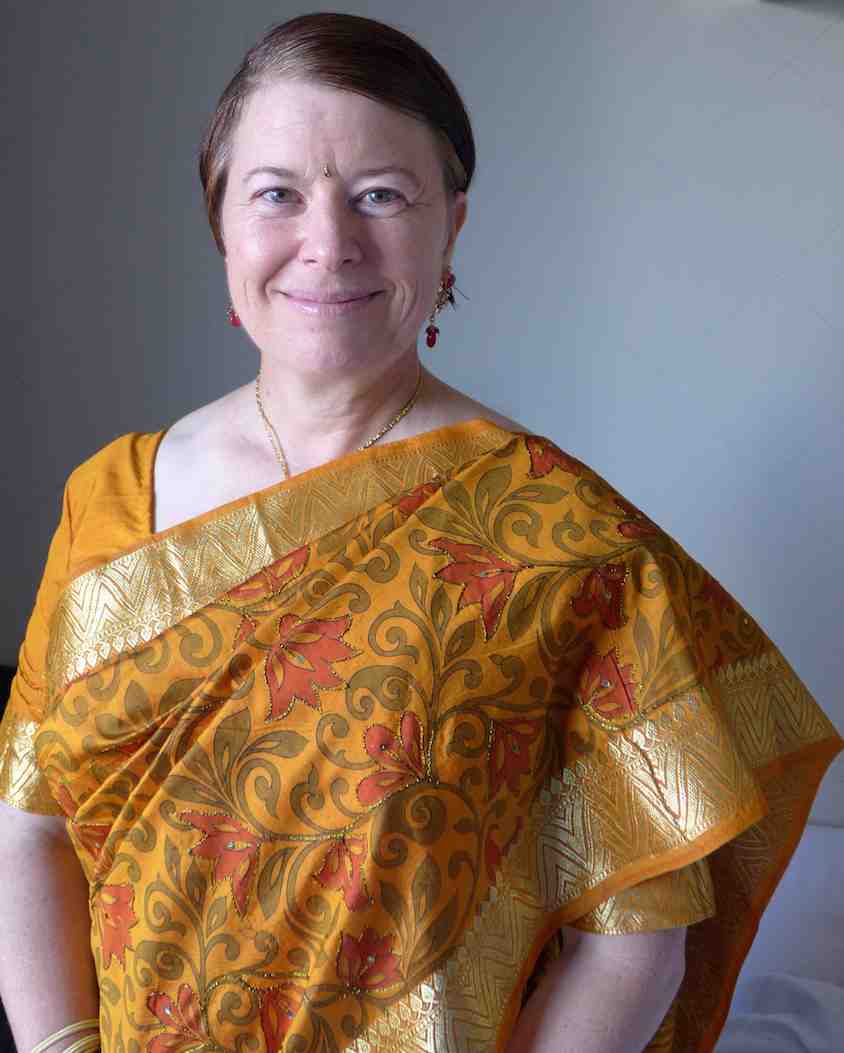
Pleats, pallu, mehndi, bindi.

Me and my palloo.

Me and my pallu.


Thankfully it seemed we were all well wrapped, as none of us had a dreaded wardrobe malfunction during the event. All the members of the American contingent were to take a turn at a “ramp walk” to show off our clothing at the post-wedding reception and talent show, and thanks to the excellent taste of the bride and the bride’s mom–and their monster mad shopping skillz–we were greeted with hearty applause.
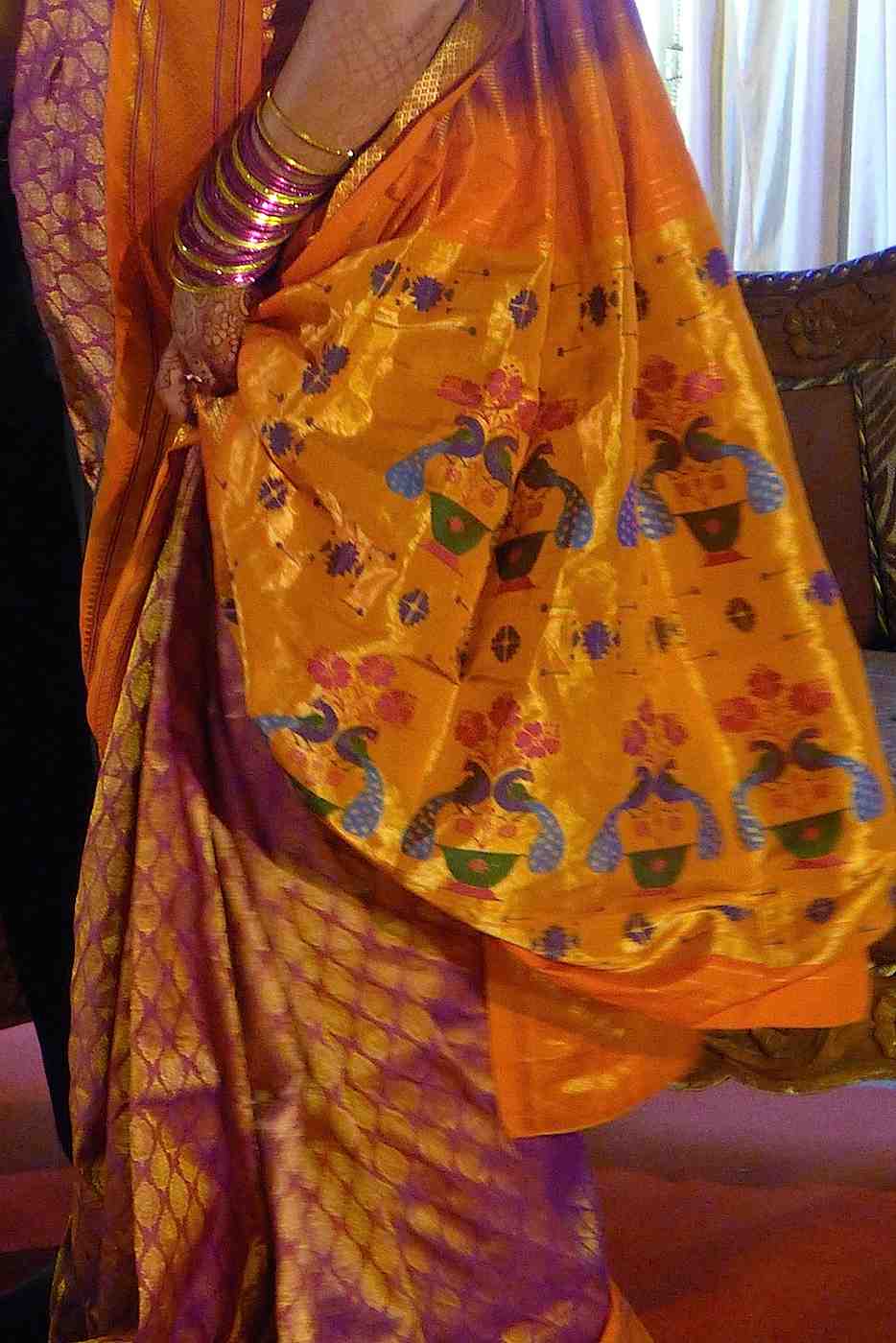
 

The bride's handwoven silk saree at the evening reception, plus bangles.
The bride’s handwoven silk saree at the evening reception, plus bangles.
Dust, Dancing, Shopping, and Sugar: Our First Days in India

Howdy (or Namaskaar, or Namaste) y’all:

We’ve been here a week and have been too busy/exhausted/sick to post, but today we have a free morning and I’m taking a minute to post an update so you don’t worry we’re dead.

The flight from L.A. was long and (for me) particularly brutal as I got a Big Banger of a headache that lasted pretty much the whole way. Overpreparer that I am, I had Advil and protein bars at the ready in my carry-on, so I was able to take the pain down to a dull roar for most of the flight. I regretted not bringing a neck pillow, as “sleeping” cramped in a coach seat was frustratingly uncomfortable; once our section was finally asleep, everyone was awakened by a loud, long conversation in the aisle right next to us. Many were more than grumpy but no one said anything, mostly because we weren’t sure what would be effective.

Between the sleepless crankies, the headache, and United’s crappy selection of hundreds of mediocre movies, the flight became a floating steel-encapsulated living Hell. This was not an auspicious start to our adventure, but we tried to remain as upbeat as our exhaustion allowed.

———–

We were late into Mumbai, arriving at about 9:30 pm, but our hosts were awaiting us at the airport with flowers nonetheless, along with drivers to take us to our hotel. We had to wait another couple hours for the bride and groom’s flight, also late; we finally staggered into the van headed for Pune around 1 am.

After 24 hours in air transit you’d think 3-4 hours more on the road would be a mere annoyance. IT WAS TERRIFYING. Everything you’ve ever heard about driving in India is true–probably even worse than you’ve heard.

Most drivers start their journeys at night (due to the heat, most trucks are not air-conditioned) so the road was packed, with dust and exhaust fumes swirling in the headlights as we careened towards our hotel.

Soon my airplane headache was compounded by carsickness and the dreadful certainty that we would die. In India, lane markings are simply ignored. Trucks cut traffic between lanes at high speeds while honking repeatedly to cue other vehicles to edge away. Motorcycles zip from one lane to another while larger vehicles brake and swerve with mere inches of clearance. Cars, trucks, and motorcycles stop randomly in the middle of the road for a smoke-o while others drive on the dirt shoulder at full speed to get around them. We were not surprised to learn that India has the highest traffic mortality rate in the world. We were surprised we didn’t end up as part of that statistic.

Note: I managed to get some footage to be used as forensic evidence should we all die en route, but sadly I won’t be able to upload it until I get back due to an operating system issue. Look for exciting action-packed commuting videos on Facebook after our return!

We got into our hotel around 4 am and slept a little. Trying to negotiate a developing nation on a couple hours sleep is no picnic. Still, we had a schedule so we did what we had to do.

Bleary-eyed, we poked around the hotel in the morning as a) we were exhausted and b) had been warned not to go anywhere without an Indian escort (if you think driving in India is bad, try crossing a street). We’re staying at what’s considered a mid-level hotel, but some words of advice if you should attempt India in future:

1. In addition to providing flowers, our hosts put a gift basket in our hotel room with cookies and Indian snacks like moong dal, or deep-fried lentils. This was helpful, as the hotel restaurant was open limited hours and access to food/caffeine was restricted.

2. Food access becomes an issue if you are taking Malarone (anti-malarial pills) as the drug messes with your gut during its entire transit through your system. ‘Nuff said.

3. Speaking of guts: bring your own toilet paper, bar soap, toothpaste, sewing kit, shampoo, etc. Most of the stuff you take for granted at a motel in the States you’re not assured here even in a “business hotel.” Thankfully our rooms had Western-style toilets, not the case at many of the historic sites we visited.

3. Indian food contains a lot of grease and starch and can make one feel pretty bloaty, an effect amplified if you are (wisely) avoiding raw food. Most places have tons of “veg” items; you’re not going to see beef or pork anywhere–only chicken, lamb, and sometimes fish.

Hotels serve alcohol but most places won’t have it as it’s strictly regulated (and many religiously observant folks don’t drink). You can find Starbucks in the bigger cities, but most coffee you’ll encounter is instant. Tea is normally served mixed with hot buffalo milk so it’s also quite rich.

Finally, Indians love their sugar but their treats have different tastes and textures than ours (especially the chocolate, so bring your own if you know you’ll have a craving for a specific something). I can leave most of the pastries alone–there are English style cookies, thanks to Empress Victoria and the Raj, wot wot–but I have fallen in love with chikki, the Indian version of peanut brittle made with jaggery, or unrefined sugar.

4. Our room was fitted with a “magic eye,” i.e. a video camera that allows women who are staying alone see who is knocking at the hotel room door. This is helpful in a country notorious for violence against women–and recently, for horrible rapes of foreigners–and for religious females (like the one on our plane who requested to be reseated because she was sitting between two men).

5. Reading the locally-produced newspaper is helpful for starting conversations with the locals, who are usually happy to contextualize news items you’re interested in. They usually appreciate your interest in their country and culture too. It’s sad how many tourists resist getting their feet wet, culturally speaking (though often they end up doing so in Asian “starting block”-style toilets. Bring your own TP for those too.)

6. Tech here is really, really spotty. Our hotel had a “business center” and wireless service in-room, but the connections weren’t reliable and download speeds very slow. Part of the reason we’ve not been posting is that every page download takes forever.

As a result, most hotel records are kept on paper; we had to provide passport and visa copies a couple times upon arrival even though they had been submitted in advance.

7. Indians are for the most part friendly, polite, and gracious, but if you’re out in public you have to watch your wallet and belongings like a hawk (we keep our documents and cash in a neck wallet under our clothes; our hosts thought this was such a good idea they bought their own).

Also when you’re in public expect to have people stop you and ask to take your picture–they often just take your picture without your permission anyway. Then expect to have anyone else in the vicinity to pile in for their own photos, delaying your progress.

—————————-

SHOPPING, DANCING, PHOTOS

The next day we went wedding clothes shopping for the groom and male guests. It was intense and exhausting. I took a lot of photos before I noticed the “No Photography” sign in the store (they’re in most clothing stores)–whoops. My hostess said nobody really cares, but I hate giving the nationals more contempt for stupid Americans. I got a few nice photos in exchange for the dose of embarrassment, I guess.

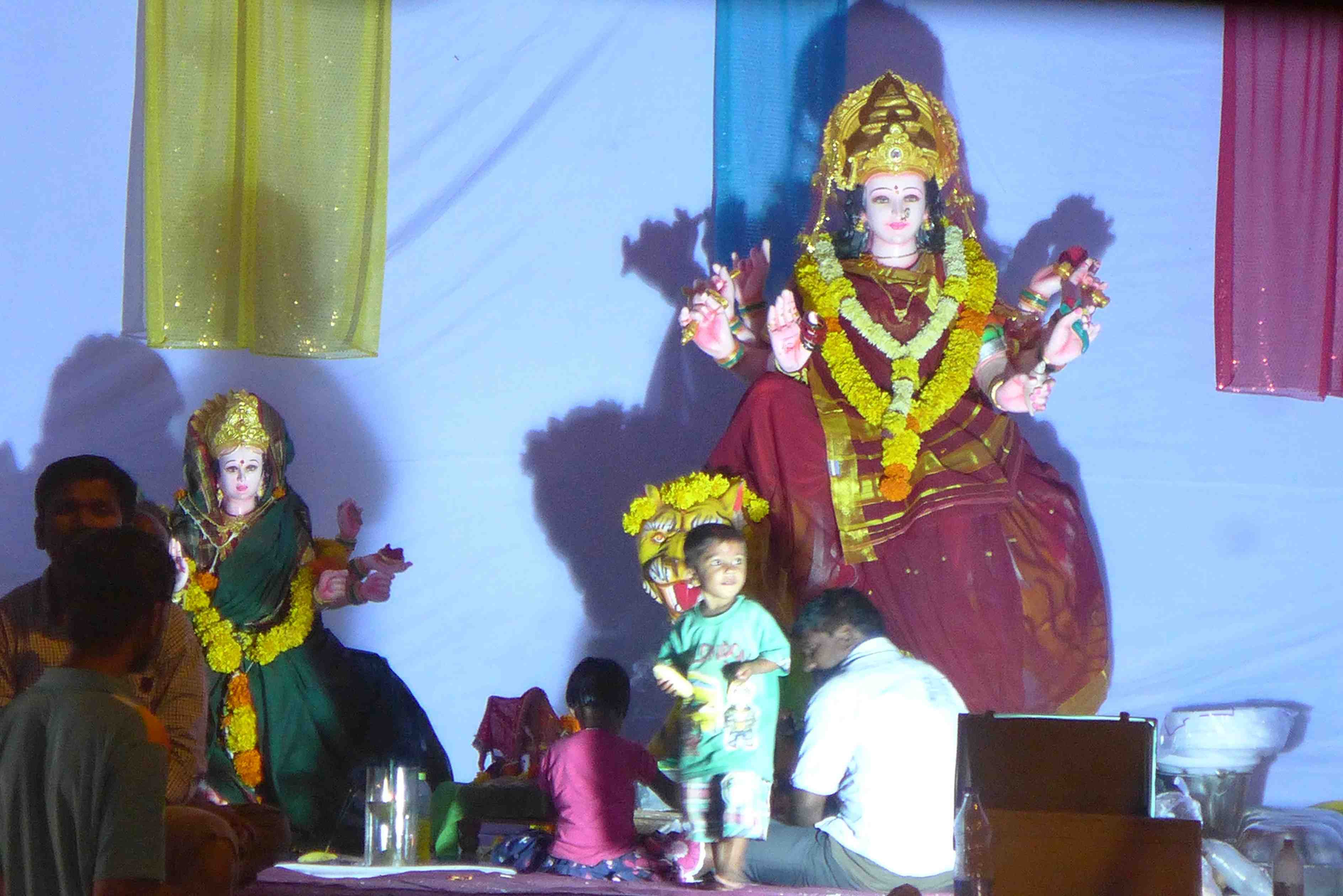
It was also the last day of Navratri, a nine-day festival celebrating the victory of the goddess Durga over the demon Mahishasura. On that night is the Dandiya, a colorful folk dance from Gujarat, where you dance with sticks and clack them together as you whirl around. Large dances are organized with competitions for the best dancers. We saw much great happy clattering and spinning around, and some of us were invited to join in. The young dancers we encountered were all very sweet and seemed to have fun teaching us the moves.

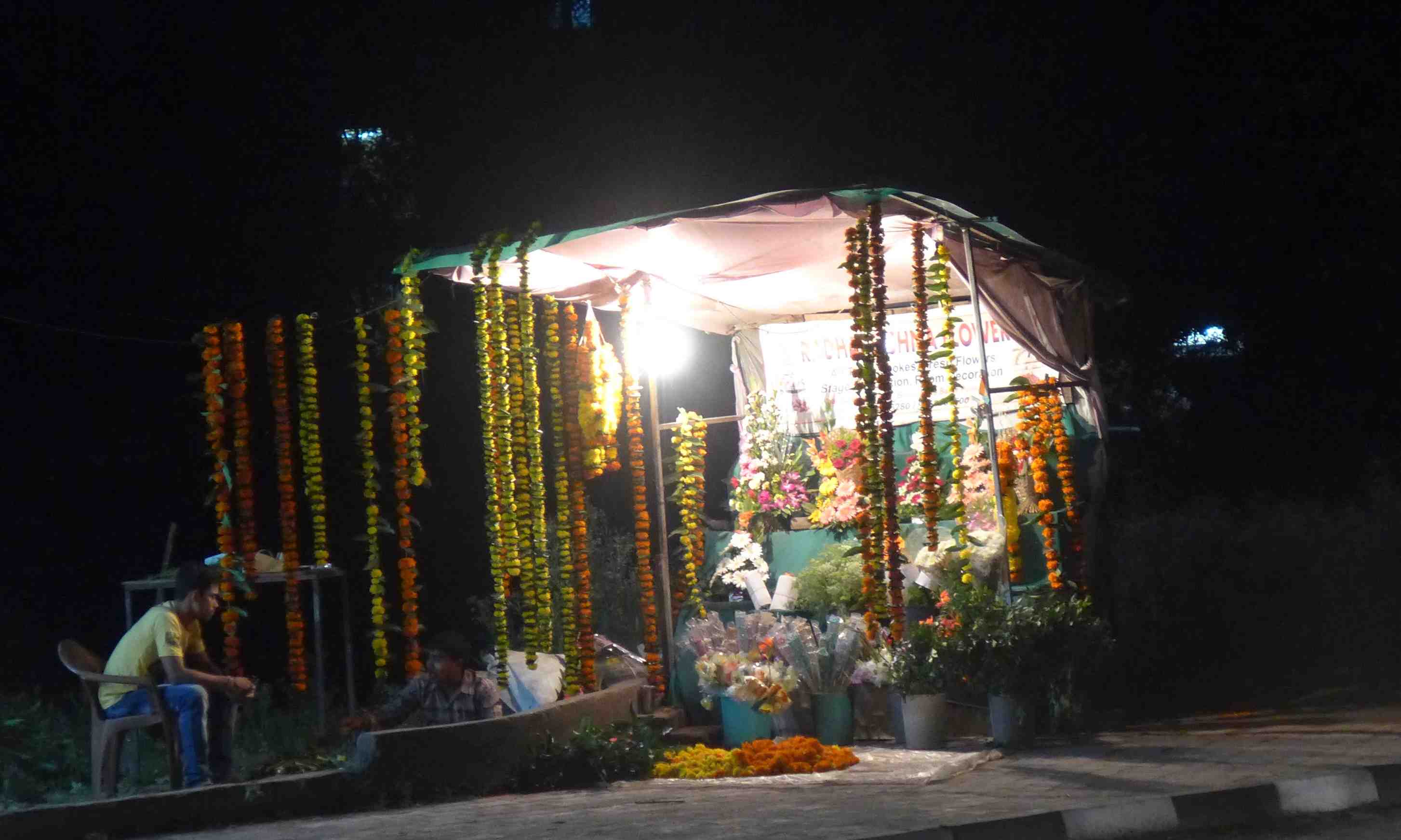
The tenth day of the festival is Dussehra, where businesses and tools of trade are decorated with leaves and garlands.

Here are some photos of those holiday doings, and I’ll post more about our recent adventures soon. We’re in Aurangabad now but have to get up really early to get back to Pune tomorrow for the final wedding preparations (Mehendi!)

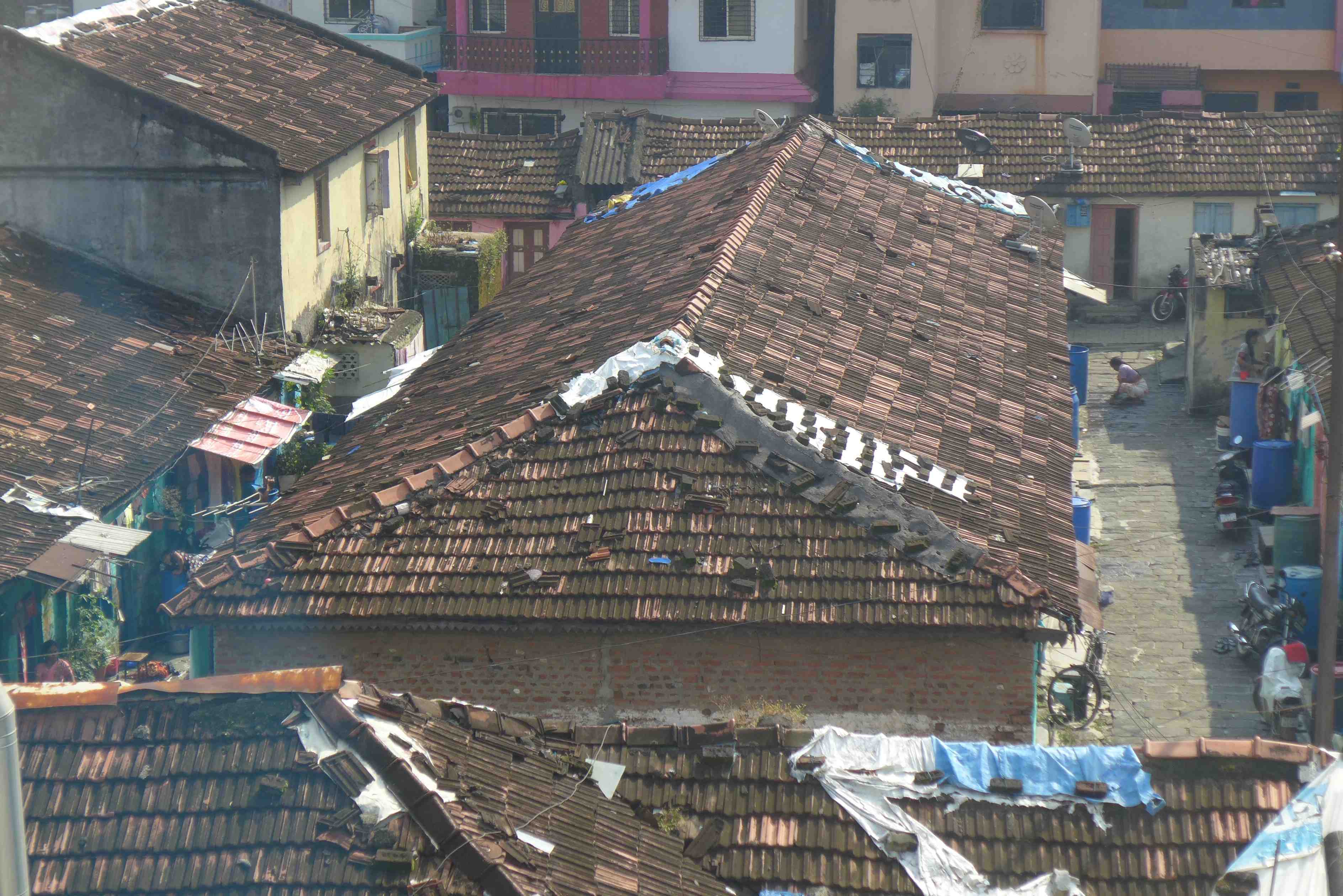
View from our hotel. The blue barrels catch rainwater, and we could see the women fetching buckets to take indoors in the morning.

View from our hotel. The blue barrels catch rainwater, and we could see the women fetching buckets to take indoors in the morning.

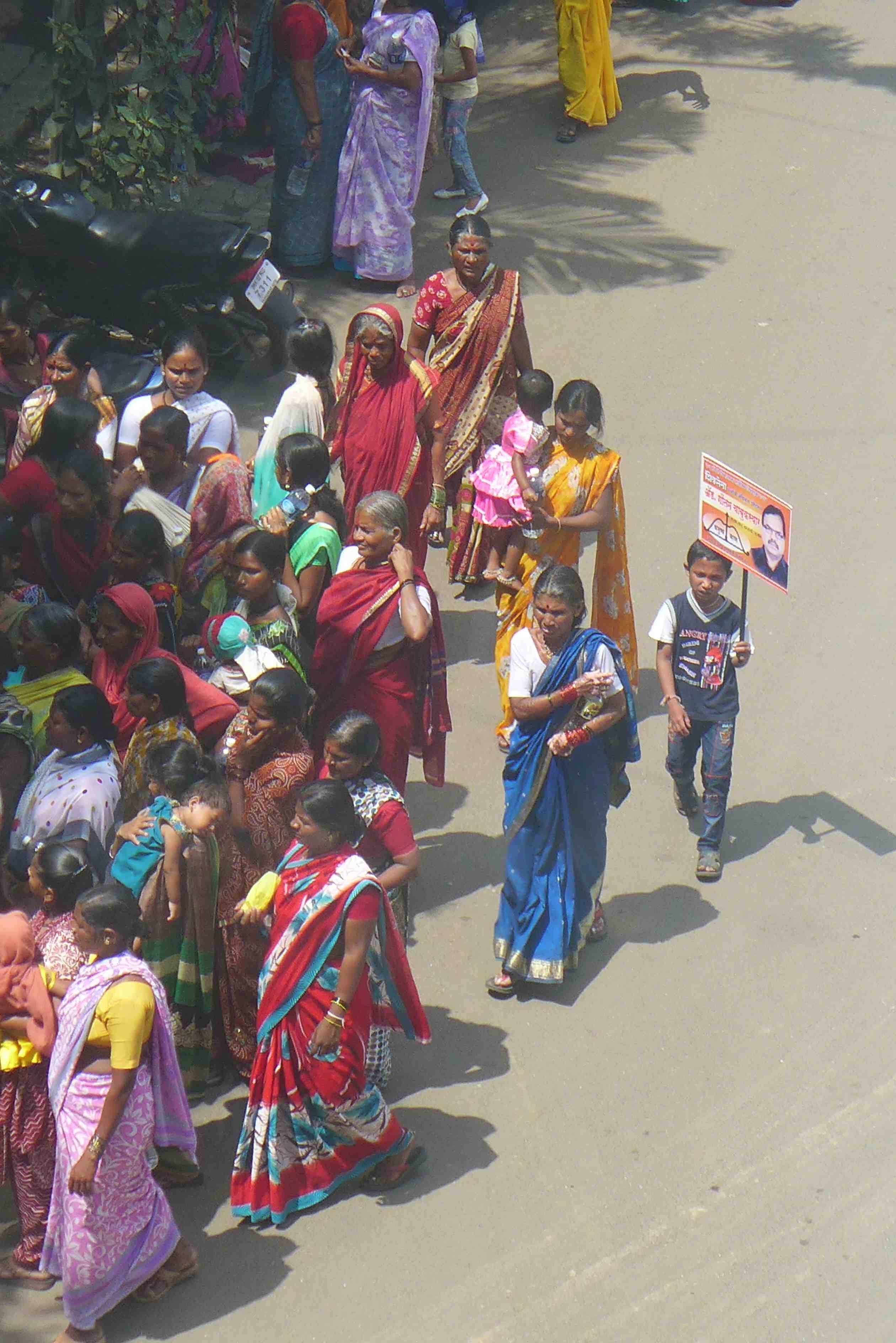
Political rally. State parliamentary elections are next week and it's fierce. Women marched separately from men.

Political rally. State parliamentary elections are next week and it’s fierce. Women marched separately from men.

Roadside stand selling garlands and flower petals for the holiday.

Roadside stand selling garlands and flower petals for the holiday.

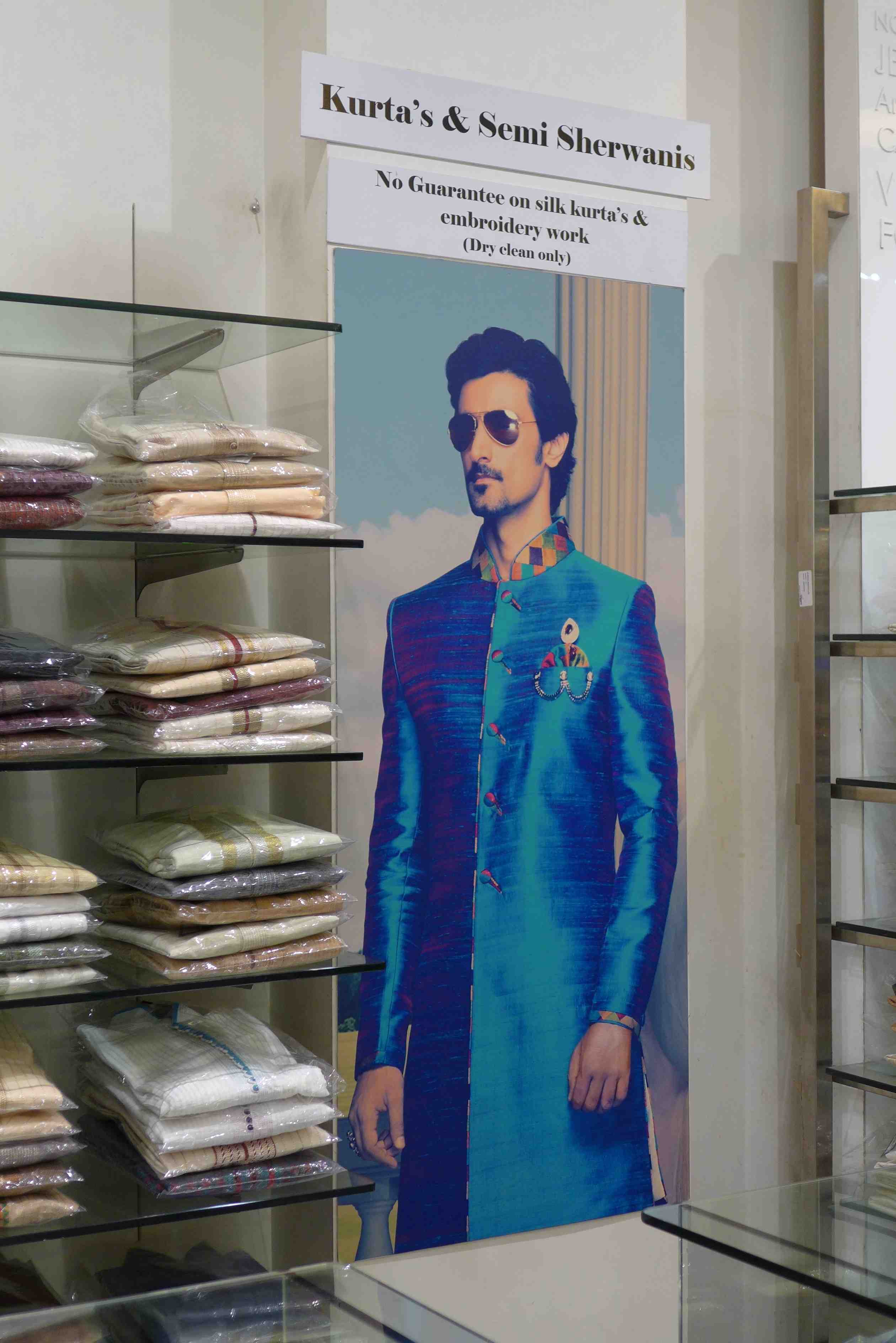
Poster for wedding kurtas for men.

Poster for wedding kurtas for men.

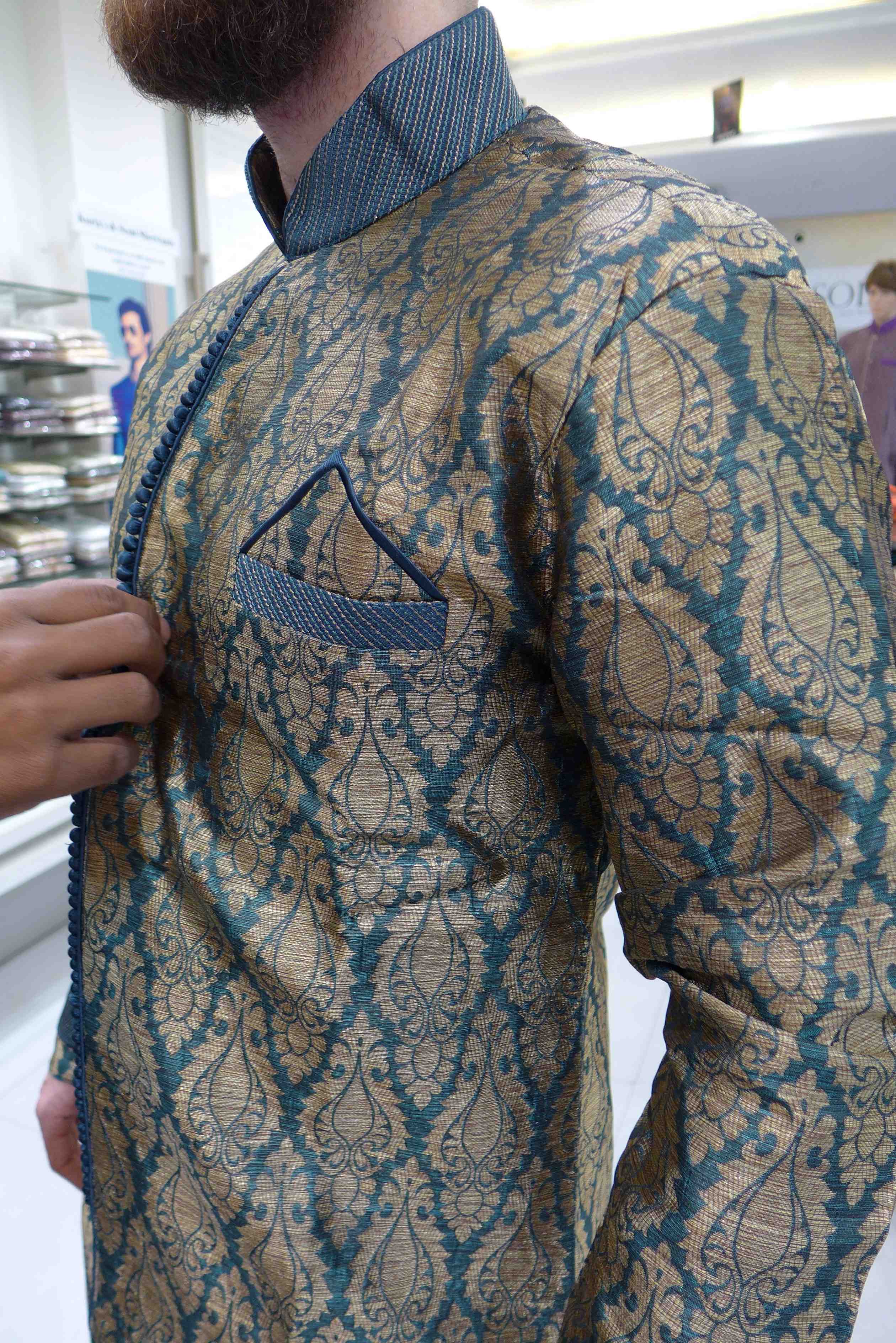
Western style meets Desi wear. Note ornamental "pocket square" for wedding kurta.

Western style meets Desi wear. Note ornamental “pocket square” for wedding kurta.

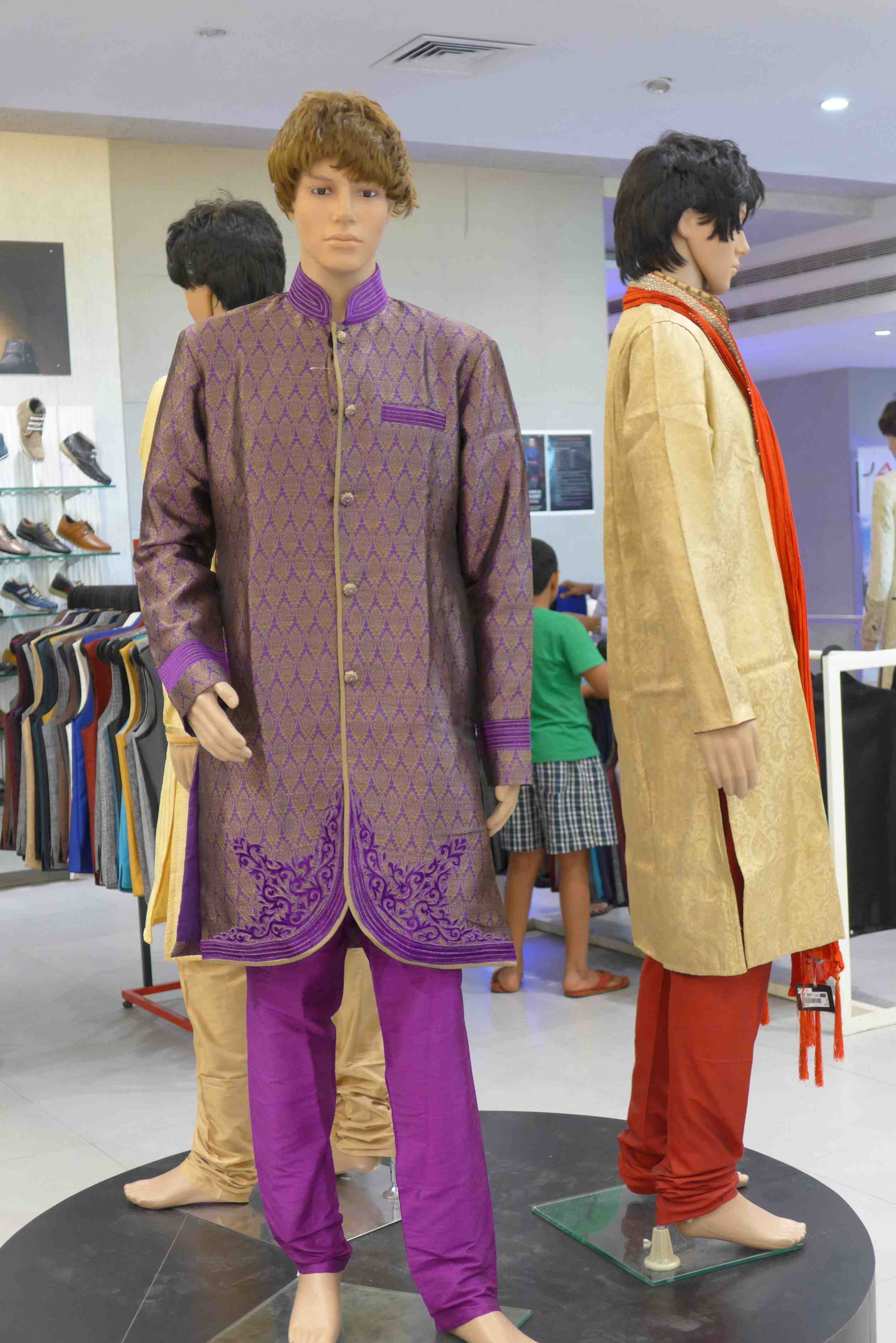
More wedding kurtas for men.

More wedding kurtas for men.

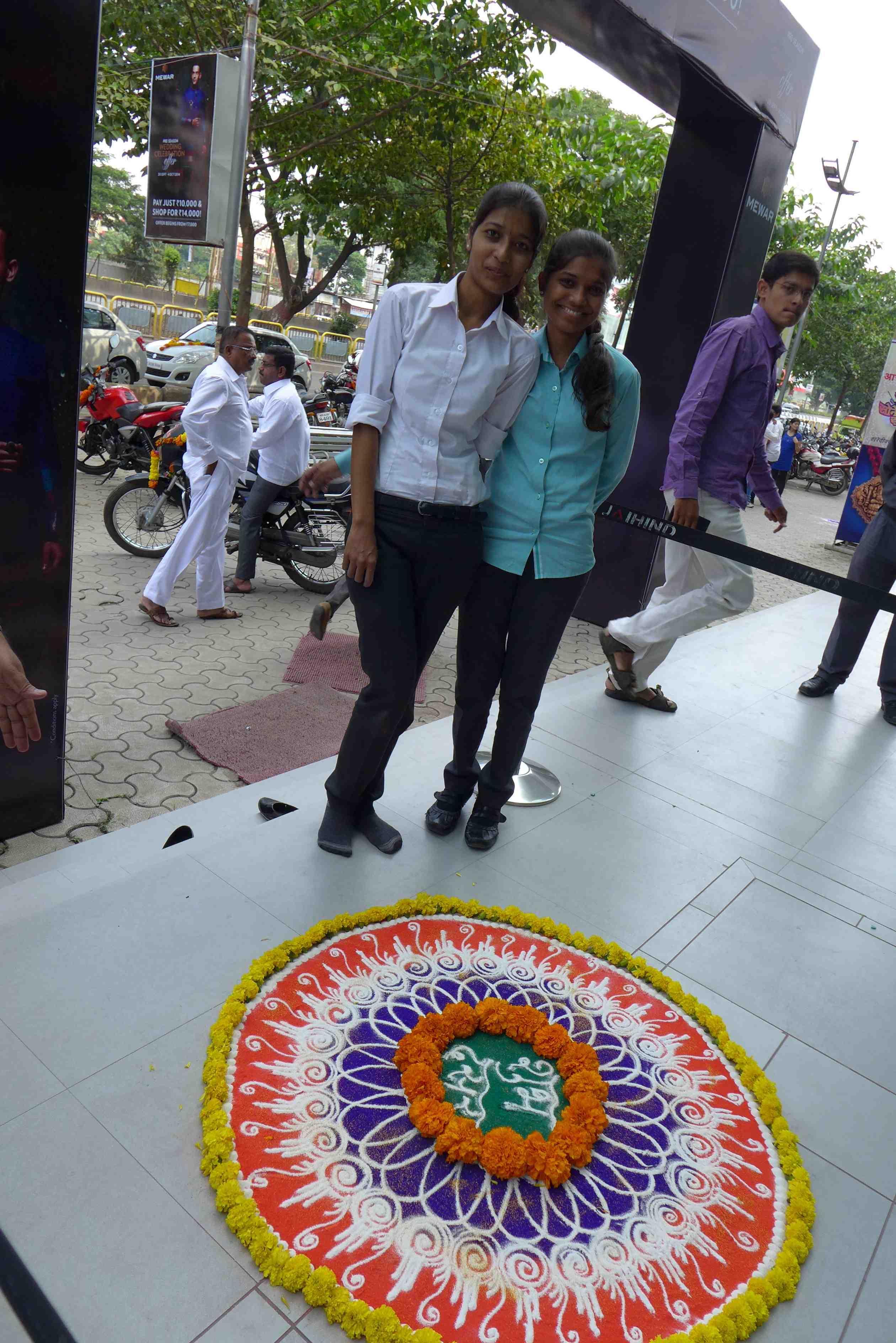
These two ladies work at the clothing store and have just completed this beautiful mandala made with flower petals and sand. Many businesses create these at the entrance for holiday blessings.

These two ladies work at the clothing store and have just completed this beautiful mandala made with flower petals and sand. Many businesses create these at the entrance for holiday blessings.

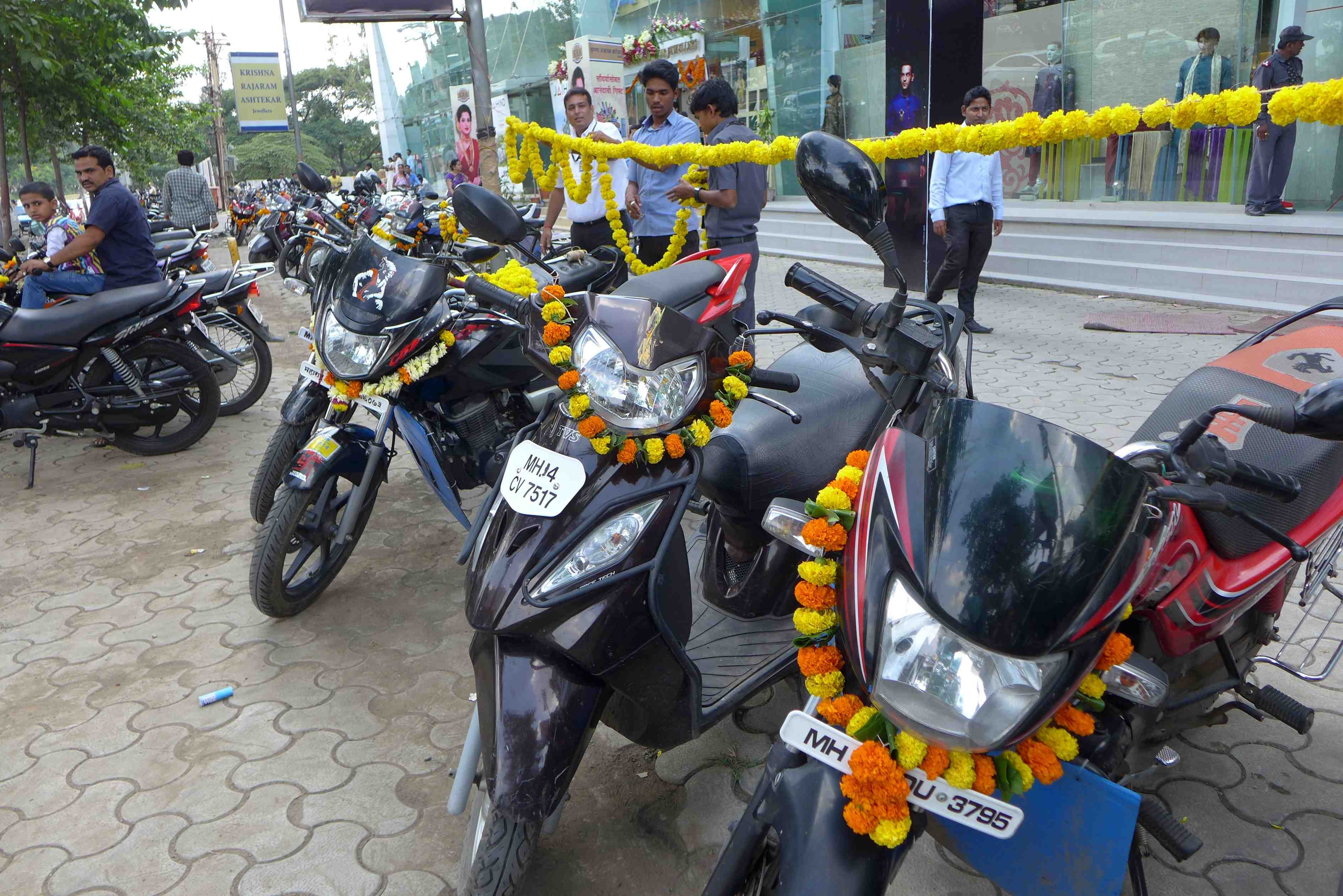
Motorcycles in front of the store decorated with garlands (most cars, trucks, and entrances to businesses are garlanded too).

Motorcycles in front of the store decorated with garlands (most cars, trucks, and entrances to businesses are garlanded too).


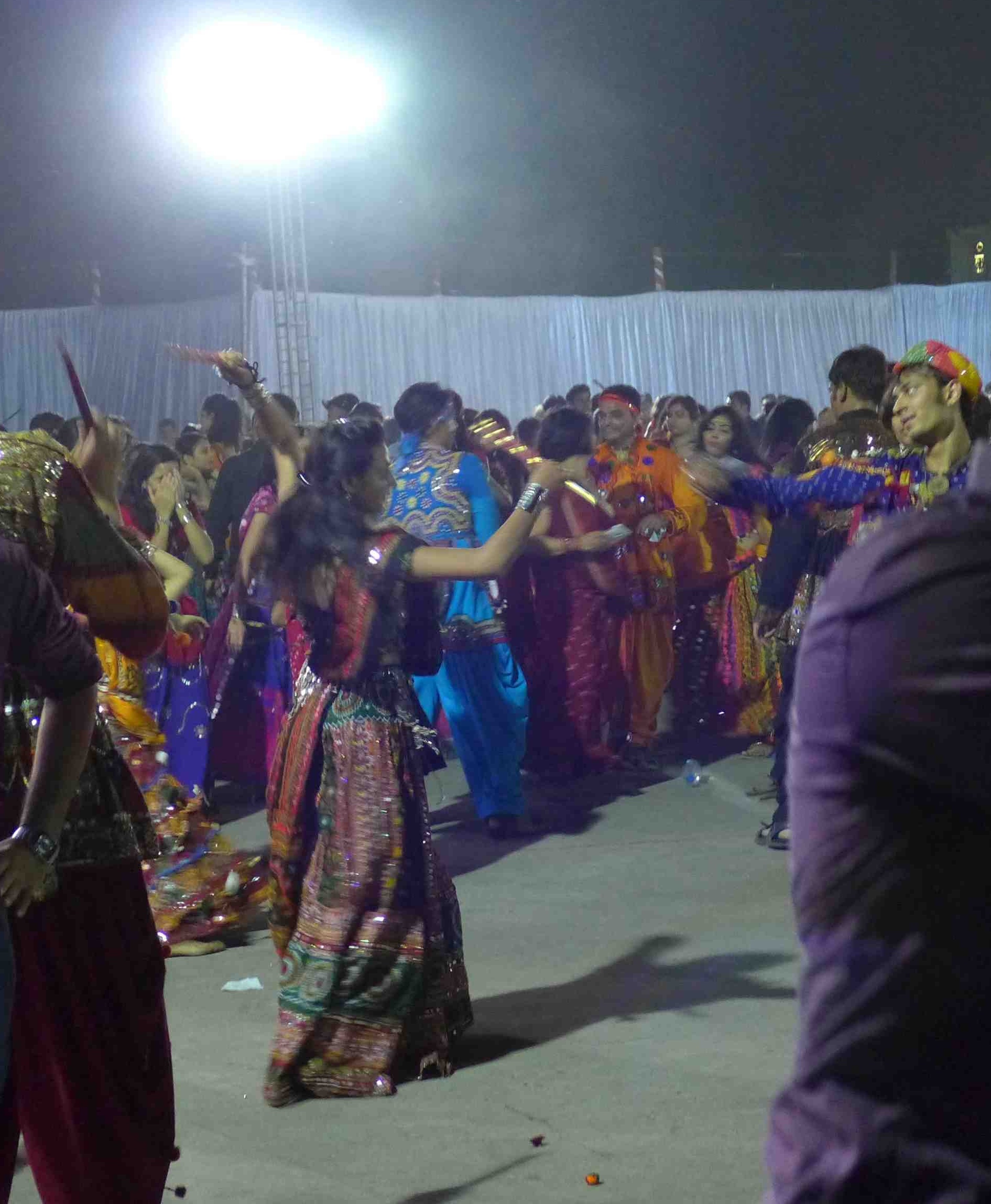
Dandiya. I think I have film of this too, but will know after I get home. See the sticks? It was fun.

Dandiya. I think I have film of this too, but will know after I get home. See the sticks? It was fun.

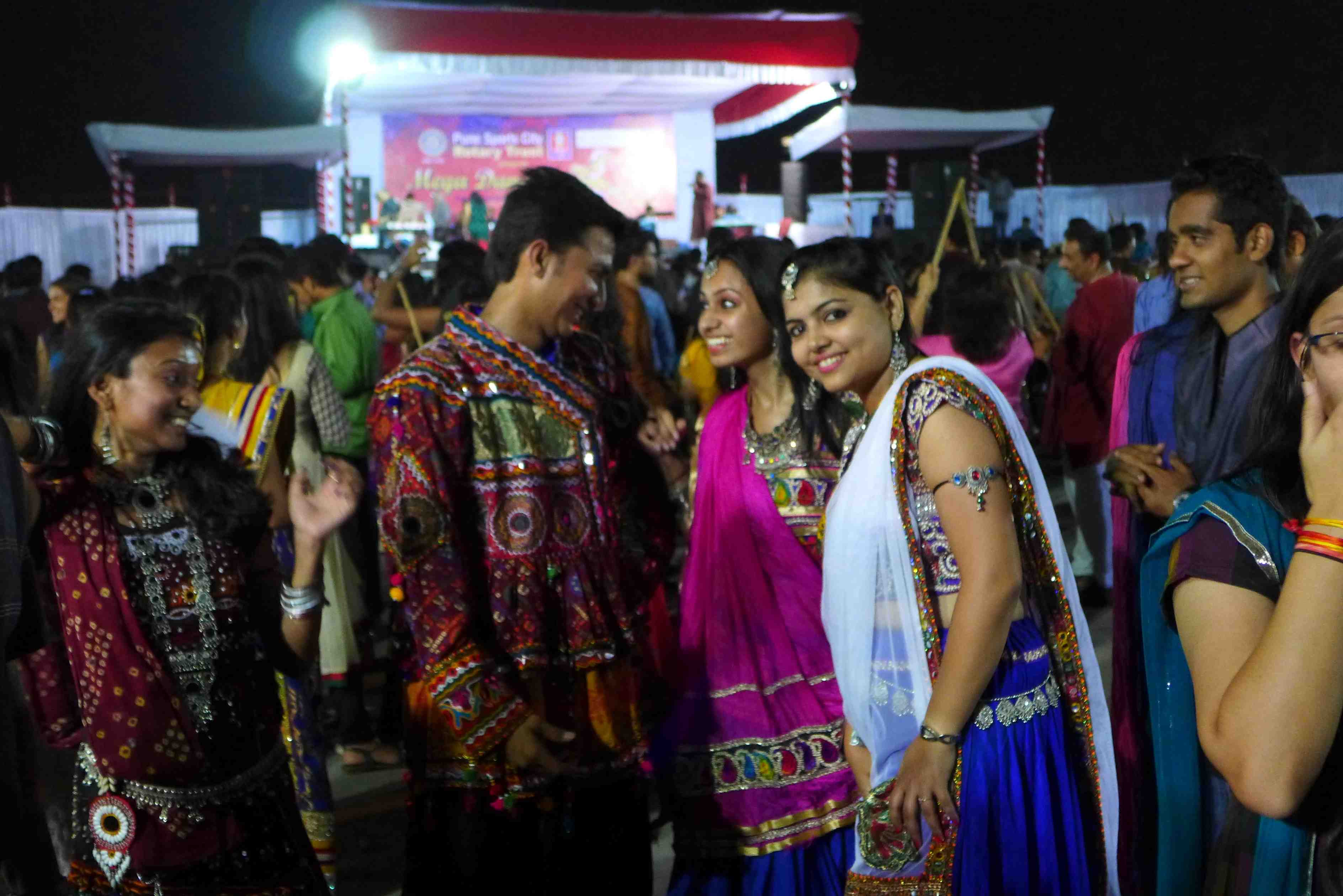
A group of young dancers who graciously invited us into their circle and taught us the moves. The dance and the attire come from the state of Gujarat, to the north of our present position in Maharashtra ("The Great State").

A group of young dancers who graciously invited us into their circle and taught us the moves. The dance and the attire come from the state of Gujarat, to the north of our present position in Maharashtra (“The Great State”).

Roadside shrine to Durga, set up by neighborhood groups with local donations. There were large shrines too with long lines outside.

Roadside shrine to Durga, set up by neighborhood groups with local donations. There were large shrines too with long lines outside.

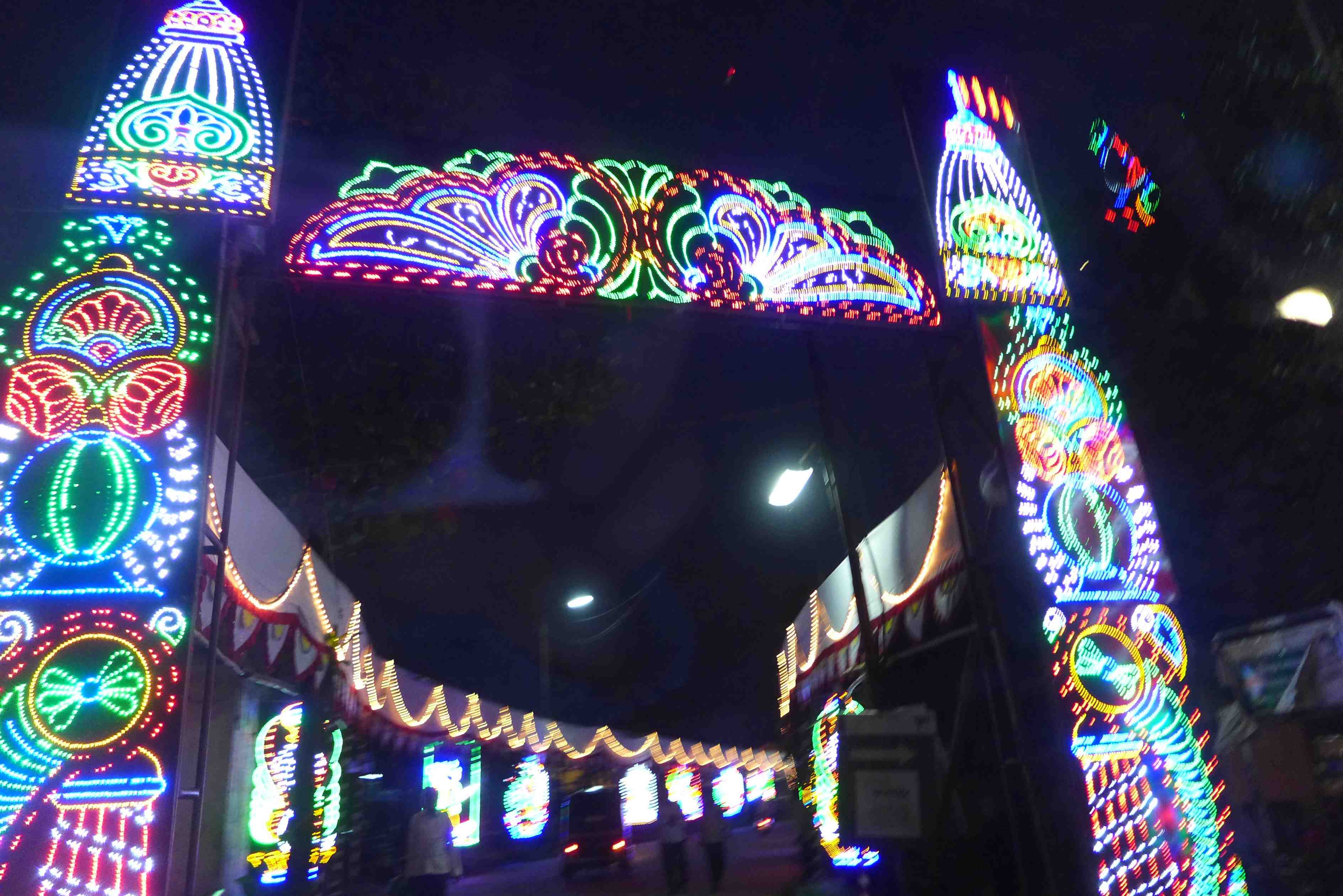
Some neighborhood have overhead signs, like gateways, at their entrances. Not sure this one was permanent but it sure is festive!

Some neighborhood have overhead signs, like gateways, at their entrances. Not sure this one was permanent but it sure is festive!