The Final Summary: Please Wave At Trains, and Other Travel Advice

I like that people wave at trains–not just kids do it, but lots of grown-ups too.  Right after we departed Los Angeles on our first day, a few miles out from Union Station, a construction guy climbing on a cement freeway pylon turned from his work and waved to us.  It made us feel good, and seemingly him too.  It was a sweet thing to do for people who were just passing by.

Waving at trains is a gesture of camaraderie and support, a momentary ticker-tape parade saying “Hooray for Adventure!”  There’s something very companionable about it: a welcome to the community (no matter how quickly the visitor may rumble through) and an expression of good wishes for their journey.  How often do we take a sec to say, “Hello, and best of luck!” to a perfect stranger?  Waving at trains is a way to high-five as we roll along our merry way to the future, whatever it may be.

I encourage you to wave at trains, to take a moment to signal your approval to the lonely traveler.  And who knows? That traveler may stop and become your neighbor–a wave may become a handshake, or something more.

If nothing else, waving at a train is a benediction, a gift; glimpse the lives passing by and raise your hand in peace and solidarity with them.  Life is short and full of trouble, so why not offer as many people as you can this brief blessing as they go by?  It costs nothing, and to quote Langston Hughes (painted on our room wall at McMenamin’s) “dig and be dug in return.”  So bless, and be blessed, as you go on your way.
Mummers Museum, Philadelphia PA

DOS AND DONTS FOR TRAIN TREKKING ACROSS THE USA

I’ve made a list of things to keep in mind should you want to take a train trip of your own.  Feel free to drop a line if you have questions….

DO assess what kind of weather, events, and level of population density you like before you block out time and make your plans.  We thoroughly enjoyed empty towns in the cold weather of April, even if we missed a few cool attractions that weren’t open for high season yet.  We dug the rough weather and came prepared for it, but if you’re a “Spring Break in Fort Lauderdale” type, the cold, rain, and snow we deliberately encountered might be your nightmare.

If you’re going to want to be in the heat and the thick of offerings like Mardi Gras, Riverwalk, and The Dells, find out when big events are happening and plan around them.  Bear in mind that the North stays cold longer than the South, so their events and attractions don’t get rolling until June.  Obviously you won’t be the only one who enjoys summer fun, so book well in advance (and take sunscreen.)

DON’T try to book your Amtrak schedule online!!!   The interface is a malinformative, frustrating mess.  Call the Amtrak phone reps (and call back, if you get someone inexperienced) to make your reservations and purchases by phone.  It’s the least agonizing way but still won’t be easy.  You have to book EACH PERSON’S TRAVEL SEPARATELY! even if it’s the same itinerary.  Moronic, yes, but what it is.  Be patient and eventually you’ll get ‘er done.

DO stay at inns, B&Bs, and mom ‘n’ pop joints instead of big hotels if you want the full-on American immersion experience.  TripAdvisor.com is useful in figuring out the locations and amenities, though be prepared to spend substantial time researching and emailing.

If you prefer to be far from the madding crowd rather than part of it, you might want to make reservations at the larger, more impersonal hotels (or just have your travel agent do it for you if you don’t have time to investigate other options.)

DON’T expect a luxury experience with Amtrak.  It’s not an elegant way to travel–in fact, in some ways the opposite, kinda downmarket, and the bathrooms get kind of gross on the second day of a segment.  Trains aren’t a good choice if you’re a germphobe.

However, if immersion is what you’re looking for, you’ll get it–both in the landscape of our country and the people that live there.  You’ll see the poor side of town from your train window, and you will have to socialize with other train passengers during meals unless you invest in a roomette and order your meals “to go” from the dining car (which you can do, and your attendant can even deliver them on request.)

If you dream of the luxurious days of wood-paneled railroad cars with buckets of champagne and caviar inside, skip Amtrak entirely and contact one of the private railcar associations: http://www.aaprco.com/ or http://www.rpca.com/, or search for one of the many historical train enthusiast societies.  You may be able to hitch a ride on an antique traincar or even charter one for yourself; otherwise, you’ll have to content yourself with a copy of your favorite train porn, be it “Murder on the Orient Express” or “On The Twentieth Century,” while squirreled away in a corner on the Amtrak train.

DO bring “train shoes,” i.e. slip-ons with rubber soles.  Amtrak requires that you wear rubber-bottomed shoes while walking around the train, but it’s likely during a long segment you’ll want to get out of your street shoes into something more comfortable.  Train shoes let you walk to the restroom or cafe car without having to lace up the boots again; I bought some slippers at a CVS in New Orleans that worked just fine as an alternative to my high-tops.

DO bring healthy snacks and think about alternate meals if you’re not into eating the way America eats: that is, high-fat, high-salt, high-sugar cafeteria-style food.  That’s what Amtrak will give you three times a day–it’s included in your fare if have a roomette or suite–and on long segments it’s hard not to eat the stuff just out of boredom.  Plan ahead if you have special dietary needs, because Amtrak can’t accommodate much deviation from the pre-processed microwaved meals it serves.

DON’T pack your schedule.  Give yourself ample time to arrive and settle in at each destination, and take a few hours to wander around in your surroundings.  Some of the best stuff we saw was off the beaten path and FREE (like the Forevertron.)  In most towns we enjoyed hanging out just having coffee and people-watching–well, if it was good coffee, like in New Orleans or Portland–much more than we enjoyed some of the much-vaunted “must-see” tourist rip-off sites.

DO invest in good wireless technology if you need bandwidth, or leave the gadgets at home if you can get by with intermittent stops at internet cafes at your destination.   Our cellular USB modem thingy by BroadbandToGo worked great on the train when there was cell network available outside, but there was NO connection in most of Texas, Alabama, Mississippi, North Dakota, Montana, or while traversing mountain ranges or expansive nature preserves.  Amtrak doesn’t offer wireless, sorry–and the way their budget is, they won’t be anytime soon.  Amtrak roomettes do have an AC plug though, so at least you can charge your phone or laptop while you’re traveling.

BTW, general travel note: we found out a lot of the smaller hotels/inns that offer free wireless as part of their amenities also block Port 25 so you can’t retrieve email (and they often will have no clue what you’re talking about if you mention it.)  Fortunately I brought my tech support with me and he was able to tunnel into my email account when the need got urgent, but don’t expect to be so lucky if you need email access while you’re out of town.

DO bring all necessary drugs, even over-the-counter ones, since you may not be able to go purchase them when you need them (Amtrak’s cafe car has aspirin and Pepto Bismol for sale, but that’s about it.)  Be sure to stock up on girl-meds and allergy reducers, and also your chosen caffeine.  You get spoiled here in L.A. when it comes to joe (and super-spoiled in New Orleans and Portland if you like wicked dark and gritty high-octane coffee like I do.)  Be forewarned you’ll get paltry, headache-inducing coffee on the train as well as most train stations, small towns, and all of Texas.  Pack your own brewsticks if good java is important to your well-being; sleeper cars have hot water available (though don’t expect ceramic cups anywhere onboard except the Coast Starlight line.)

And smokers beware: Amtrak trains are smokefree, and you can only smoke on SOME station stops, normally only once or twice a day.  Nonsmokers beware too: if you step off the train to get a breath of fresh air during a stop, you’ll get a dose of second-hand smoke instead.  You’ll have to breathe when you get to your destination, so be sure you plan accordingly if you like clean, pure O2.

DO tip your porter–excuse me, railcar attendant–and dining car servers. Though don’t ask us how much….this came to us as a bit of a surprise and we probably way overtipped because that’s how we roll.  At least I hope we did.  We didn’t get negative feedback about it, anyway.

The attendants vary in how attentive they are; they will help you stow your luggage when you get onboard and normally convert your roomette into nighttime bunks, and will get you meals or water if you ask.  Some travelers tip when they first meet the attendant (I guess to assure prompt service) and some when they deboard.  Your call.

So enjoy your journey along with your vacation, and here’s the entire “Motto” by Langston Hughes, thanks again to the artists at McMenamin’s:

I play it cool
And dig all jive
That’s the reason
I stay alive.

My motto,
As I live and learn,
is:
Dig And Be Dug
In Return.”


Great advice for living both on and off the rails, don’t you think?
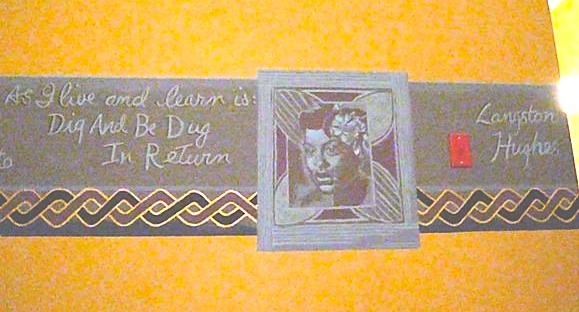
"Motto" @ McMenamin's

Safe travels, y’all….and don’t forget to wave.

Elizabeth Oakes

May 9th 2010, Los Angeles, CA

PS Love and props to Samuel, who planned this trip and without whom it would have been a meaningless morass of miles.  xoxxo <3
Portland Envy; Cascading Home

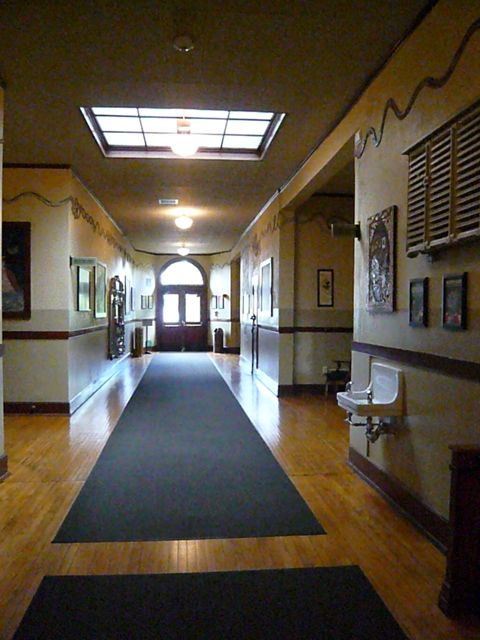
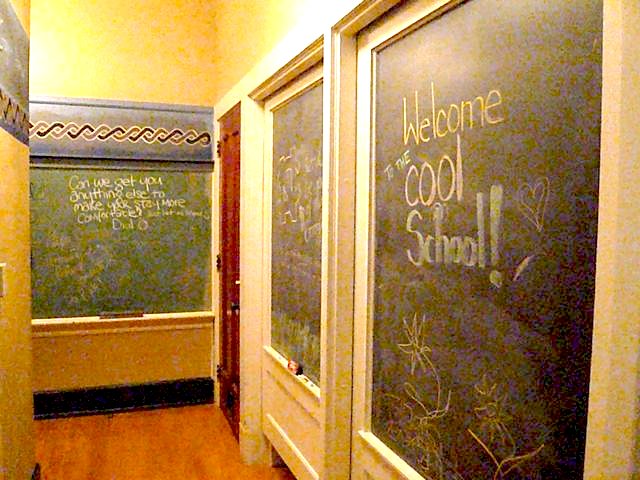
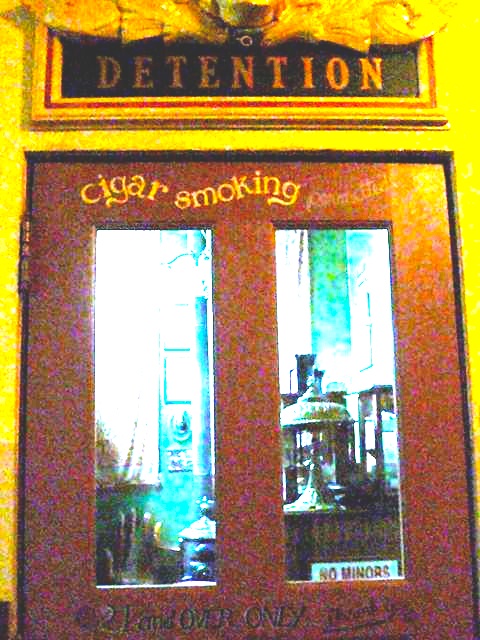
We stayed at one of the many McMenamin’s inns in the Portland/Greater Oregon area; these crazy brothers have made a mint buying historic buildings all over the Northwest (like the Kennedy Elementary School where we stayed, or Masonic lodges or movie theatres or castles) and repurposing them into event/traveler complexes with microbrew pubs, movie theatres, live music, cafes, hotel rooms, and all sorts of artistically arrayed nooks and crannies.  The vibe is casual and social; the rooms are artful and fun–our “classroom” entry hall was lined with chalkboards upon which the staff had scrawled hotel messages and doodles.  Not luxuriously appointed (shower was a plastic cubicle, no TV so you go and socialize at one of the minimicropubs) but quirky and comfy.  There were six micropubs at the Kennedy school, a couple of which only seated five or six people each, my favorite being the converted principal’s office where one could go for “Detention”:

Detention Micropub at McMenamin's: Where the Bad Kids Go

McMenamin's Kennedy School, South Hallway

Entry to our room @ McMenamin's Kennedy School Inn

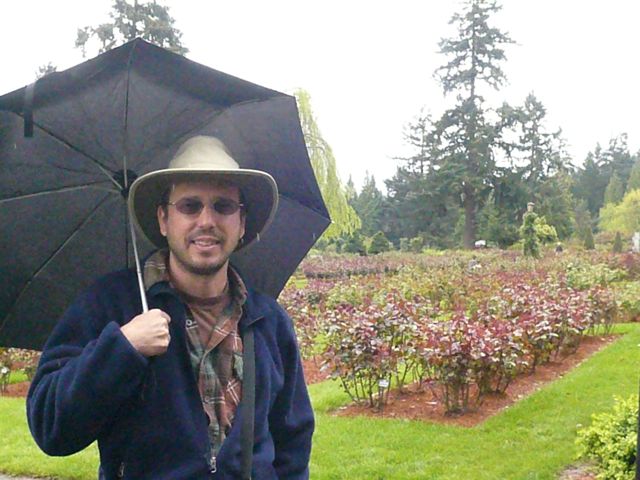
We had resolved to take it a little easy and not run around too much.  After some consternation we figured out Portland’s intricate but comprehensive bus/train/trolley system and made a pilgrimage to Powell’s Books, then to the huge Washington Park, home of the International Rose Test Garden where they were testing almost exclusively closed rosebuds at the moment….that is to say, we were a little early for the annual blossom explosion, but we knew we might be.

International Rose Test Garden, Portland OR

It’s a huge and beautiful city park and we could have easily spent the day there despite the non-performing roses, but we had a coffee date with an old friend who had moved up to Portland six years ago.  It was a great convo–he loves it up there, as do I…I am always filled with regret when I have to leave the Northwest.  We have many friends who feel the same way, who would move up to Oregon or Washington in a heartbeat if they could find a way to make a living there.  Portland is a wonderful, livable city, but it’s a comparatively small city (why it remains livable, you see) and not the economic engine most of us require to pay the bills.  Ah well.  It’s nice to know it’s there, waiting for us, when we finally retire to wear flannel and write novels while drinking thick black coffee while the dousing rain batters the rhododendrons outside.  Sigh.

The next morning, after one last breakfast and deep draught of McMenamin’s French press coffee–dark and gritty as mud and full of motivating caffeine–we boarded the train for home, the renowned Coast Starlight (where your coffee and wine are served in real glasses and mugs!)  From Portland it would be an overnighter to L.A. through the Cascades and into California’s Central Valley to home.

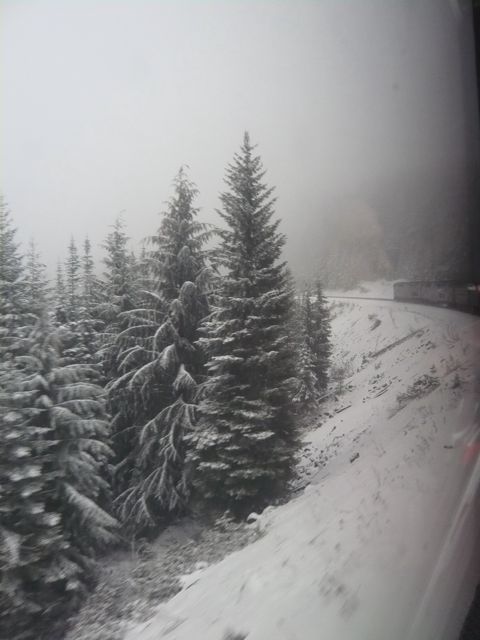
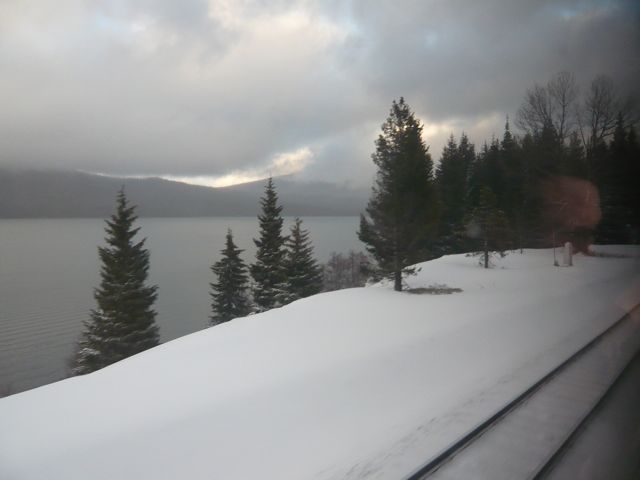
And it was splendid, real ceramic mugs notwithstanding.  The Cascades were rugged and as we ventured higher in altitude the world went all Christmas, white-out snow along the tracks, caught in the arms of the sharply-etched trees.

Our train chugging through a Cinco de Mayo snowstorm high in the Cascades

Klamath Lake, from the window of the Coast Starlight

I had been hoping to have some wireless connectivity during this last leg of our journey since I had articles to post, but thankfully there was none through these majestic mountains.  Samuel and I huddled together and enjoyed the view (when we weren’t trying to frantically photo the otherworldly snow tableaux that emerged at every turn of the tracks.)

There was a snowy sunset, and we slept.

Coming home through California the next day was a bit of a downer, the journey drawing to an end and the realization that a frantic Re-Entry Mambo would start as soon as we got home from the station.  There was haze in the air, starting pretty much in Northern California, and the sprawl began spreading into the horizon as we drew further south.  I had pretty good connectivity though (except through Vandenberg Air Force Base, where they nix that) and got some work done–my way of being in denial that Playtime Was Over.

When we got to Union Station, we detrained and were met (surprise!) by Samuel’s parents, whom we didn’t know were planning to pick us up.  We had already made arrangements with another friend for transport, so we all hung out in the loading zone and tried to acclimate to the L.A. high-blood-pressure pace once again.

Oddly, some production company was shooting a TV thang in Union Station when we arrived and they had changed the signs to say, “Le Havre, France.”  Would that it were so and the journey were starting anew! except there was like, a mime in a beret.

(…..guess….I’ll….be…..heading…..home…..then…… Run away, run away!!)

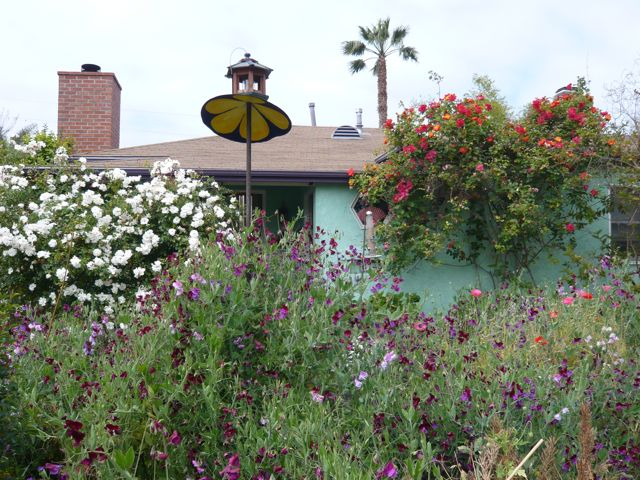
So we got to the house about 10 p.m. and it was bit of a shock–all was well, no house fire this time–and the sweet peas and poppies and roses and grape vines were so overgrown we could hardly see the front of the house (which was a little wonderful.)  Walking into the house and seeing the scene we left behind three weeks ago, strewn with signs of frantic repacking and last-minute trip prep, seemed incongruous and surreal once the ride was over.  We put our packs down, started hooking tech devices back up, culling email, piling laundry, etc.   We were home and needed to massage some life back into our L.A. existence before we went to bed, with much more to be done the next day/weekend/week, and so on.

The trek is over but the journey continues–stories and scenes still being pondered, digested, and contextualized.  We thank you for letting us share our rail adventure with you, and for being part of our greater adventure in life.

The ultimate journey is return, they say.  We have returned for now.

Home, Overgrown

Thumbs Up: Dr. Evermor’s Forevertron

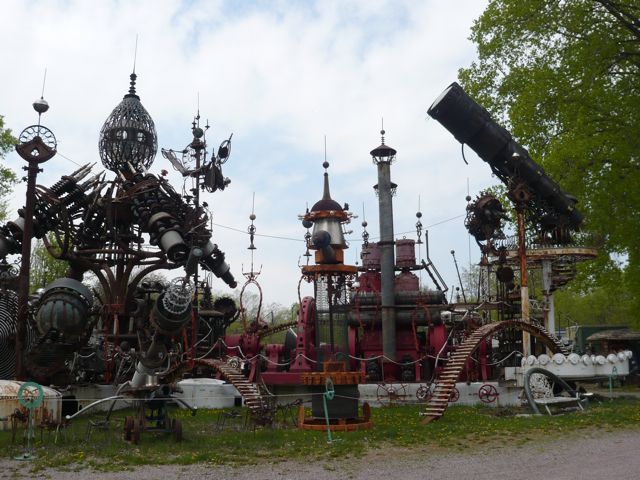
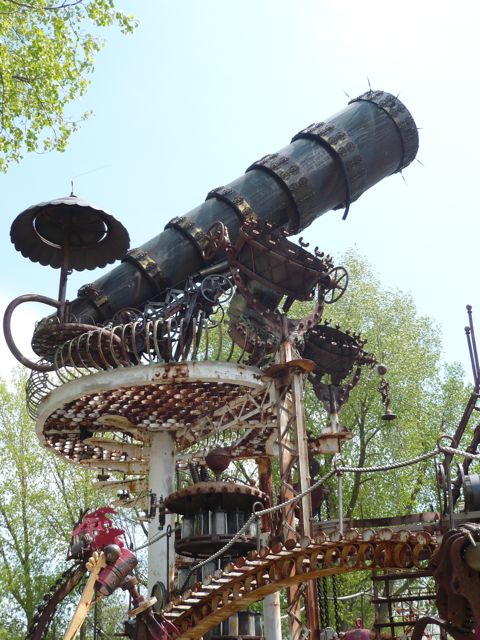
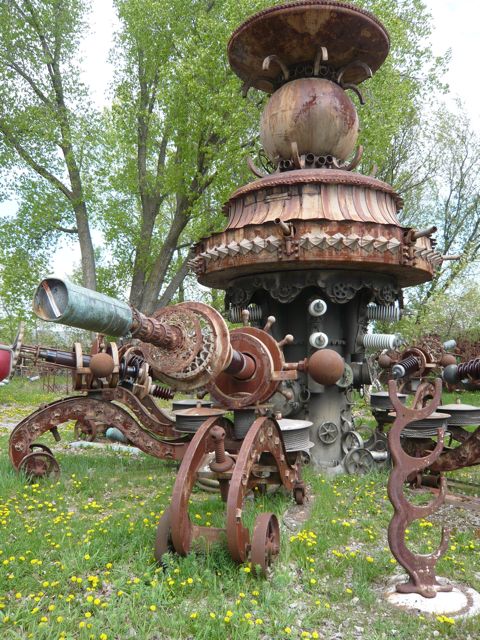
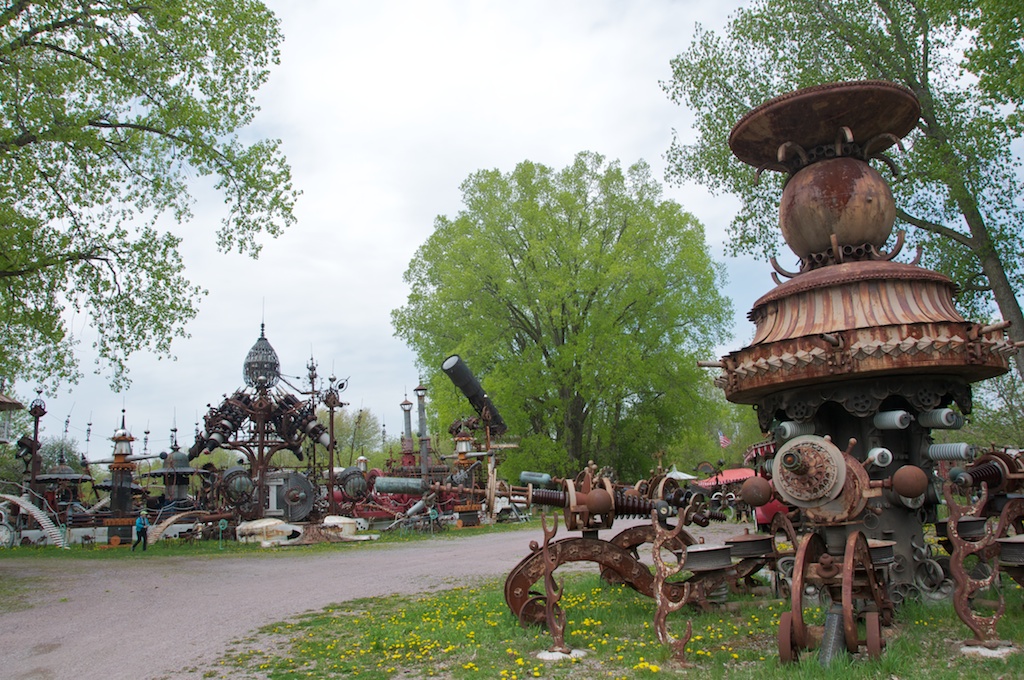
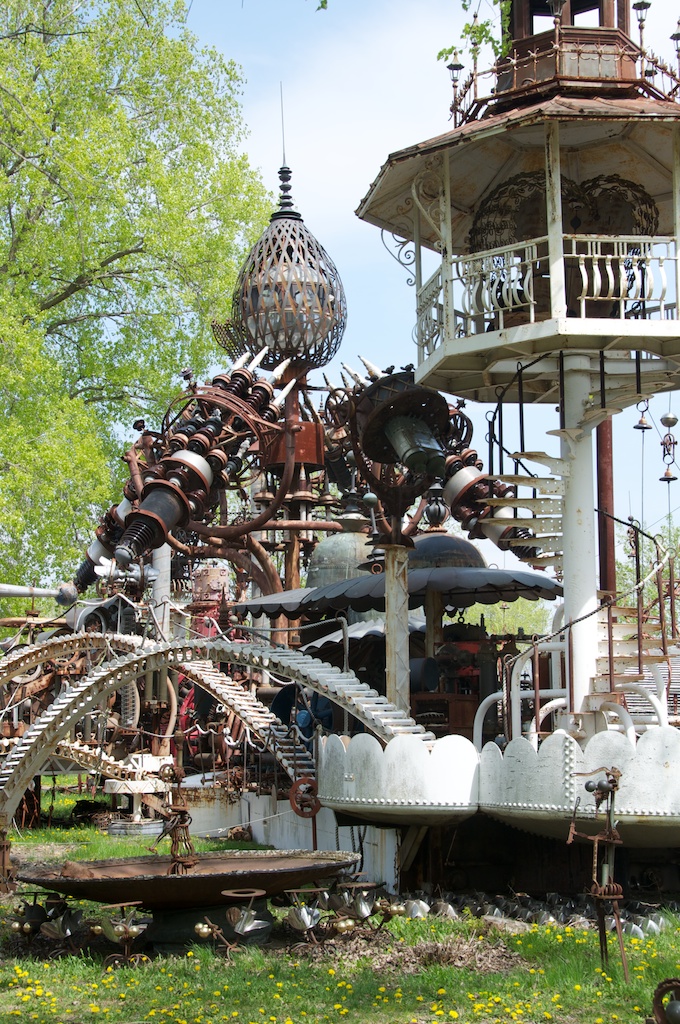
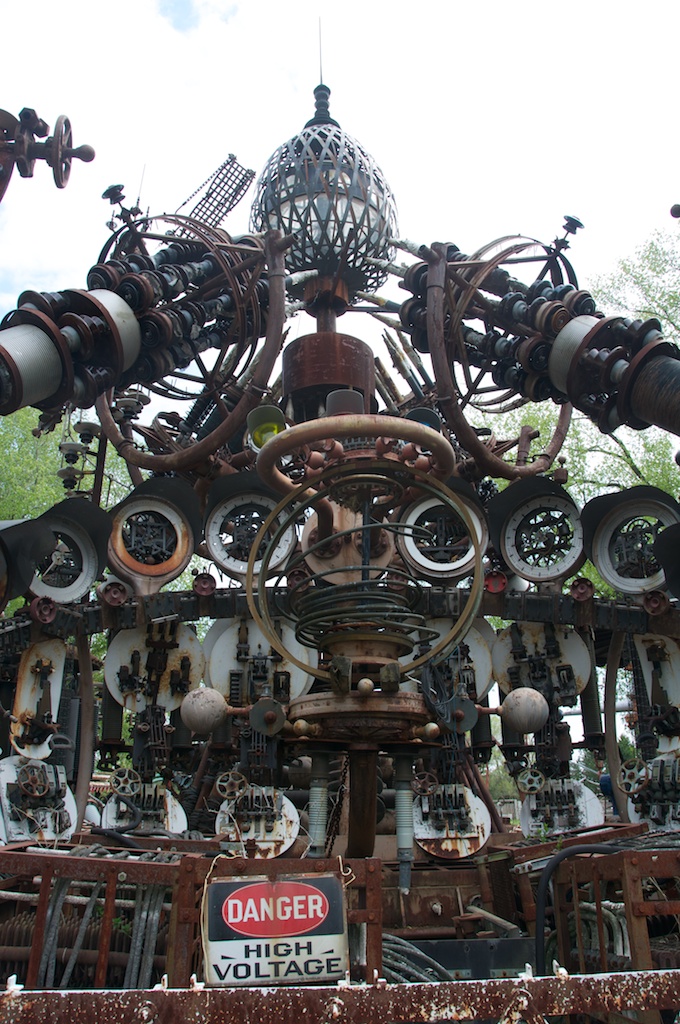
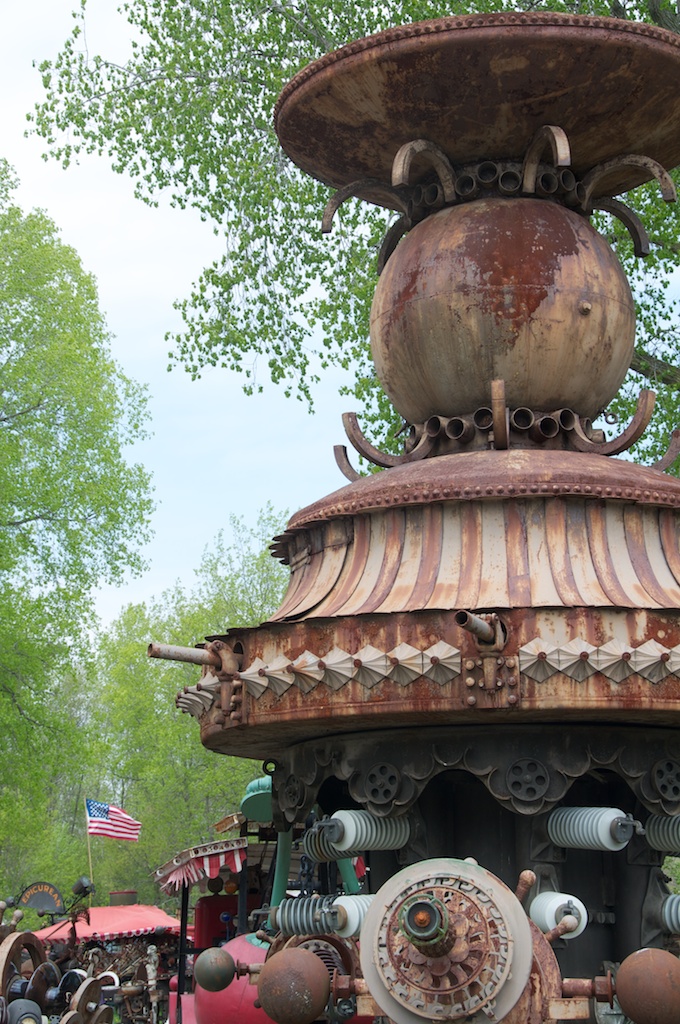
It’s hard to put into words how The Forevertron made me feel when I first saw it–a cross between admiration and heartbreak–and how those feelings kept unfolding in every corner of the junkyard complex that houses this gargantuan scrap-metal work of art.

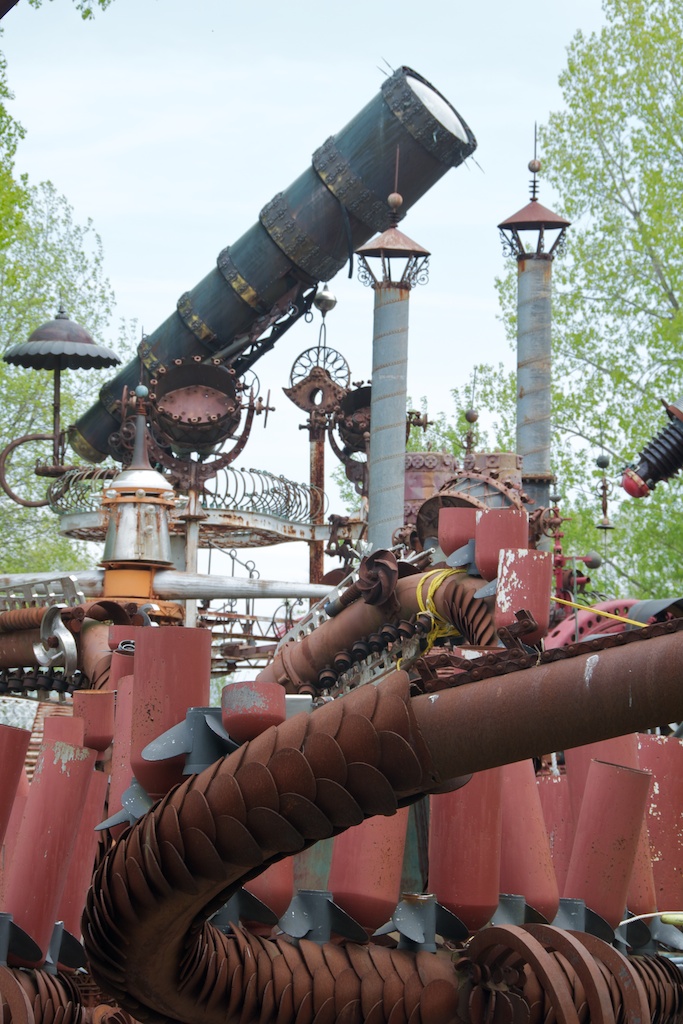
The Forevertron and its attendants are also impossible to photograph in a way that convey its wistfulness and wonderfulness, but here are a few paltry attempts of my own (and some better ones here.)

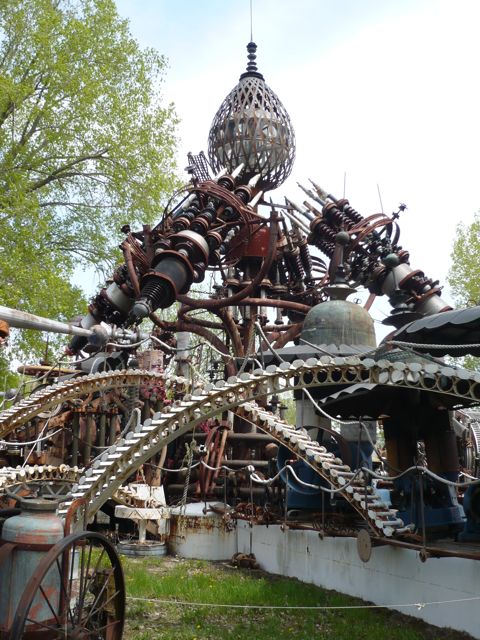
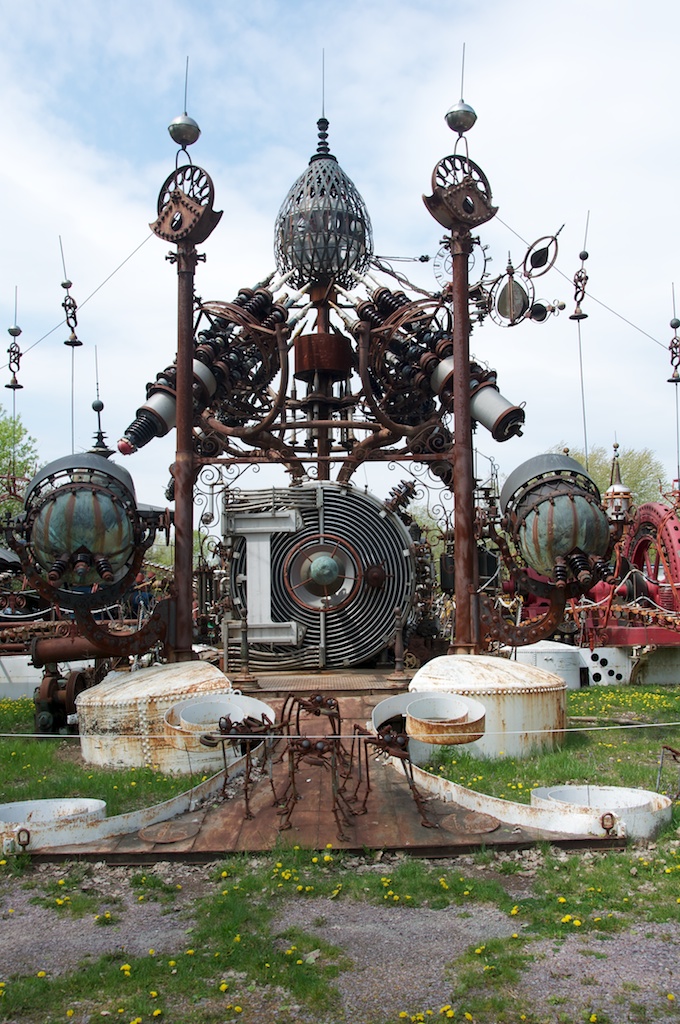
The Forevertron, central chamber

Forevertron, another inadequate view

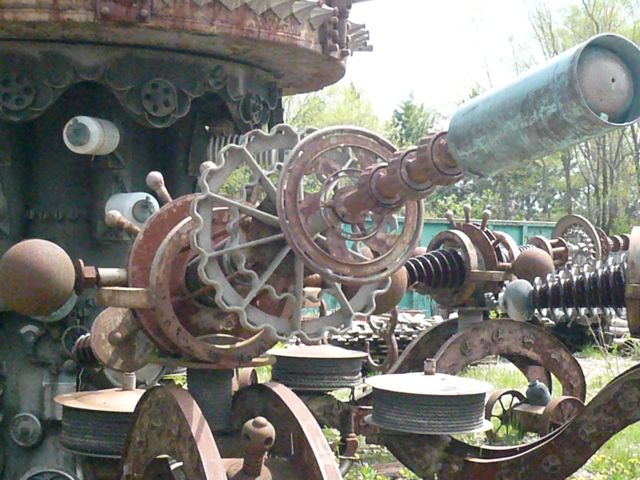
Forevertron Telescope

Forevertron Love Cannon, which disables enemies with love

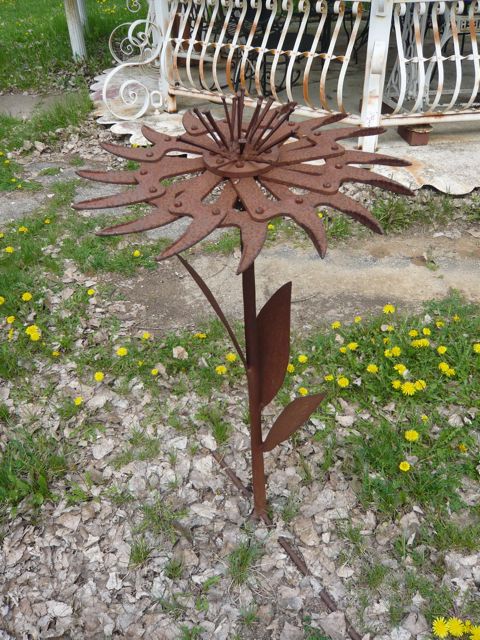
Flower in the Forevertron GardenProcession of Aliens?  Defenders? near Forevertron

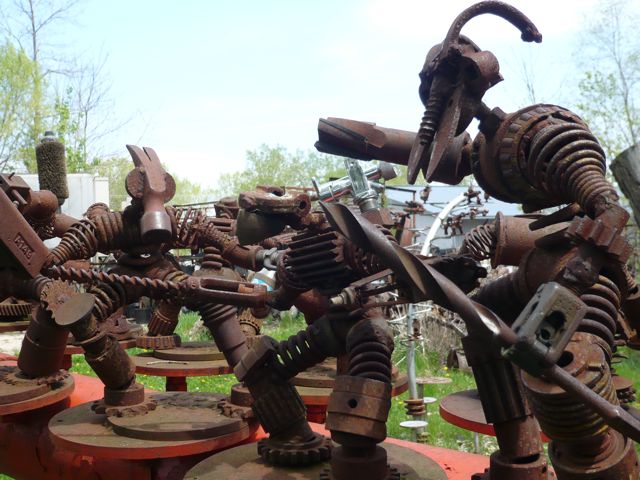
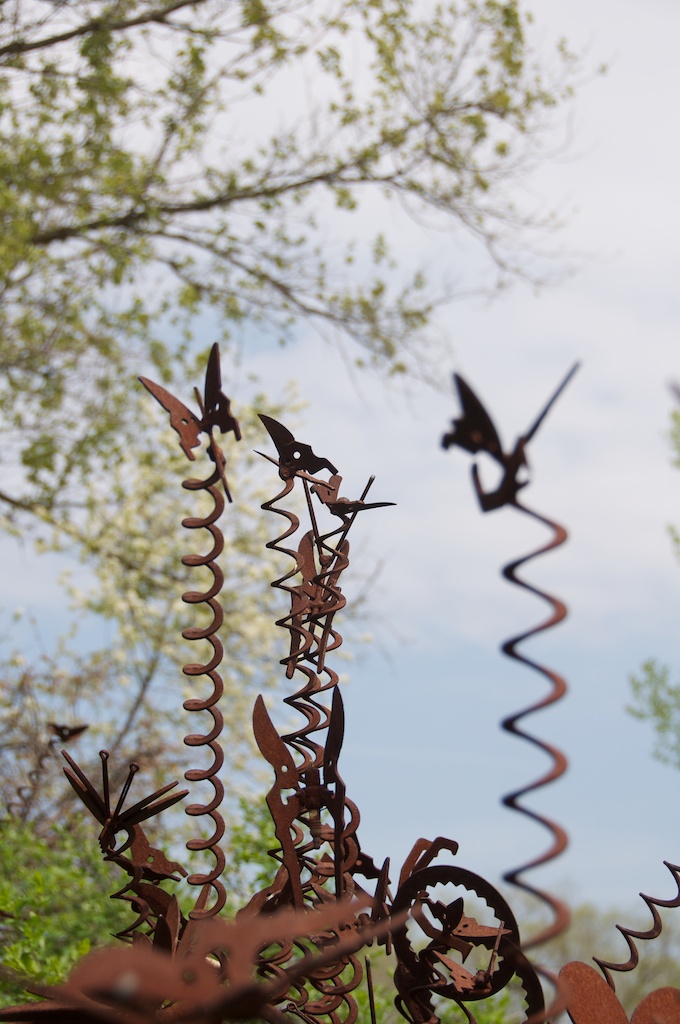
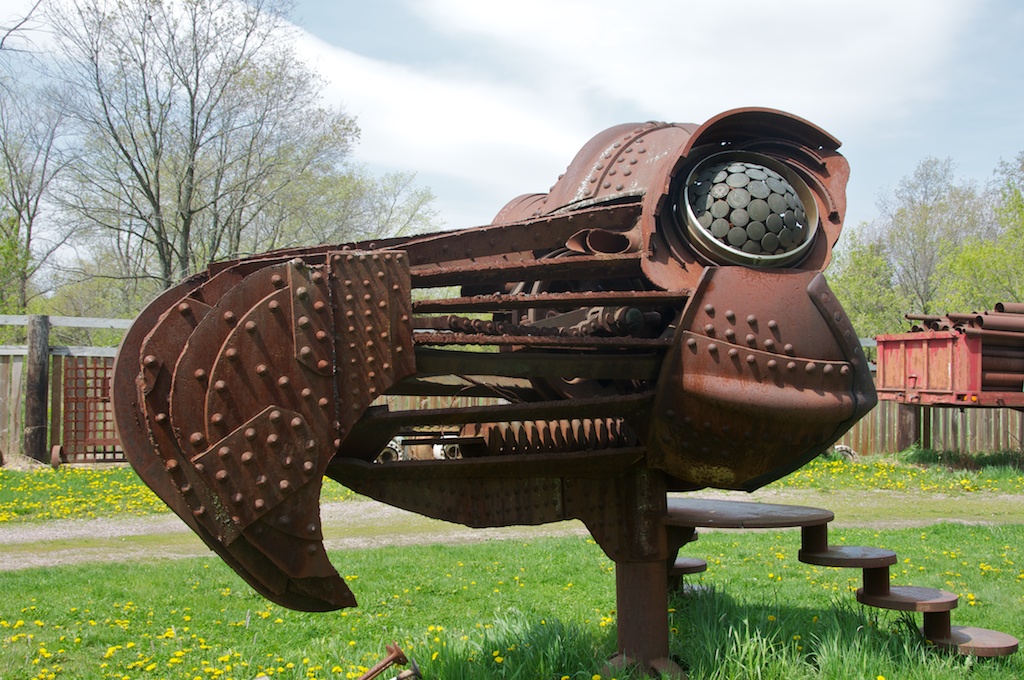
As one wanders the Forevertron grounds and inspects the intense detail–saw blades layered by the hundreds to make tails for huge rusting birds, gears lovingly sized and welded around the mouth a gigantic piston housing as a floral border–the sense of awe and also sadness grow.   The amount of work required to assemble this structure (and the Victorian fairy tale of time/space travel upon which its aesthetic hangs) out of discarded metal is mind-boggling; the realization of the amount of waste in our world, and the expressed yearning for a better place to live and explore, is also writ large in its monolithic pipes, tubes, and engine parts.

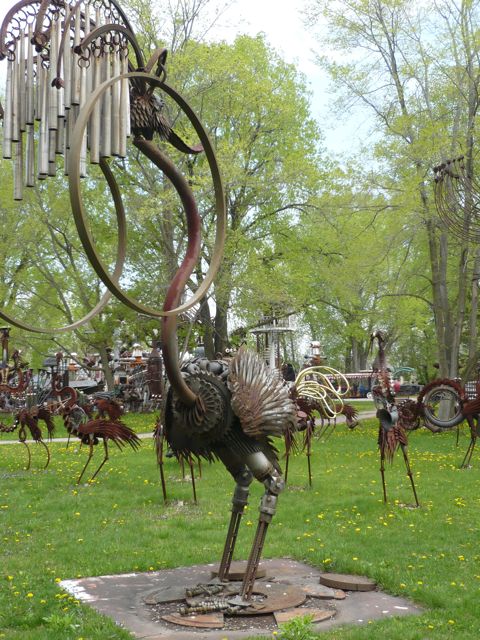
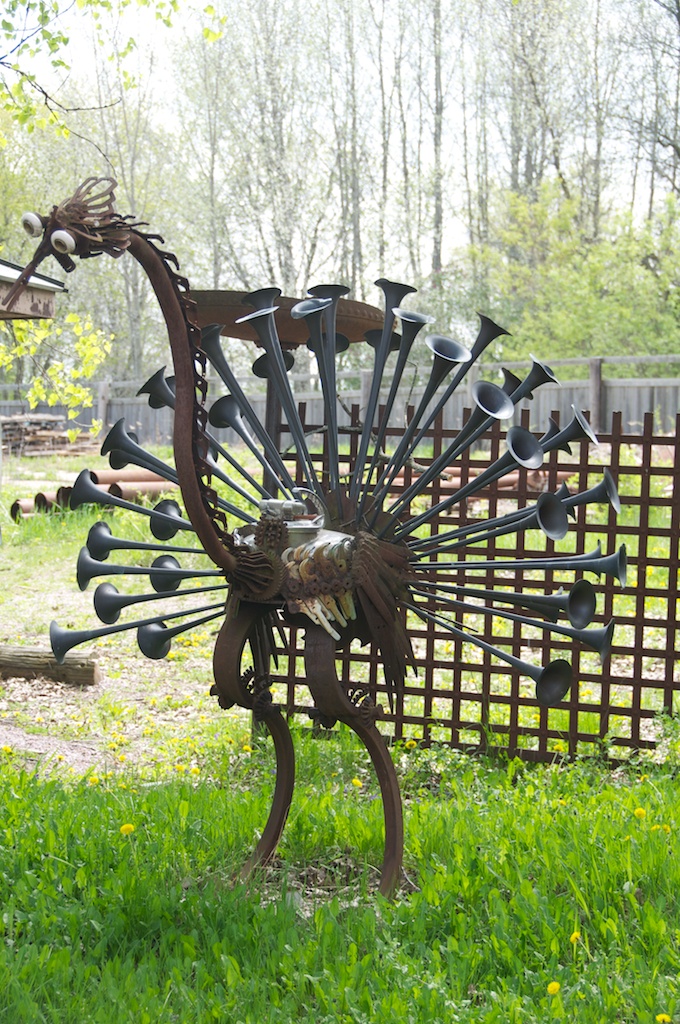
Orchestral Chime Bird, Forevertron

The artist Tom Every is now in a nursing home, and there’s little information about him on the Interwebs or around Spring Green, WI (it is rumored he had a nasty falling-out with Alex Jordan, builder of House on the Rock–Every’s influence on certain portions of the House on the Rock seems clear, but you won’t hear anyone mention him there.)  I suggest taking the time to read the newspaper clippings hung up on swinging boards near the entrance to the Forevertron, since these give the most complete and intimate accounts of Every’s life and the Forevertron.  This PBS piece describes his transformation into “Dr. Evermor”:

“Every’s shift from wrecker to preserver of wreckage led to his “rebirth” as Dr. Evermor. Through this new identity, he would build the Forevertron. Dr. Evermor recalls this important period: “I became Dr. Evermor around 1983 when we started to build the Forevertron. I was a bit upset with the world, not so much the economic conditions as the judicial system and things like that, and I wanted to perpetuate myself back into the heavens on this magnetic lightning force field.”
Love Beam (detail), the Forevertron

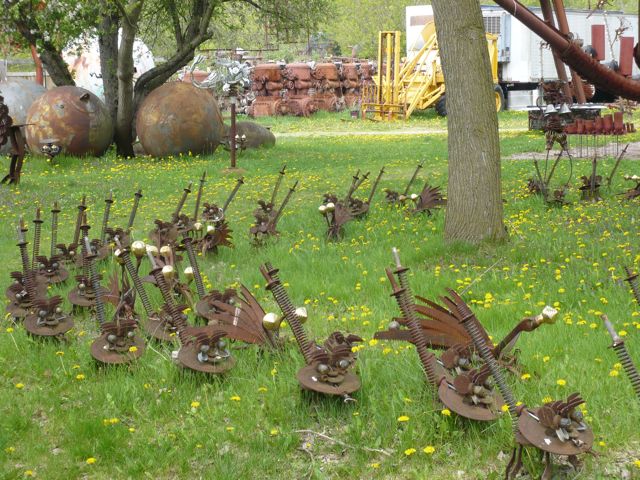
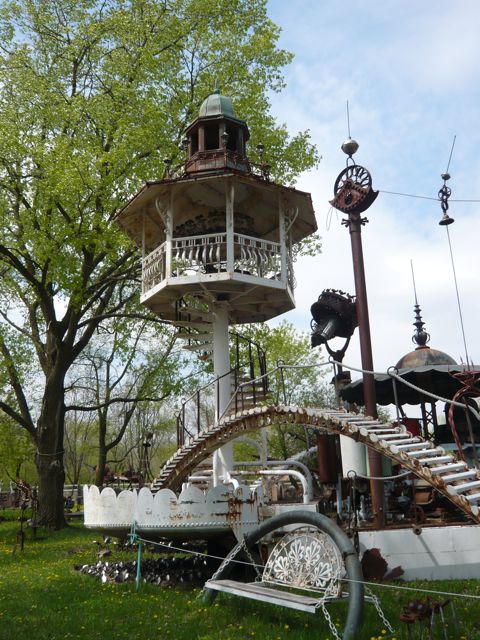
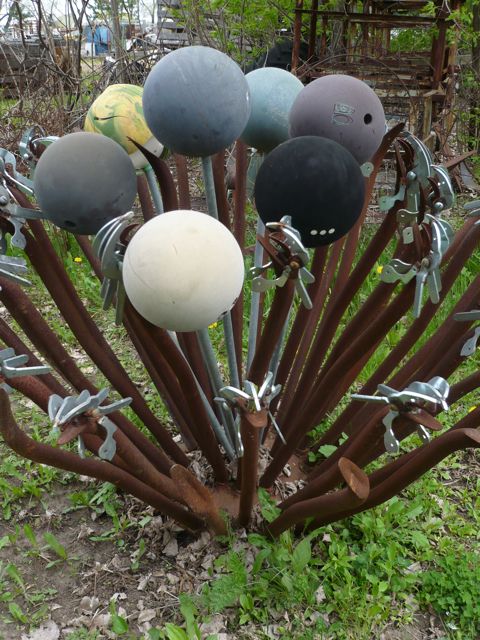
Thus: Dr. Evermor’s Forevertron, a time machine with central transport compartment, a Gravitron (which lightens the traveler before traversing space), a telescope for skeptics to witness a traveler’s flight, and an elevated white wrought iron gazebo for the comfort of visiting royal observers.  The Forevertron is surrounded by an array of creatures and gizmos, and nearby one will find an army of hybrid animal/musical instruments and a garden constructed of pliers, springs, and bowling balls.

Victoria and Albert's Observation Gazebo, the Forevertron

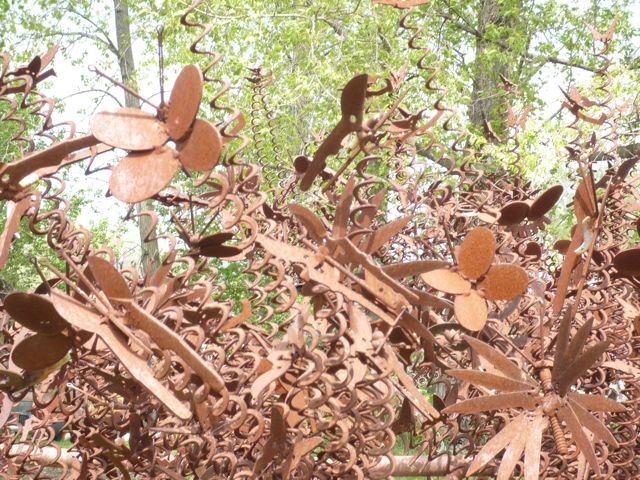
Butterflies, the Forevertron

Bowling Ball Shrub, the Forevertron

For a stuck-up city kid, it’s worth pondering how so much creativity packed itself into a tiny town in Wisconsin–Frank Lloyd Wright’s Taliesin (Spring Green, WI was his hometown), Alex Jordan and his House on the Rock–and the Forevertron just hollering distance away in Sumpter, WI.  Three completely different lives and visions, in the middle of dairycow country.  It’s a little humbling, but maybe it’s all that wide-open, fertile space that allows the sort of large dreams that distinguished these artists’ work (or maybe it’s something in the cheese.)

Anyway, if you find yourself wandering Wisconsin’s Dairyland, stop by the Forevertron and have your mind blown.  And leave a donation–this is work from the heart, and the salvage store that hosts the Forevertron doesn’t charge admission (unlike the ungodly sum one pays to get into the broken-down House on the Rock.)  Adventurers, Away!

Toolheads--Warriors or Dancers? or Both?

More Wisconsin Cheese, and Empire

More jello molds.  It’s a Wisconsin thang.  I like the rainbow one, in case you can’t decide on just one of the many colorful flavors.

The Other Stuff That Comes From Cows, Wisconsin

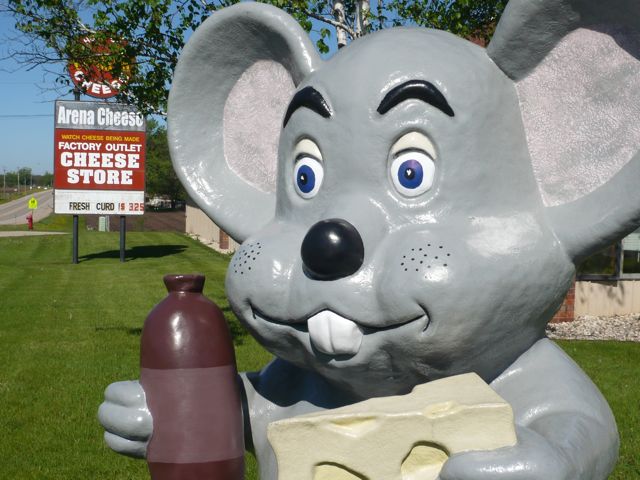
A Cheese Store, Wisconsin

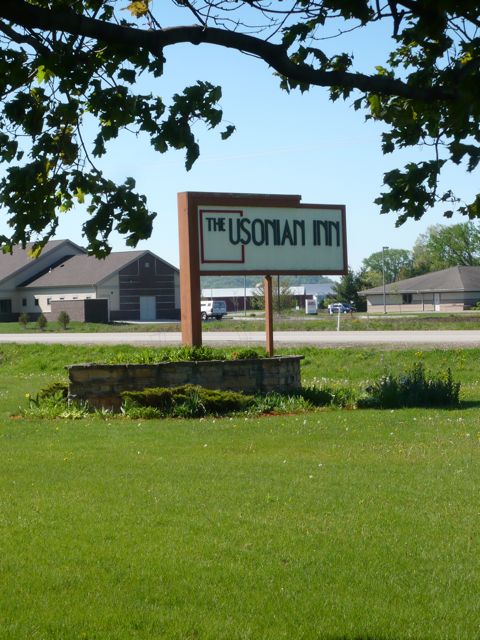
We proceeded to Spring Green, home of Frank Lloyd Wright‘s Taliesin (also closed–opened for the season the day we left, dammit–Strike Two!) and were made extremely damp by a couple torrential Midwest storms, lightning and rain and thunder and thunderous rain and awe-inspiringly intense.  We stayed at a FLW style inn–as close as we got to Frank Lloyd Wright this trip, though I overheard one guest who was checking in say she had read “Loving Frank” and that’s why she came to see Taliesin.

The Usonian Inn, Spring Green WI. Strong coffee, weak network.

Our innkeeper was Romanian and very stressed and very friendly and very friendly about how very stressed she was (technical issues; we understood, as in addition to the digital TV errors she was complaining about to us, the inn’s advertised wireless internet didn’t have the signal strength to reach our room–our USB wireless network thingy wasn’t picking up any local bandwidth either–so we were SOL and had to sit in the lobby if we wanted to retrieve email.)  The inn had a great modernistic mechanized Miele coffee maker though–best coffee we had in Wisconsin, I would say, and so stylishly made.  It’s fun to watch machines do things, which would become a theme for the rest of the day.

Since Frank wasn’t available, we went to see Spring Green’s other crazy architect attraction, the House On The Rock.

Main house, House On The Rock

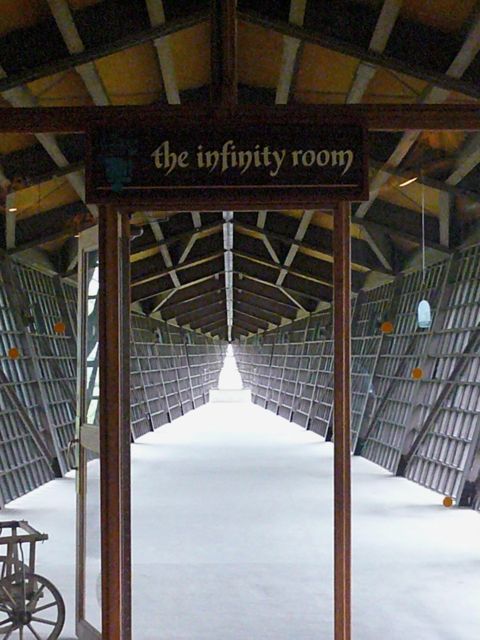
The Infinity Room, House On The Rock

It’s hard to describe Alex Jordan‘s maniac design aesthetic and dusty, decadent decor–some of the concepts for which may have been stolen from local artist Tom Every, creator of the Forevertron–but it was an entertaining day meandering through the labyrinth of collected stuff.  It’s not that there were rare or authentic items–much of the collection was knock-offs, chintz, and mass-produced–but there was a LOT, a never-ending chain of dimly-lit rooms like opium dens, filled with sequins, brass, costumed mannequins, and hoarded stuff.

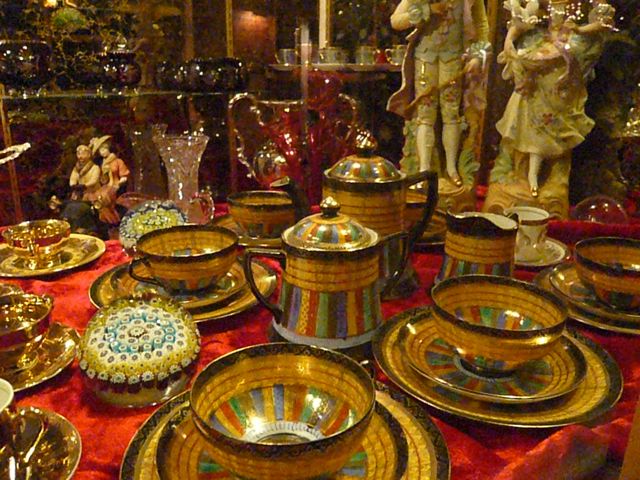
Tea stuff, House On The Rock

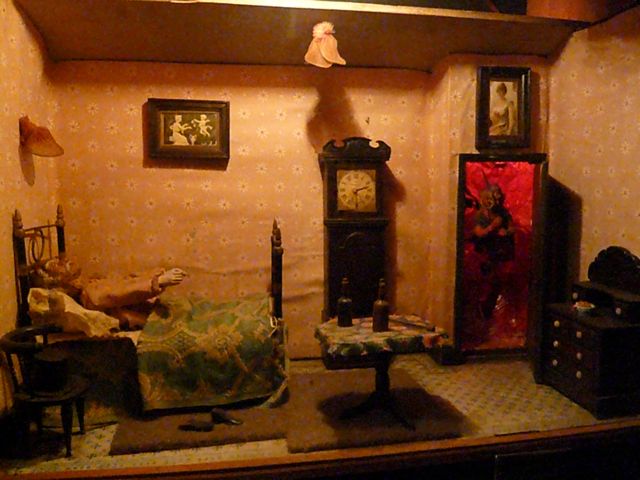
Mechanical puppet show, "The Death Of A Drunk"

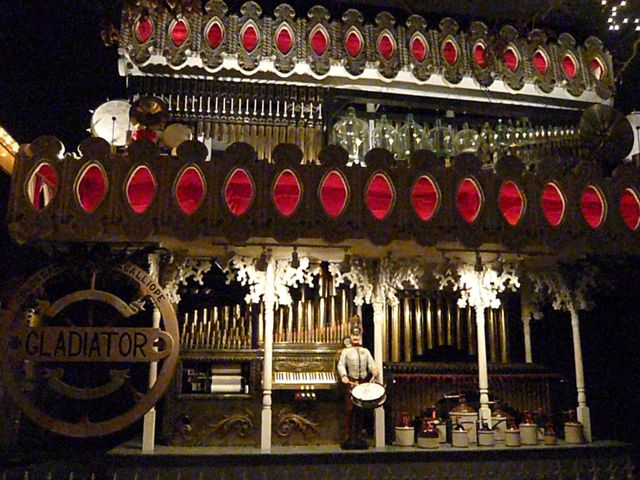
"The Gladiator," a room-sized music machine

I was disappointed because the majority of the advertised mechanical music collection–Regina disk-operated music boxes, bandwagons, calliopes and the like–were non-operational OR WORSE, were rigged to play a tape-recording while the machine was moving and some of the percussion pieces pounded.

"Mikado" music machine, fakey!! (but the guy in the middle beats the drum and raises his eyebrows)

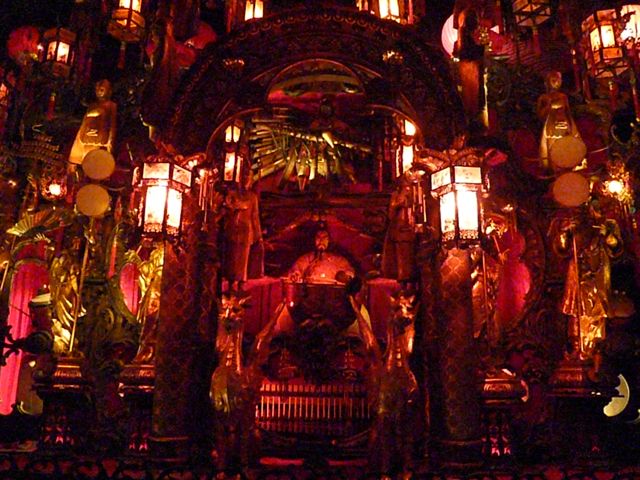
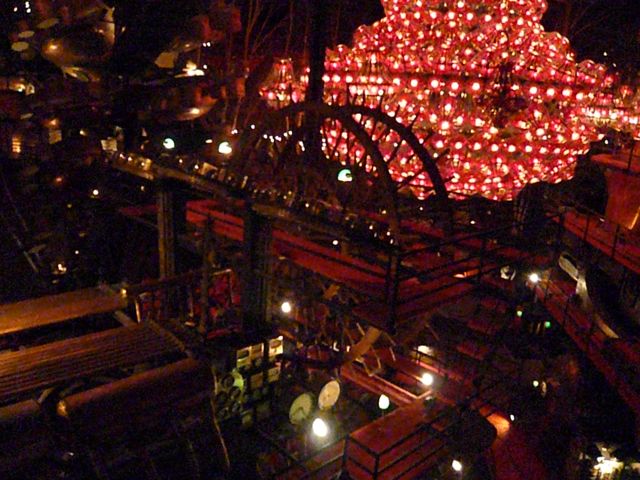
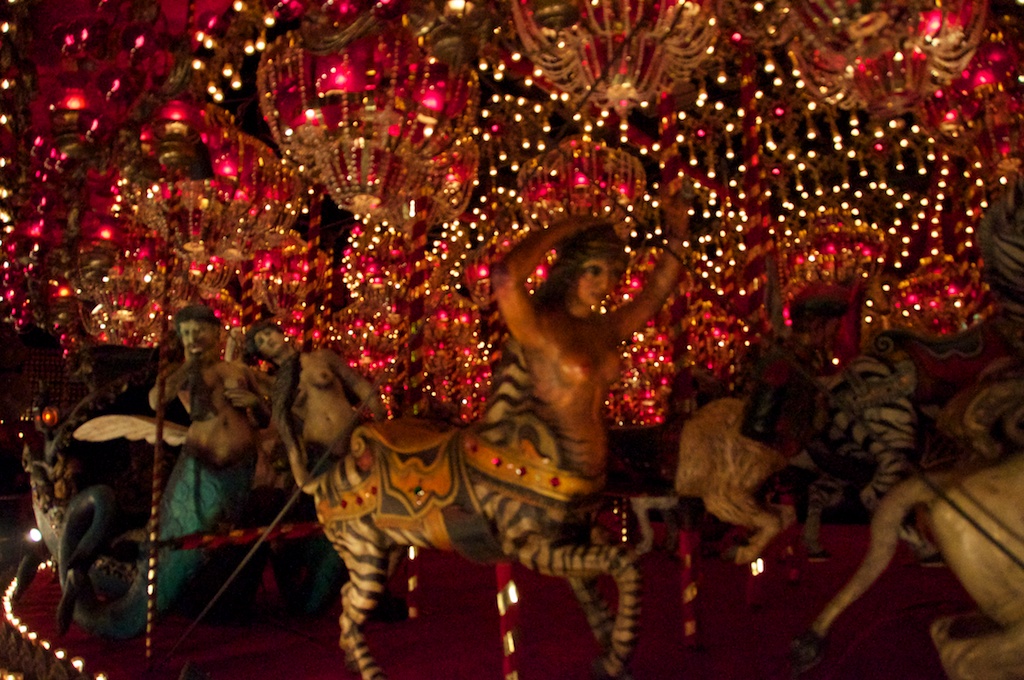
Still, some of the exhibits–oversized walk-in dioramas like “The Organ Room” or the Carousel–were breathtaking, mostly because they were so HUGE and SO CRAMMED with LOTS OF THINGS.  It’s hard to imagine SO MUCH STUFF packed tightly into ONE MASSIVE DIMLY LIT BUILDING IN WISCONSIN, but there you have it.

WordPress won’t let me center this video and YouTube wouldn’t let me upload the better res version so you could see the figures clearly,  but here’s a quick glimpse of the huge percussive Carousel in motion:

Dimly lit detail, Organ Room

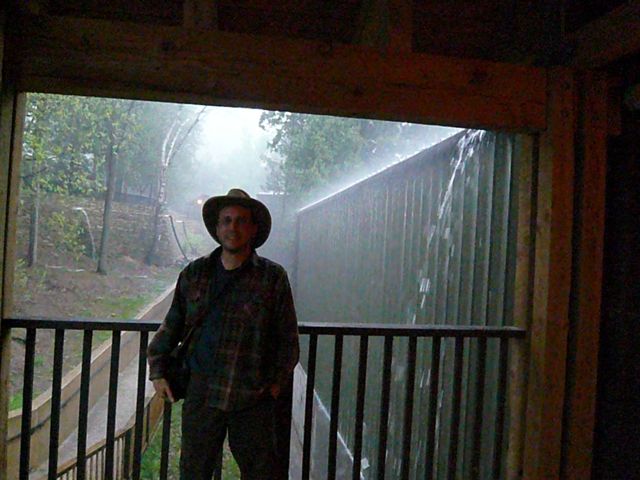
Pouring Rain As We Left House On The Rock

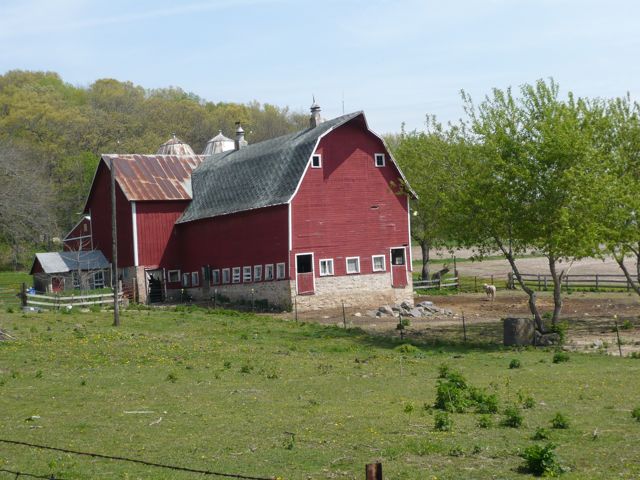
Someday I would like to get back to Baraboo to see Circus World, and muse on the many hills and dales which are–for real–filled with green grass, cows, and red barns with silos.  Until then, We’ll Always Have Cheese.

Red Barns--Yep, Here's Where We Grow 'Em

THE EMPIRE BUILDER, OR

TWO AND A HALF DAYS FROM BADLAND TO PORTLAND

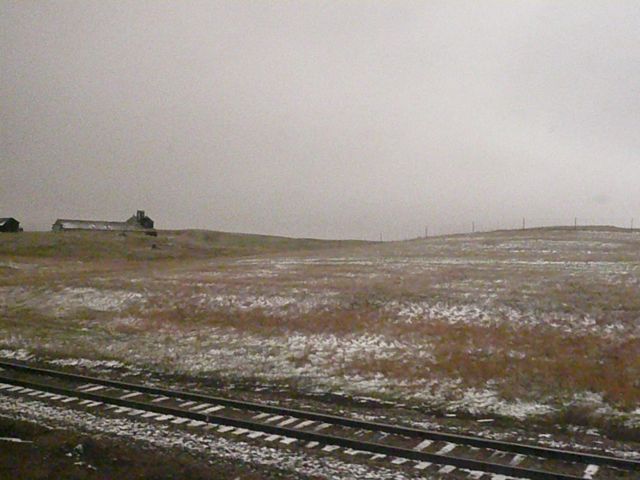
Our Baraboo/Dells/Spring Green adventure done, we drove back to Milwaukee and boarded the Amtrak Empire Builder for Portland.  It was two days of badlands and snow–yes, snow!

Snow, North Dakota

The train got more and more sticky and trash-laden as the days went on–we saw babies being changed on coach seats (yeccch) and stinky bags of trash accruing in the baggage areas waiting to be discarded.  We were grateful we could afford a “roomette” again for the trek–you really didn’t want to be in the coach car for the long schlep.

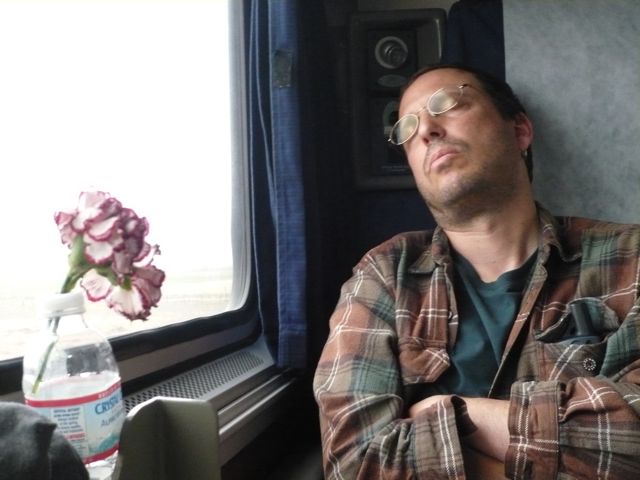
Samuel, May Day Flowers--both tired

We lunched with a pair of sisters traveling to Portland to care for their brother with cancer, and one time when we were walking through to the dining car we overheard one woman telling her three young children, “…he can’t know where we live when we move.”  Yikes.

We met an uncanny number people who worked in the aerospace industry during our trans-country train lunches, and it reeeeaaallly makes you wonder why these people aren’t traveling by plane.

Many of the other passengers were clearly too poor or decrepit to fly; you can really see how class plays into who gets on the train, and who gets to sit where with or without amenities.

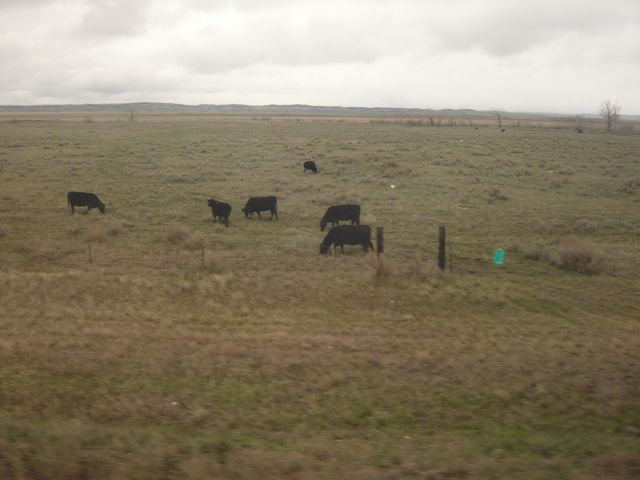
Cows, Storm, from the window of the Empire Builder

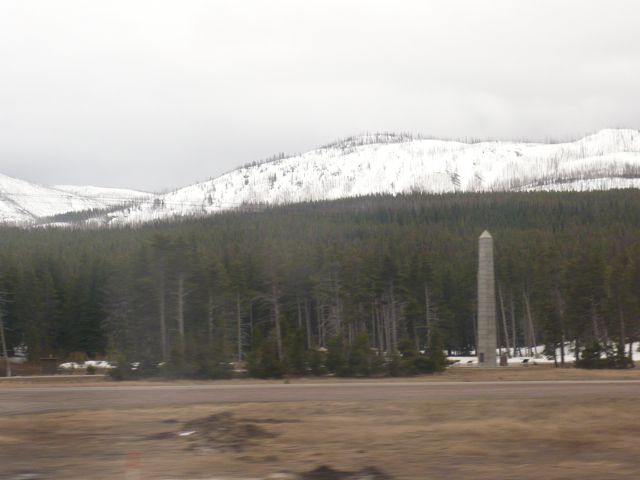
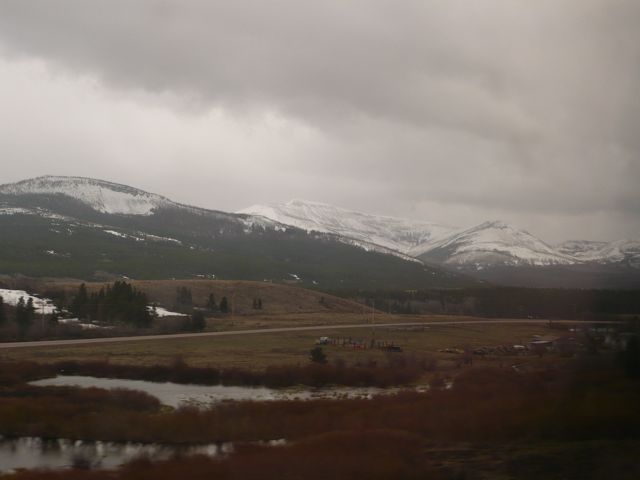
The last part of the Empire Builder trip was through Montana’s Glacier Park, and it made all the stickiness and trashiness pretty worth it.  More snow, exquisite scenery.  We’d like to railroad back to a lodge out there sometime and enjoy the natural beauty while standing still (while being mindful not to get et by grizzlies, which can happen up here sometimes.)

The Continental Divide (see obelisk)

Day Two, Montana's Glacier Park

Sleep’s not something that really happens on a train, even in the privacy of a “roomette;” you lie in your bunk and roll around all night as the train shudders past rough switches or grinds into a midnight station.  After two nights of not-sleep and not-shower, one can feel a bit put upon.   However, Amtrak cleverly put the best scenery for last on The Empire Builder, so you are distracted from your misery a little and forget the long miles that came before.

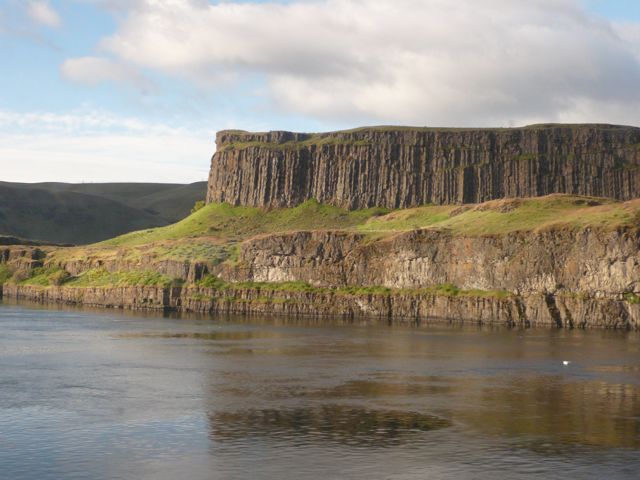
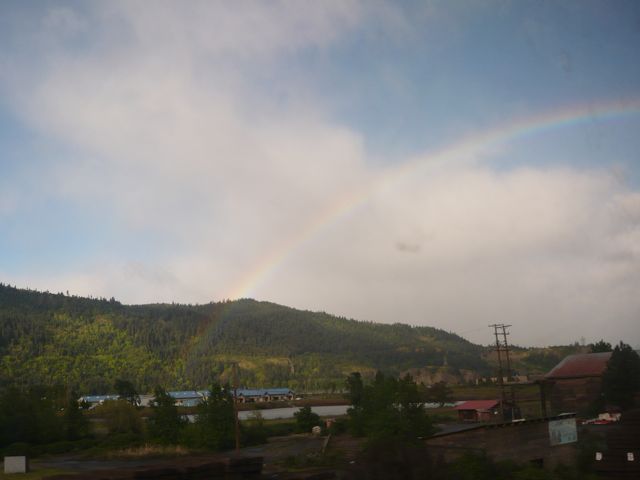
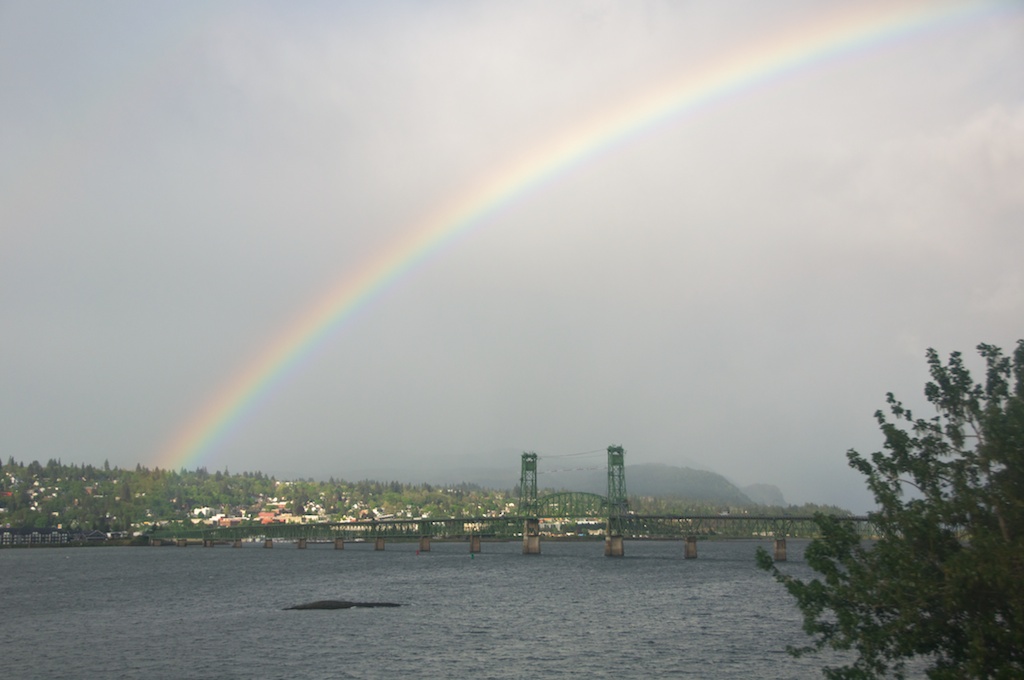
That final morning, we passed through The Dalles (OR) on approach to Portland; a rainstorm and a rainbow greeting us when we crossed the state line like a promise that we’d never have to endure such a grueling train ride again:

The Dalles

The Rainbow

We arrived at Portland late morning and as soon as I deboarded I immediately became nostalgic for my old stomping ground in Seattle.  The rhododendrons and dogwoods were in full bloom and the air was cold and felt nutritious to breathe; it was rainy and glorious, and we had nothing planned but a little R&R (rose garden and renovated hotel) before we ventured home.

Next: McMenamins, and The Starlight Express Home!

Thoughts on Traveling with Amtrak

Before departing on this journey, I was filled with excitement (yes, and trepidation) by the transportation aspect: what would it be like to travel around the country on Amtrak trains? After all, I’ve traveled on trains throughout Britain and Europe, as well as in India, Thailand, Malaysia, and Japan, and the experience varied dramatically. Train travel can be a futuristic, hi-tech experience (like the Shinkansen in Japan), an interminable, disgusting, crowded, and smoky experience (like a train I once took from Vienna to Beograd), or pretty much anything in between.

Train

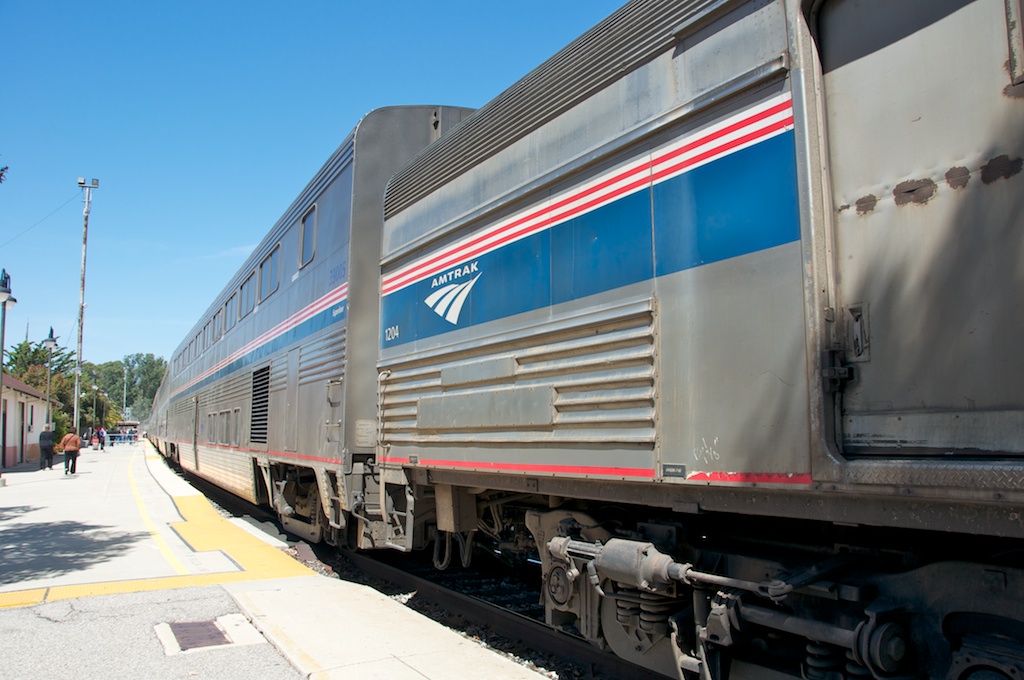
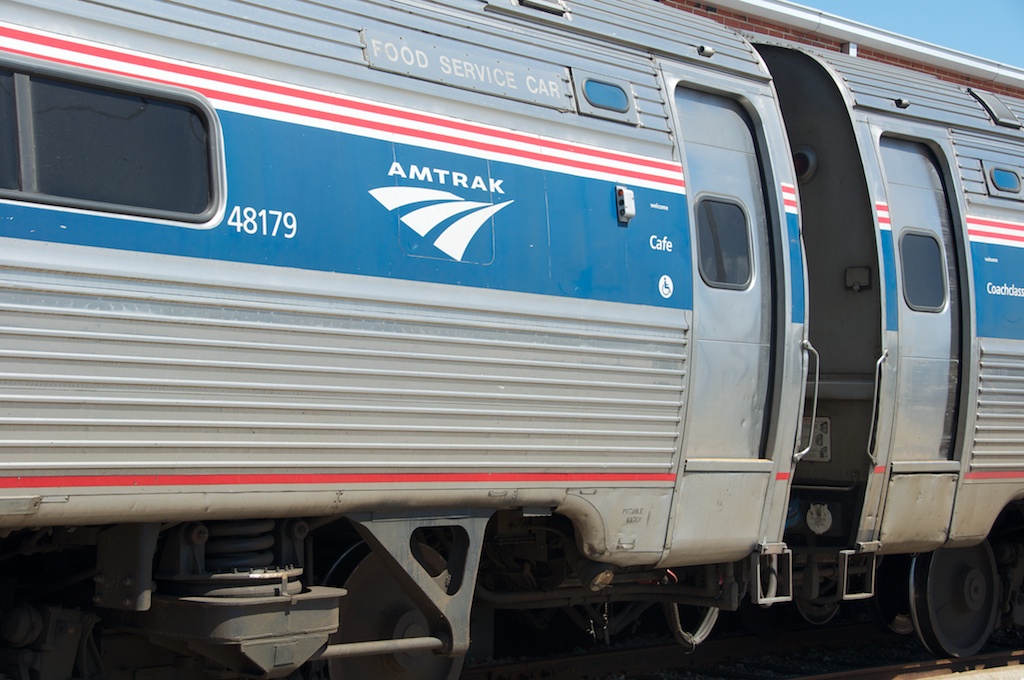
Amtrak Cafe Car

Still, I didn’t know exactly what to expect on this journey. Elizabeth and I had taken a short Amtrak trek up to San Luis Obispo about ten years ago, and enjoyed it, but that was a few hours, while on this trip we’d be spending days on the train. Would we suffer from cabin-fever? Would we get to our first stop in San Antonio, and start the search a divorce lawyer? Or would it be a romantic adventure?

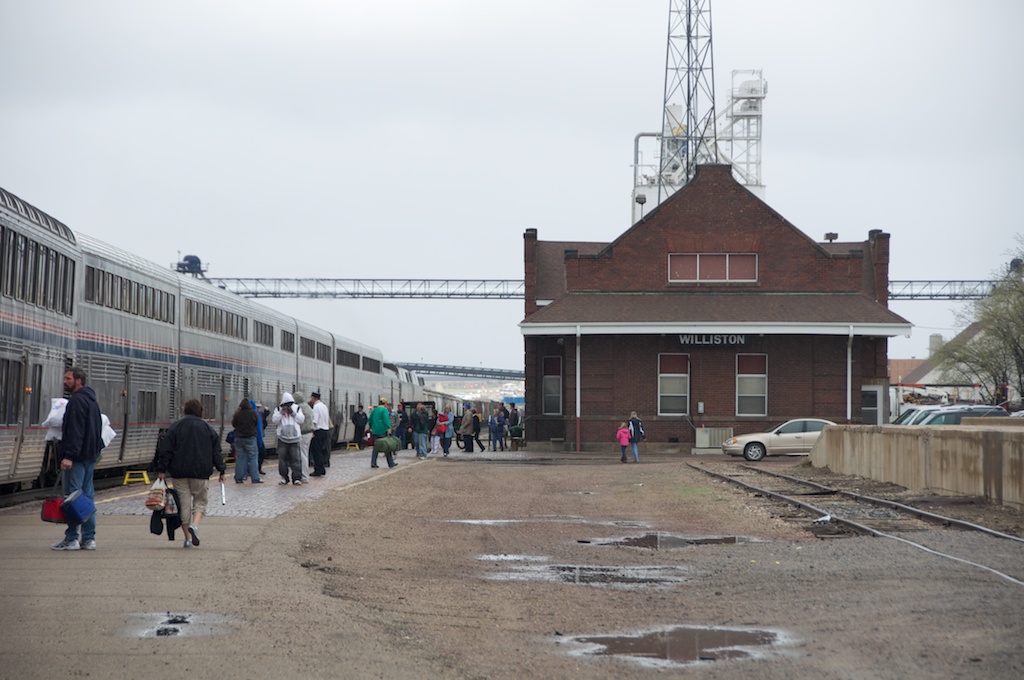
Station Stop, North Dakota

Station Stop, North Dakota

If you’ve been reading this blog, you know the answers to those questions.

We found that traveling by Amtrak is, in many ways, a more civilized means of transportation. You don’t have to go through the abuse that you would at the airport. They dispense with the security theater. As one car attendant said to me “terrorists would have a hard time hijacking a train and crashing it into the World Trade Center”.

Train trips have always been a good source for stories. I think this is a natural outgrowth of the social aspect of trains; somehow, and I don’t really understand how, trains invite social interaction in a much more profound way than airplanes do. I’ve been on many transcontinental flights where I haven’t exchanged more than “excuse me” to any of the people sitting in my row. I don’t think I’ve ever been on a train where I haven’t had at least a short conversation — and often much more than that. I’ve been lectured on the moral imperatives of marriage and personal hygiene by an Indian businessman en route to Agra, and gotten drunk with soldiers on a Thai train. I’ve had strange, laughter-punctuated pidgin communications with people where we shared no language other than hand gestures and simple drawings. I’ve talked tech, compared cell phones, and traded snacks or paperbacks with people on trains. I’ve heard life stories, business tales, political views, and ghost stories.

Amtrak

Amtrak Sleeper

On Amtrak, you meet other people in the passageway, possibly in the lounge car, and always if you eat in the dining car. You may get bounced into them as you walk by in the coach car. You find yourself having a lot of conversations.

The slower pace of transport also seems to result in more natural conversation with train employees. There’s not a focus-tested greeting or script for each interaction. Conductors will tell you something about the upcoming station, or talk about the weather. Sleeping car attendants will talk about the circus train that they saw the previous day.

Just as trains are more social than airplanes, they also occupy an interesting place in our national psyche. People love trains. We attach a mystique to them in a way that we do with few other modes of transportation. Some of this is clearly historical: just as we now find horse-drawn hansoms and hackneys romantic, we think of trains as quaint. But there’s more to it than that. People wave to passing trains — all kinds of people, not just children. As we were pulling out through eastern Los Angeles County, we saw a construction worker pause from his labor to wave at us as we went by.

Montana

Station Stop, Montana

But what of the nitty gritty details of Amtrak travel? Here’s where there’s both good and bad.

The Ride
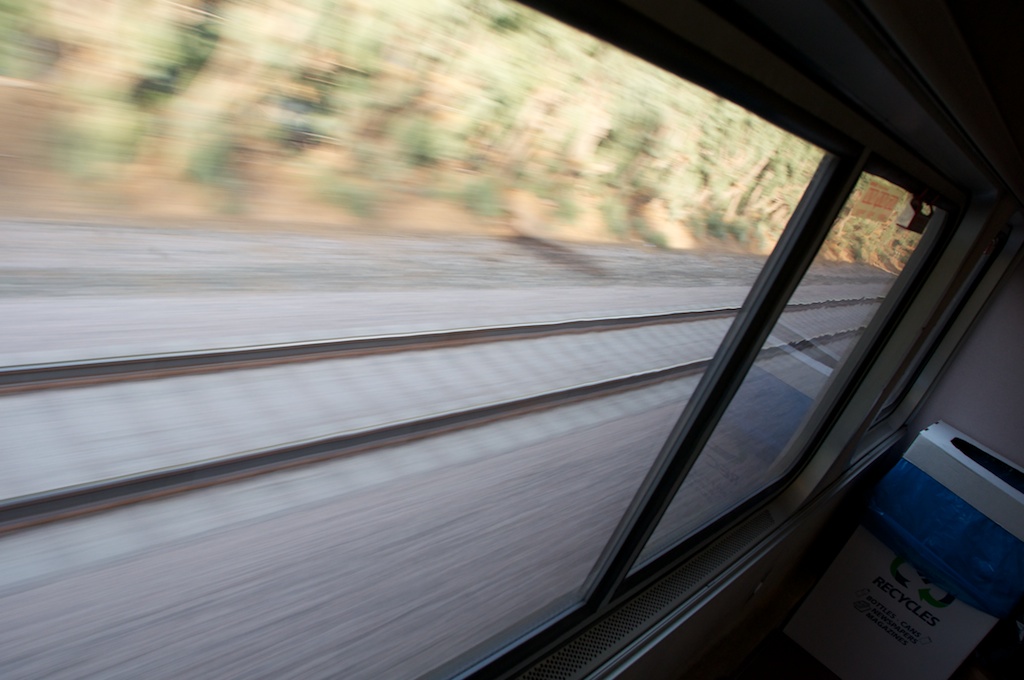
Unlike trains in, say, Japan, there is a lot of physical motion on an Amtrak train. There is side-to-side motion when the train is switching spurs or going over crossings, there is leaning when going around curves or on certain stretches of track, and there is back-and-forth jerking. As far as I know, most of the rails in the United States are still bolted segments rather than the welded track used in western Europe and Japan. This contributes to the roughness of the ride (although, to be fair, there are reported to be as many miles of rail in California alone as there are in Japan).

Depending on which route you’re on, the ride may be anywhere from “mostly smooth” to “roller coaster.” Presumably, this has a lot to do with the quality of the track and the speed at which the train moves. We found that the smoothest route was the Coast Starlight route along the West Coast.

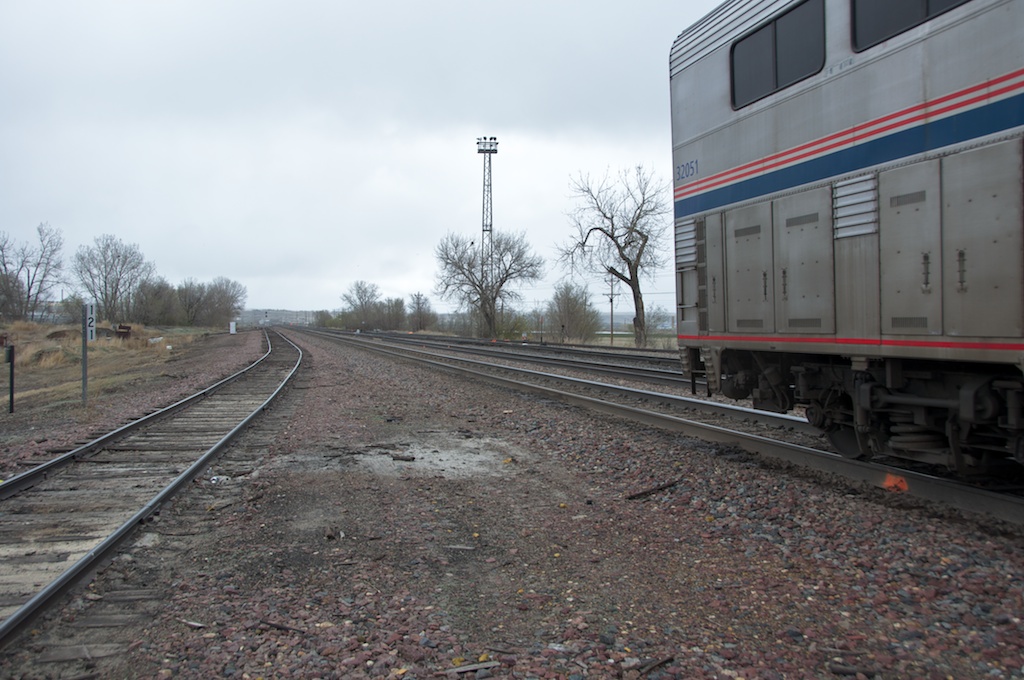
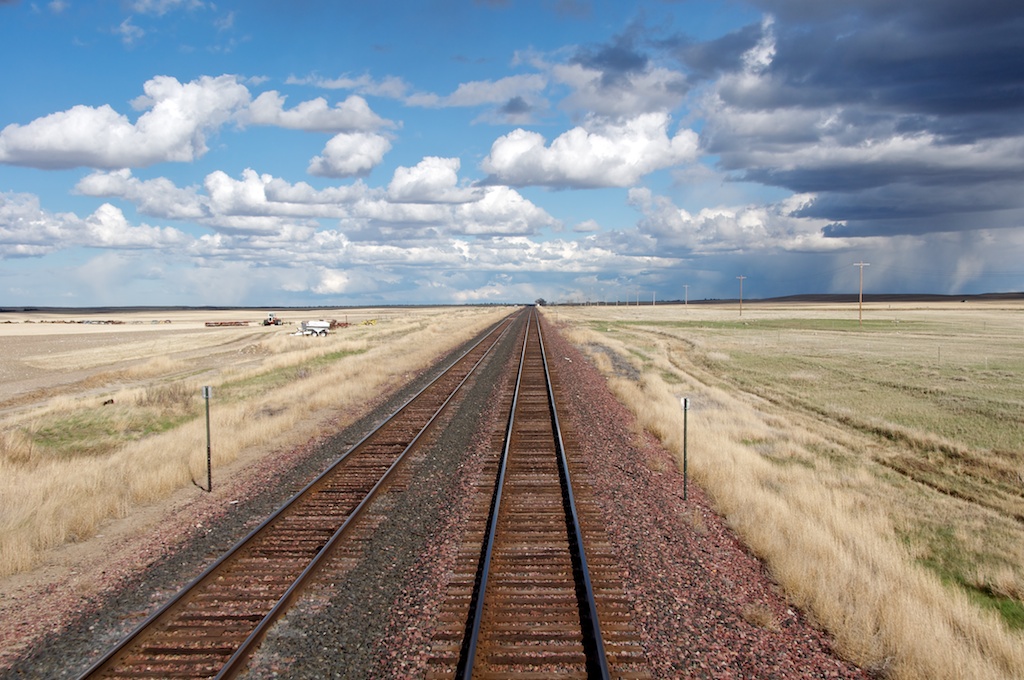
Track

Track

Business Class versus Sleeper versus Coach
On routes that don’t go overnight, trains are generally divided into coach and business class coach. There are evidently also “quiet cars” where conversation, cell phone usage, and probably children are prohibited. We only did a few of these shorter routes, and always in ordinary coach class, so there’s not much I can say about it.

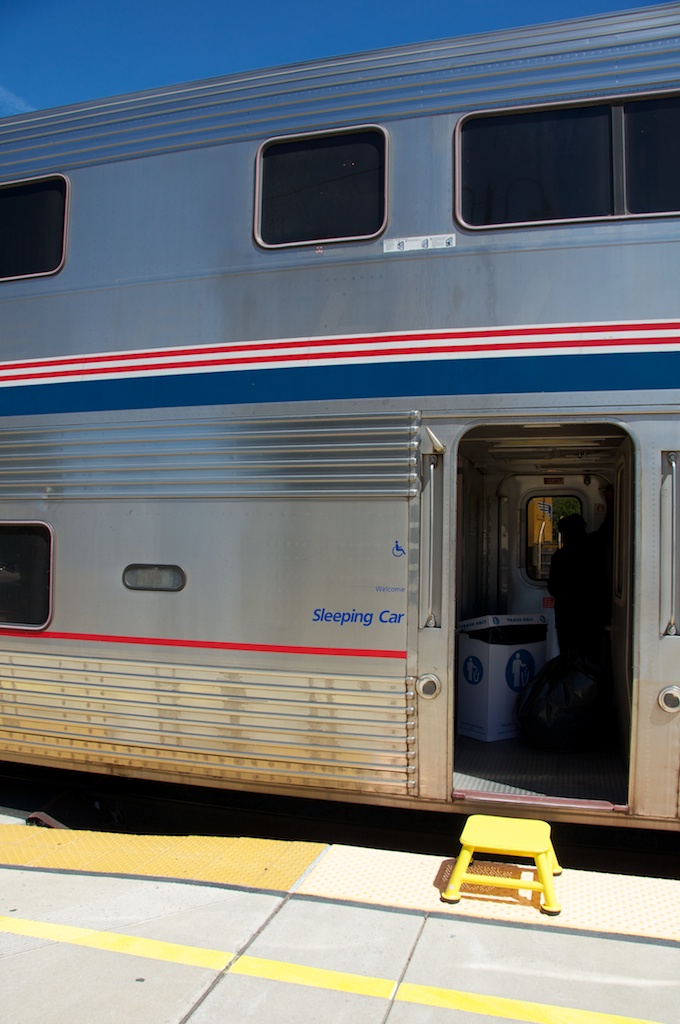
For overnight routes, sleeper cars effectively become the business class. Sleeper passengers have their dining car meals included in their fare, and are given priority treatment. You can opt for a full room (which we did not do) or a “roomette,” which is a mini compartment that has two facing seats that transform into an upper and lower bunk. There are nice touches like bottled water waiting for you in the roomette, coffee and juices available at the end of the car, and, on some of the long-haul routes, a welcoming mini-bottle of champagne or cider.

Sleeper cars have communal restroom and shower facilities. Some sleeper cars have their own, in-roomette toilet and sink, which doubles as the step to the upper bunk. As there is no separation at all in the roomette, using these facilities is contingent upon you being on very intimate terms with your travel companion. They’re also contingent upon you having good balance when over rough track.

Coach cars have rows of seats that are like more comfortable airplane seats and with better leg-room. They often have fold-out footrests, which people try to use as makeshift beds on overnight routes. When the train was not especially full, it appeared that people had reasonable success sleeping by curling up and using two neighboring seats.

Unlike the roomette compartments, which have their own doors and curtains to isolate them from the rest of the train, the coach car has no means of shutting off noise, light, or odors between neighbors.

All Aboard

All Aboard

Sleeping
We never tried sleeping except in a roomette on a sleeper car. The fact is you can sleep on the train, but you may not sleep well.

The problem with sleeping is less the motion of the train (although on particularly jerky routes, it may be a factor), but is more to do with the maintenance of the cars themselves. It’s clear that Amtrak tries to keep things in good order, but the cars are heavily used, and many of them are old. As a result, there’s a lot of irregular ambient noise, primarily squeaking and clanking. There’s also squeals of wheels on some curves, the sound of the train whistle (depending on how close to the locomotive you are, and how many roads cross the tracks), and light, noise, and hubbub from station stops. In some cars, the curtains no longer close very tightly, so light leaks in. In other cars, the door latches are broken or worn, so the compartment door thumps around from the motion of the train. And in some cars, the heating/air conditioning is temperamental.

Of course, sleeping is obviously affected by the quantity of wine or coffee consumed in the lounge or dining car.

Train

Train

Food
With the sleeper car ticket, meals are free (except for alcohol). You make your lunch and dinner reservations with the attendant who walks through the train; sleeper passengers get priority over coach passengers for making reservations, but you may end up at a table with people from either group.

The dining car has tables with cloth tablecloths and vases with fresh flowers. You get real silverware. On some routes, you get real plates and cups too.

The menu is not exactly the same across all routes, but by and large there is a similar pattern. Breakfasts are eggs, potatoes, toast, and meat or an omelet or famous “railroad french toast” or a continental. Lunch is some hot sandwich, a hamburger, a veggie burger, or sometimes a salad. Dinner is a vegetarian pasta, roasted chicken, some kind of fish or seafood, or some kind of steak. Dinners come with salad and a roll and have an option for dessert (typically cheesecake, brownie, or ice cream). For most meals, there is a daily special as well. You can get a lot more specific detail on the Amtrak site.

Food is institutional, but it’s definitely better than the average airplane meal. Quantities are generous. It’s not gourmet, but it was certainly good enough. In my experience, the less exotic things were the best: the steak was pretty good.

Track

Track

Miscellaneous
As mentioned in other posts, traveling by train exposes you to parts of the country that you wouldn’t see otherwise. It takes you through spectacular scenery, and it takes you through the uglier side of town. I don’t think that there’s any other way of getting an impression of so much of the country in so short a time.

Photography from a train can be frustrating — the windows are not especially clear, there’s a lot of reflection, and you’re often moving too fast to get The Shot.

Amtrak has some nice extras like wine and cheese tastings in the lounge car on the longer routes (Empire Builder from Chicago to Portland/Seattle, Coast Starlight from Seattle to Los Angeles). Elizabeth won a bottle of Pinot Grigio in the trivia contest, too!

I think Elizabeth summarizes it well when she points out that Amtrak has something of an identity crisis. Is Amtrak’s aim to serve tourists and rail aficionados, or is Amtrak a Greyhound bus on rails? There’s definitely an effort to make for a high-quality tourist experience: the routes go to tourist destinations (like Glacier National Park and the Grand Canyon), some routes have guides describing the places you pass through, and the services seem to be designed to cater to tourists. On the other hand, some trains are clearly commuter trains. To some extent, this is an East Coast / West Coast split, with the western trains being more oriented towards tourists and the eastern trains more for moving people efficiently, but it’s not that simple either (for example, the Florida/New York auto-train is definitely for snowbirds).

Amtrak’s fortunes follow politics. One car attendant told me that the Bush administration considered Amtrak an unnecessary expense (effectively subsidizing rail buffs), while the Obama administration sees Amtrak as part of an overall national rail infrastructure which will be increasingly important. Regardless of the reasons, Bush proposed cuts for Amtrak’s budget, while Obama has increased it. Amtrak is not profitable, and the consistent operating losses may be one reason for the continued non-operation of the New Orleans to Jacksonville segment.

Columbia River Bridge

Columbia River Bridge

Bottom Line: Would We Do It Again?
Yes.

We’re already mulling around ideas of a Pacific Northwest journey for some future Summer. We’ll keep you posted!

Random Impressions: Creativity and Spectacles

“Go see the Dells,” people said to us when they heard we would be in central Wisconsin. “It’s incredible!”

The Dells

Natural Beauty of the Wisconsin Dells

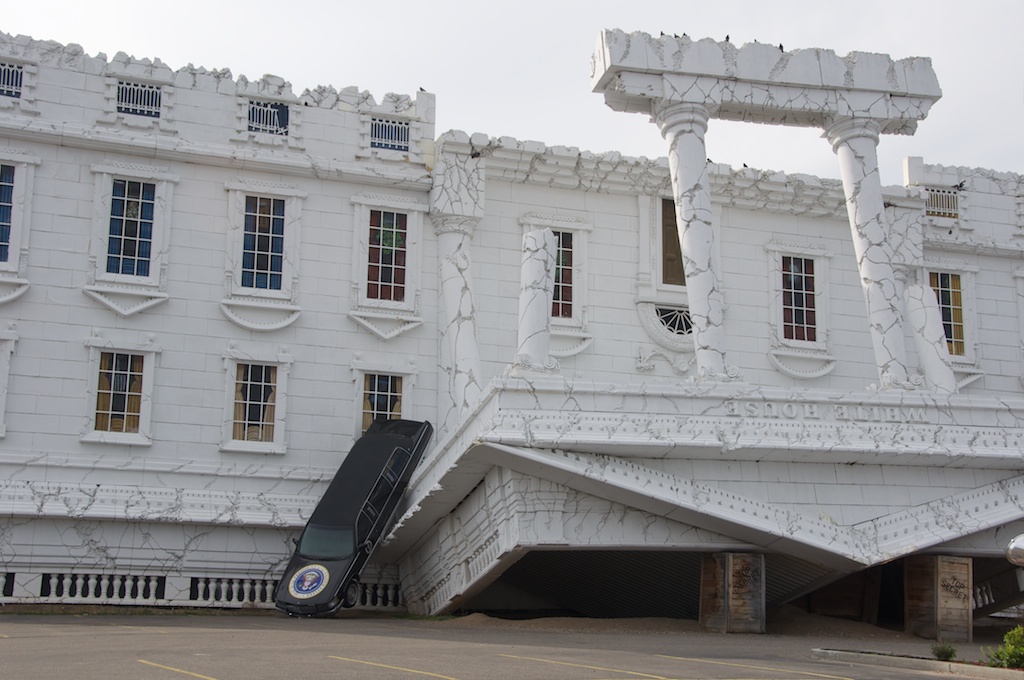
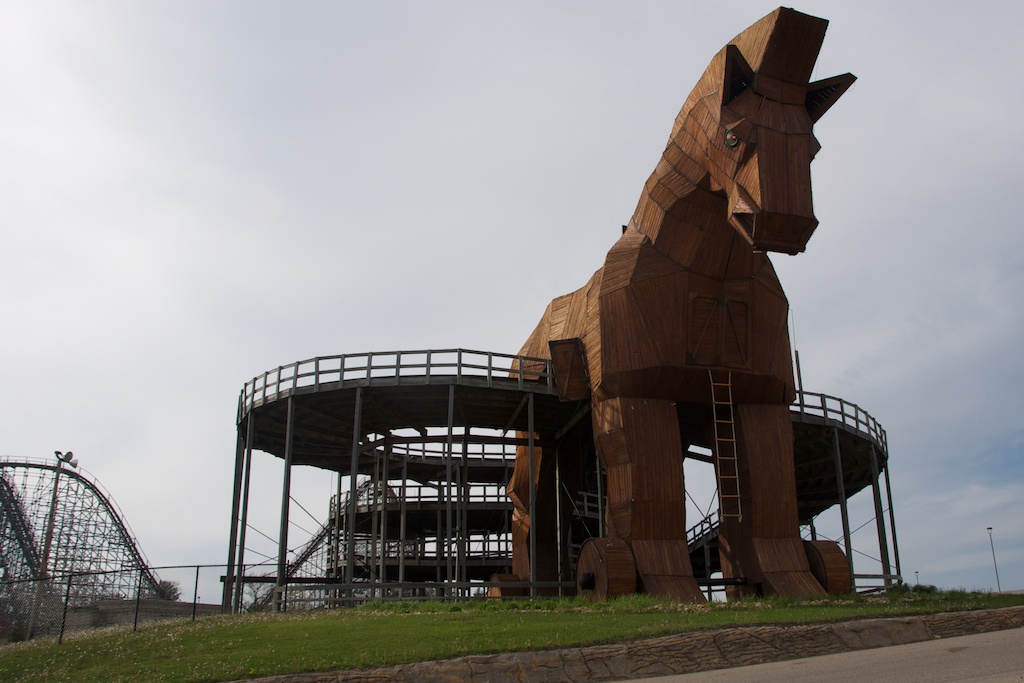
And incredible it was. A tourist attraction that started with beautiful river-carved gorges has evolved into Las Vegas on the Wisconsin. The road in is dominated by huge waterparks with a variety of themes: a giant upside-down Whitehouse, a massive Trojan Horse roller coaster, and more. Each attraction goes beyond its neighbor in outrageousness or size: a veritable creative frenzy to draw the crowd.

Thrills! Chills!

Thrills! Chills!

Big Pony

Big Pony

Like the original Las Vegas, the attractions at the Dells are impressive. There is some big-budget art design (and plenty of low-budget design too).

When I visit some place like Disneyland, or watch a well-crafted film, I can admire the quality of the art objectively. I know that there’s a whole team behind the work — sure, there’s likely to be a single art director, but the totality is the result of many contributors.


Not so, the Forevertron.

Forevertron

Main Forevertron

Tucked away behind a salvage yard and with little to announce it, the Forevertron is a massive hulk of metal; it is the ultimate “Steampunk” creation – vast turbines are enmeshed in jungles of tanks and tubing, sprouting insulators and high-voltage cathodes, dominated by complex control centers filled with gauges and dials. It is just one piece in a field of many sculptures, most of which are auxiliary components to the overall system: ostensibly the assemblage is to enable the creator to be transported to other worlds. Thus the system includes such necessary components as body mass shrinkers, defensive “love guns,” viewing areas for royalty, the great telescope for watching his progress, “juicing bugs” which provide additional power, “celestial listening ears” for receiving communications, and so forth.

Forevertron

Forevertron: Transport "Egg"

More Forevertron

More Forevertron: Tea-room for Royalty

More Forevertron

More Forevertron: Control Center

 
More Forevertron

More Forevertron: Telescope

Bird Band

Forevertron: Bird Band

More Forevertron

More Forevertron


Both the main Forevertron and its surrounding sculptures show a deep material ingenuity coupled with a sense of humor.

There are whole bands of emu and moa-like bird / musical-instrument chimaeras, marching in humorous processions. The component pieces are musical instruments and all manner of other mechanical junk. They’re made of trumpets and english horns and bells, but also have graceful flexing spines where the vertebrae are made of shearing blades or drive chains or cogs. A glockenspiel bird’s bells are various cut-up gas cylinders, while another bird’s neck is a saxophone, and many have tails made up of the bells of dozens of trumpets.

More Forevertron

More Forevertron

More Forevertron

More Forevertron

The Forevertron sculpture collection is fantastic. Unlike the attractions at the Dells, it’s mostly the work of one man (with the support of his wife and sons): Tom Every a.k.a. Dr. Evermore. Emotionally, looking at the work is exhilarating, but induces a touch of jealousy, because I know that I’ll never create anything that can compare. It’s a perverse reaction I sometimes get when looking at things I find extraordinarily well done: my admiration and joy is tinged with a kind of gluckschmerz.


A mere 33 miles by road from the Forevertron, The House on the Rock is another expression of creative exuberance. After crossing the massive parking lot, through the gate house and ticket office, you can take a tour of several parts; the first being the house itself, the others being various collections and, for want of a better term, the walk-in spectacles.

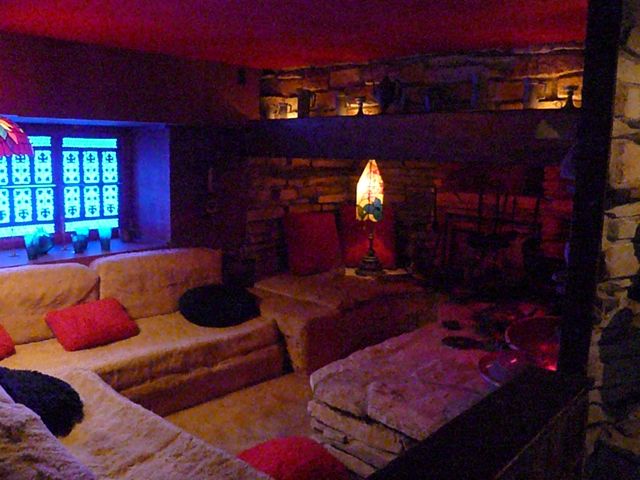
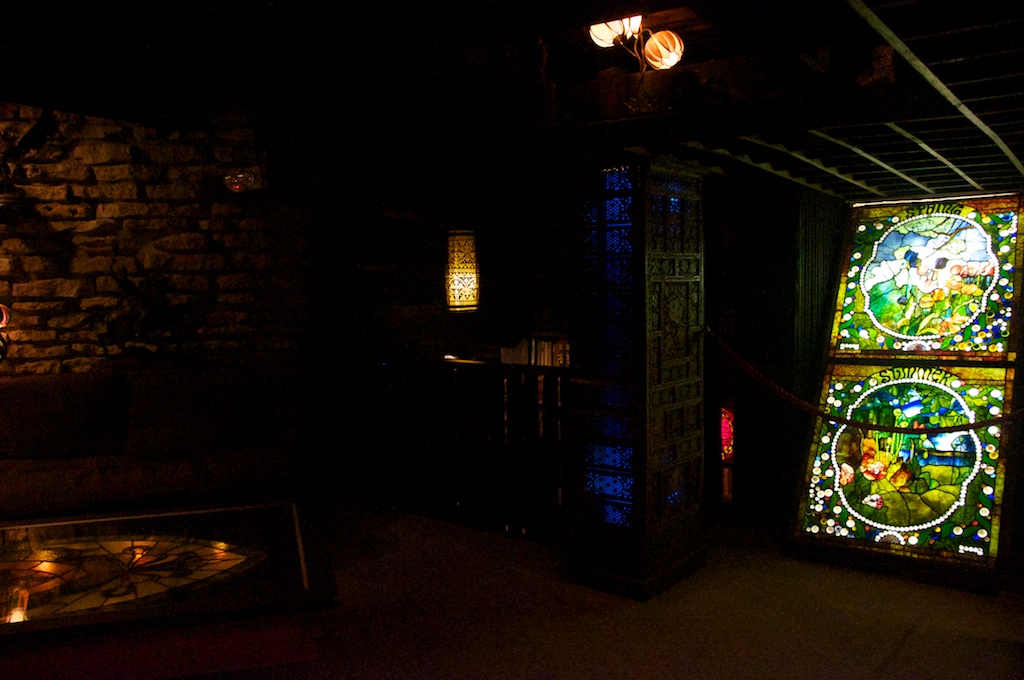
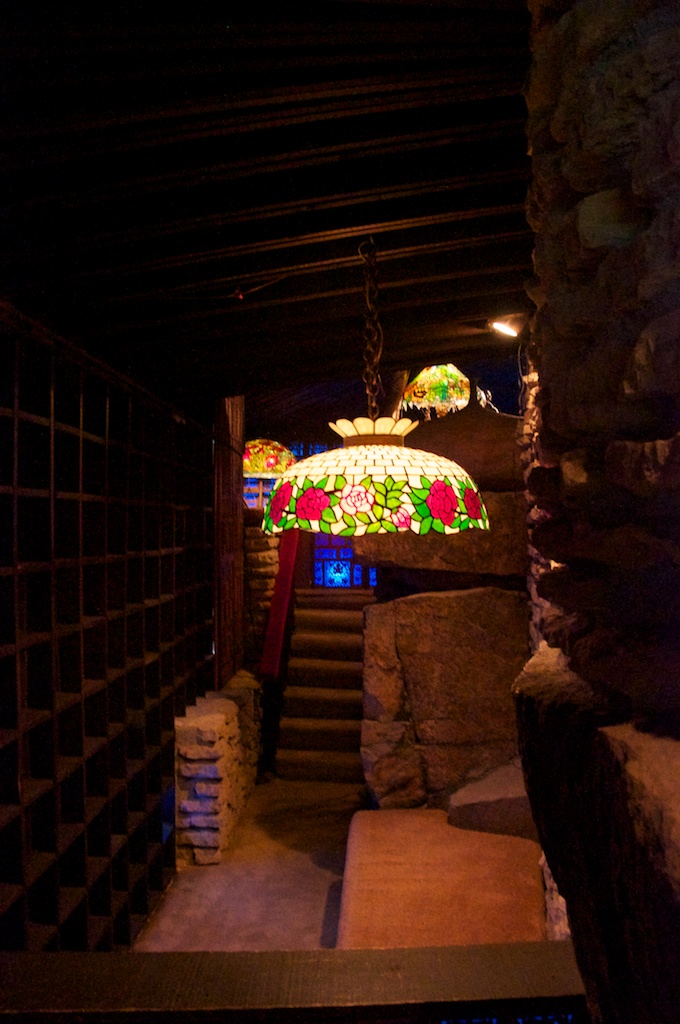
The house, as we learn from the hagiographical interpretive center, was created almost singlehandedly by Alex Jordan in an organic fashion, and without a plan. It’s a stone and wood construction across the face of a large boulder that incorporates live trees, is filled with mysterious little nooks and crannies, and is lit by stained glass windows and Tiffany lamps. It’s got hidden waterfalls, Asian-themed sculpture, built-in bookshelves and sofas, and elaborately carved Indian wooden panels throughout. Surprising views open out into the treetops, and inconspicuous doorways lead to small, pillowed chambers. It has all the power and enchantment of a real-world Rivendell blended with hints of a lurid opium den.

Inside House on the Rock

Inside House on the Rock

Inside House on the Rock

Inside House on the Rock

We are told that once Jordan started admitted paid visitors to his house, he transformed into something of a showman, and put all the admissions money back into the house and the collections. An addition to the house, a windowed cantilever walkway out eighty some odd feet above the treetops may be the first sign of this transition.

The rest of the house is collections and spectacles. Like some Dark Disney, Jordan and his team created an underground Main Street USA, dimly lit, and filled with curious collections of antiques: cigarette lighters, scrimshaw, firearms, replica jewelry, and circus miniatures. From there, he started adding nickelodeons, recorder celestas, carillons, orchestrions, and other music-making machines. The further you go, the more complex the music machines.

Blue Danube Room Detail

Blue Danube Room Detail

Orchestrion Room Detail

Orchestrion Room Detail

Organ Room Detail

Organ Room Detail

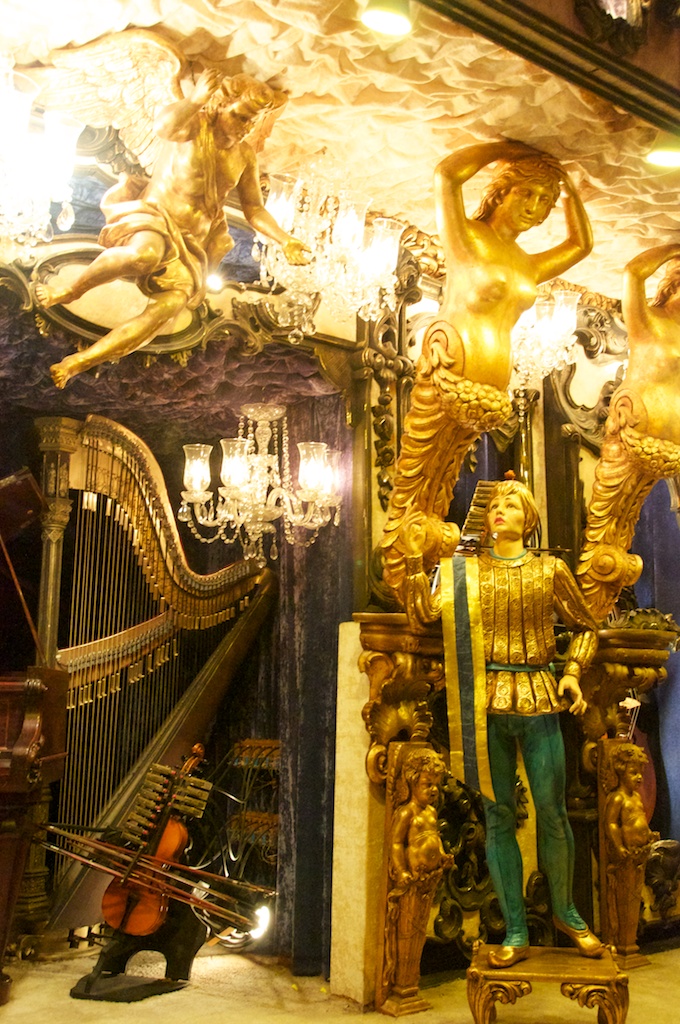
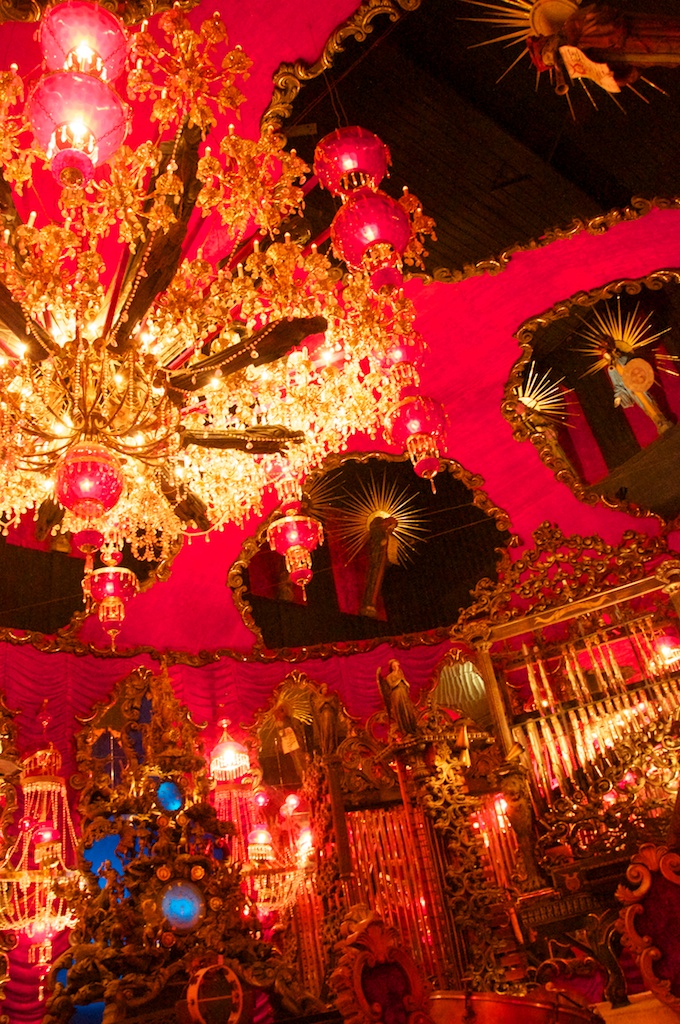
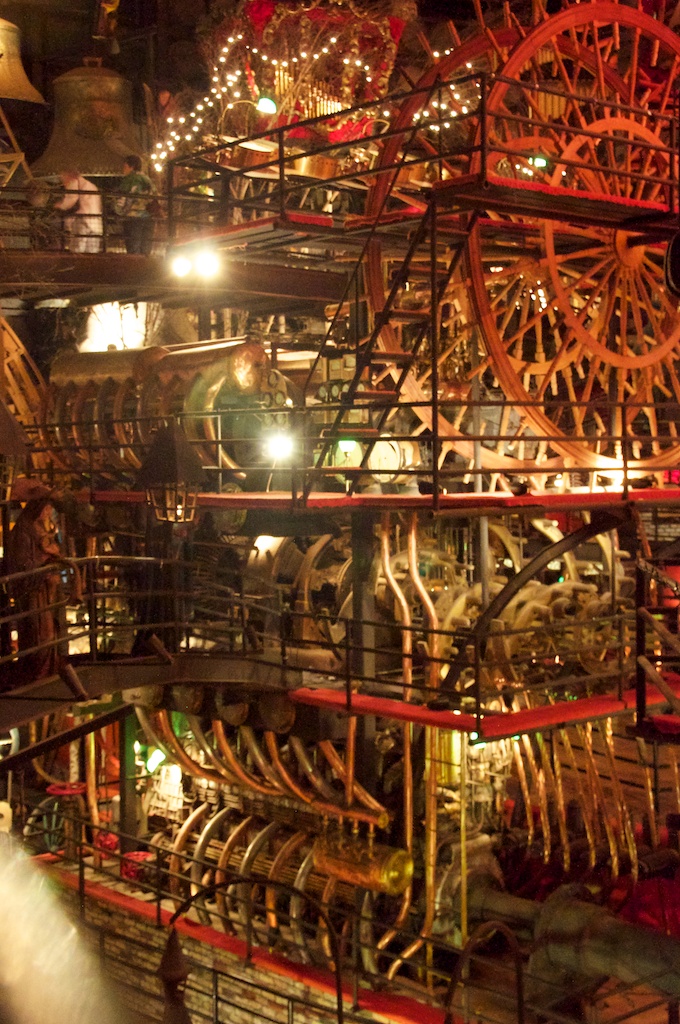
Orchestrions become whole rooms, decked out in extraordinary detail to look like Viennese Opera Houses or other scenes and are filled with automated instruments. Curiously, as the rooms get more elaborate, the music-making becomes increasingly fake: the automated violin bows move, but the violins lack strings. More and more of the sound is coming from hidden speakers behind decorations. This trend culminates in the auditorium-sized Organ Room, which simulates an enormous, fantastically complex steam organ, replete with oddly reminiscent “Steampunk” design (Tom Every claims to have done a lot of the work, although he is not credited on site. I’ve ordered a book that promises to deliver the dish). At this point, the sound is completely piped in, yet there is still some small simulation of it being an actual working machine with moving mechanical dampers.

Heavenly Host

Heavenly Host

Decadence

Decadence

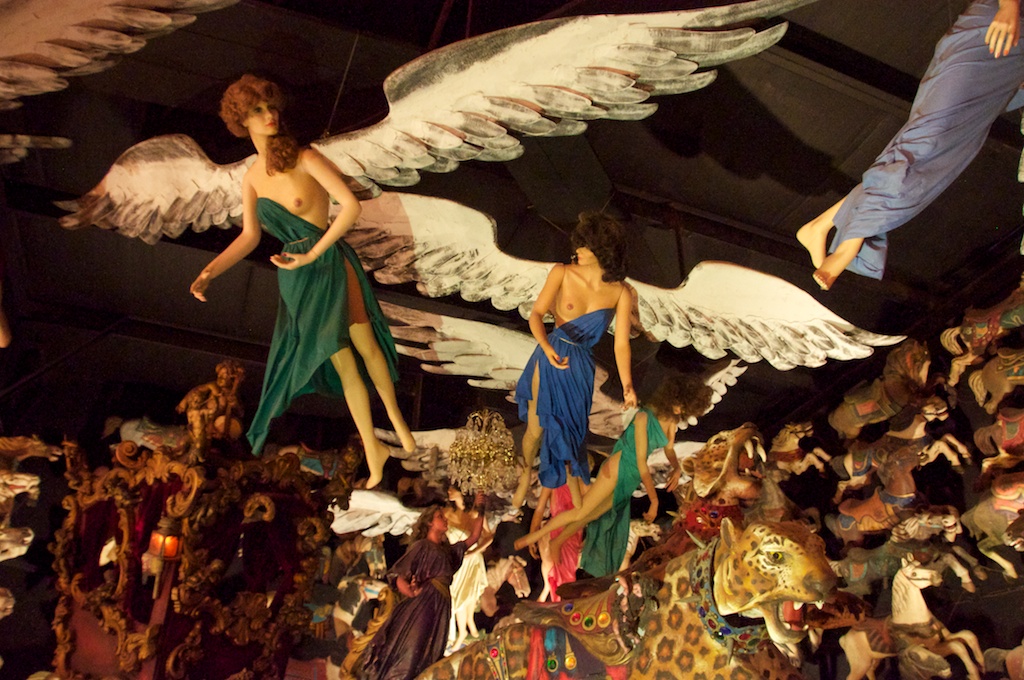
Another trend also is visible as you progress through the collections and spectacles of the House on the Rock. One of the earlier music rooms is bordello themed, with red draperies and an ornate mirror on the ceiling above a four-poster bed. The great carousel has topless mermaids and women riding mystical creatures below a heavenly horde of bare-breasted angels. One of the final exhibits, a doll carousel, is topped with masked nudes cavorting with satyrs. As the overt decadence increases, so does the religious iconography; statues of saints and dolorous medieval woodcarvings abound.

Interestingly, the only portion of the House on the Rock and its that triggers my gluckschmerz is the oldest portion of the house itself. It’s the place where my teen-aged self should have read The Hobbit. The collections are interesting, but not compelling. The spectacles are also fascinating, fun, and impressive … but the stink of fakery detracts, as does the obvious goal of impressing us. Maybe this is some deep-rooted fear of manipulation, but when someone announces that they have the craziest collection, the biggest carousel in the world, the biggest chandelier in the world, the most fantastic musical devices in the world … all those superlatives make me defensive. In contrast, the Forevertron feels like it was done for Dr. Evermore’s benefit, not the viewer’s (and the pretense that it’s a time machine or space travel device is a conceit that’s shared with the viewer — it’s not an attempt to trick us).

In any case, given the opportunity, I’d recommend a visit to both places. The pictures above don’t even begin to do justice to either place.

Sleepless in Philadelphia; Niagara Falling

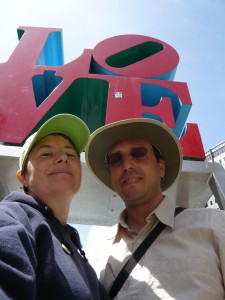
Love Park, Philadelphia

Friday morning we took the train overnight from Savannah to Philly, where we beheld a sunny morning.  We checked our luggage and our reservation at Club Quarters Philadelphia, and set out for the Mütter Museum (see “Thumbs Up”) and the Mummers Museum later that afternoon.  Both are worth seeing, but don’t confuse the two or you will be permanently messed in the head.

Like the Mütter Museum, the Mummers Museum is not for everybody.  I was drawn to it because I am fascinated by community-created rituals, and Philadelphia’s New Year’s Day Mummer Parade is a bizarre and wonderful example of how folk traditions are initiated, institutionalized, and passed down to new participants.

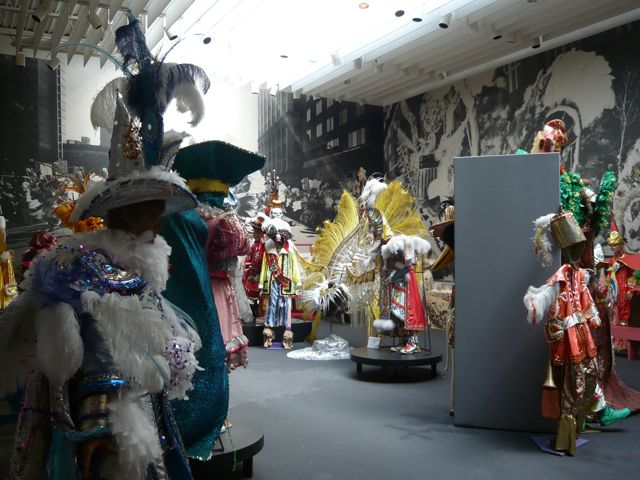
Philly is home to several Mummers “clubs” (which resemble New Orleans Mardi Gras krewes) that march and dance in a garish New Year’s Day parade, replete with “comics” (clowns), “string bands,” “wenches,” and “fancy brigades.”  The clubs can spend $100-$200k outfitting their membership in fantastical costumes (properly called “suits”) and they compete in themed choreographic presentations that are rehearsed for months on a volunteer basis.

This is a five-minute documentary featuring a champion mummer club, the South Philly Vikings.  (Note: as of 2009, there are no more cash prizes…these folks are mummers for love and bragging rights, and spend much of the year fundraising to make their show possible.  Shades of SpiderCow!!)

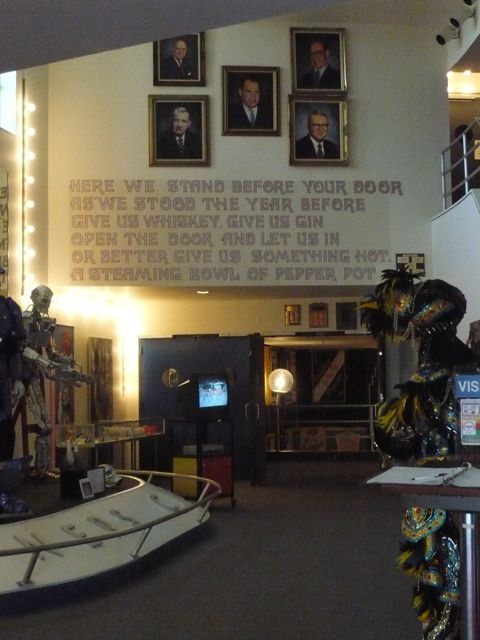
The Mummers Museum documents the evolution of the parade from its roots in ancient mummer traditions to its modern regulated state. The museum itself is a little dusty and many of the exhibits are aging and nonfunctional, but we found a few bits of history to enlighten us–the archive photos of early parades are fantastic.  It’s clear the parade was once a subversive romp by a mostly immigrant population–Samuel likened it to the “Burning Man” of its time–but now it is a big money establishment-run affair, and the Mummers Museum helps one understand this evolution from high-spirited improvisational mischief to manic civic competition.

The volunteers who run the museum–members of mummers clubs themselves–will enthusiastically talk your ear off about the Mummer phenomenon.   One is left wondering if there’s a kind of wonderful antic madness running through Philly, or if there just aren’t enough other activities to keep people gainfully occupied.  It’s easy to forgive them for oversharing their excitement though–lots of sparkles for New Year’s Day, a massive and serious contest, and an even more massive and serious party afterwards!!

Mummers Museum, main hall

The Mummers Museum is outside the main tourist area of town where I guess rent is cheap for non-profits–we had a nerve-wracking walk through a rough section of Philly to get back to our hotel.  That tired us out so we opted to have dinner close by at a cloyingly hip place on Chestnut called Continental Midtown, a “global tapas” diner (which translates as small plates, but you can’t say “small” in these recessionary days, even around foodie types who should know better.)

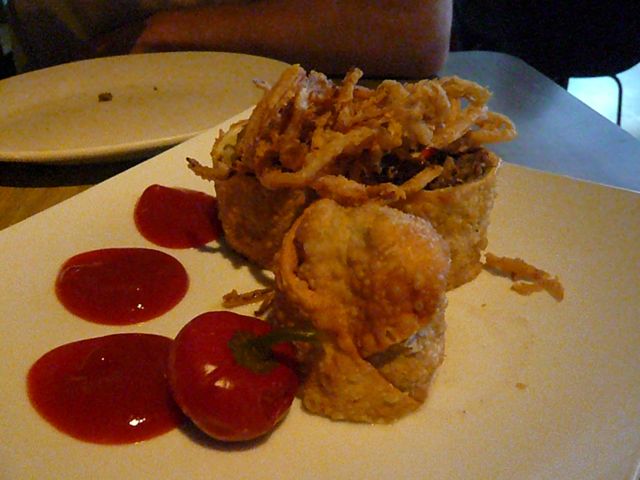
We had our Regionally Required Dish–Philly Cheese Steak–in a won ton wrapper, and it tasted pretty good, if lacking in Philly street cred.

Philly Cheese Steak Wonton, Continental Midtown Restaurant

Sadly, Philly street CRUD was all we had that night at our hotel, Club Quarters Philadelphia.

About one-thirty in the morning, the nightclub downstairs spawned what Samuel dubbed a “horn artist,” i.e. some schmuck who leaned into his/her car horn for about two hours.  That, the shrieking and yelling from the clubgoers, and the consequent sirens two hours later kept us stone awake until about four a.m.  So lovely, as we had to get up at 5:30 a.m. to make our train to New York.

We were beyond zombied and miserable when we went downstairs that morning–mind you, we were on the NINTH FLOOR and the ruckus sounded like it was just outside the window–and Club Quarters gave no quarter when I complained upon check-out.  “Oh yeah, that’s the club downstairs” was all they said, politely, and our only recourse was to write a ruthlessly truthful review on TripAdvisor about our night there.  They didn’t even have their lobby coffee ready.  We were traumatized but too exhausted to actually freak out on it.

It’s really too bad–Club Quarters could have been a nice experience if they had made some attempt to deal with the situation, or with us.  As it is, if it’s a weekend–run away, run away!!

Six a.m. Breakfast of Champions, Philly departure lounge

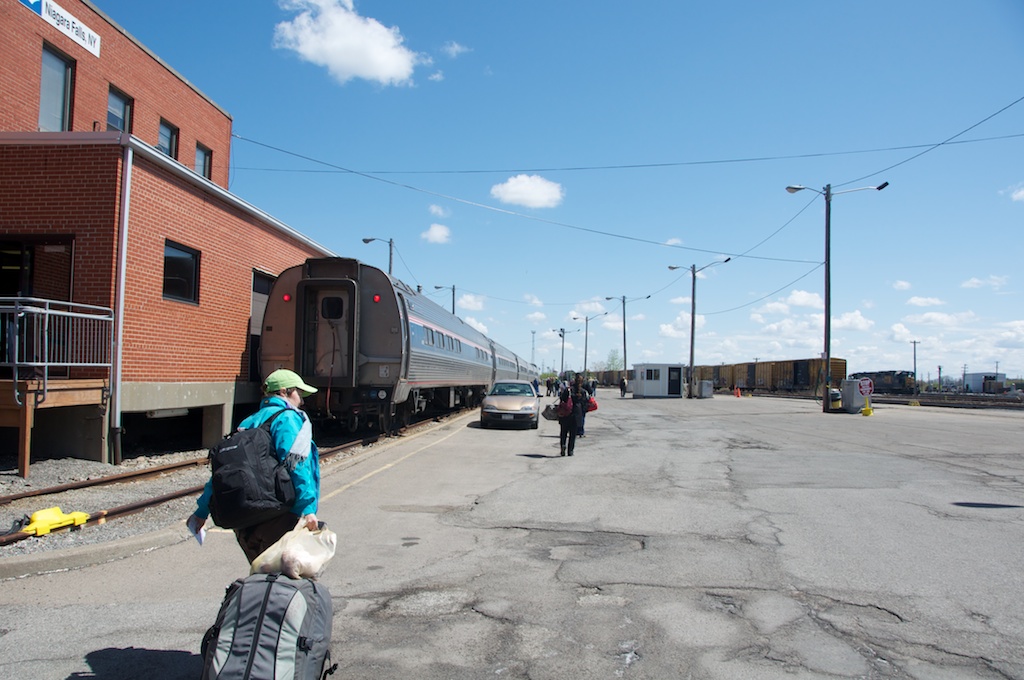
At six a.m. we slogged onto the train to Penn Station, NYC, where we transferred to the Amtrak Empire State up the Hudson River Valley to Niagara Falls.  It was a packed train, which surprised us, but the scenery was beautiful.

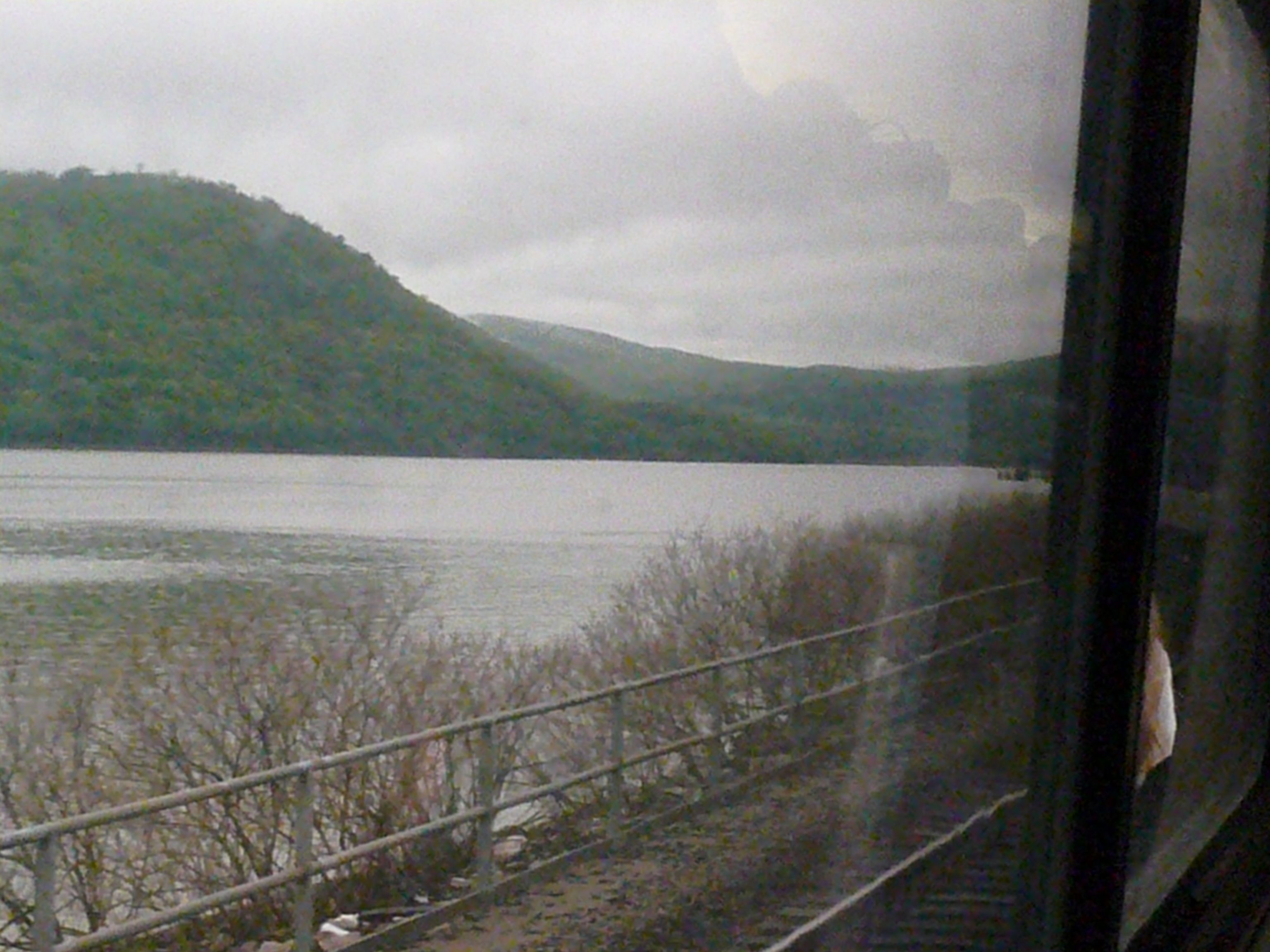
Hudson Valley, from train window

We arrived in Niagara in the late afternoon and were driven to our inn by an Indian taxi driver who drove like Batman having a panic attack (as it ended up, all our taxi drivers were Indian; apparently in Niagara there are a substantial number of immigrants and tourists from India, who often come via Canada.)

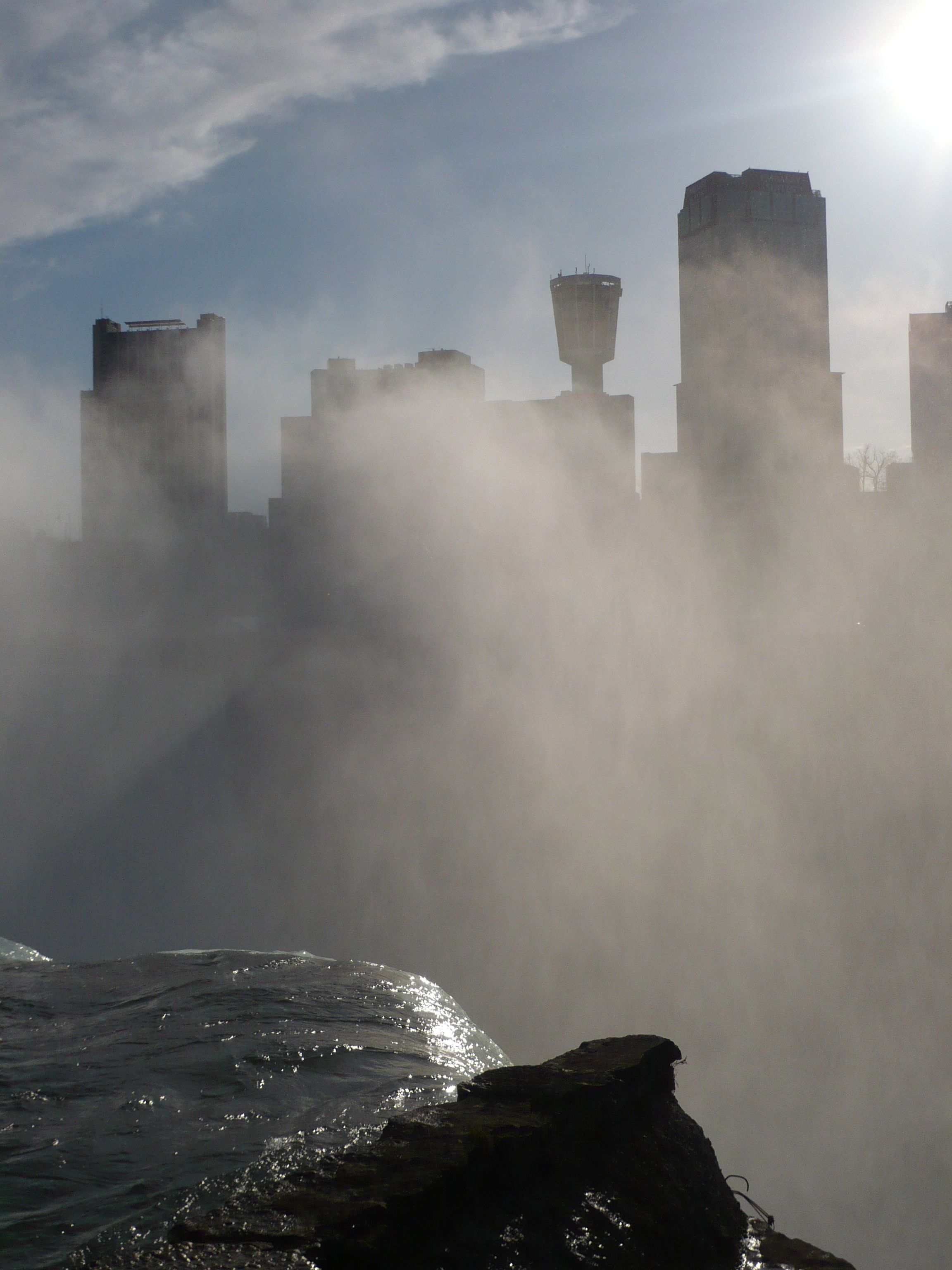
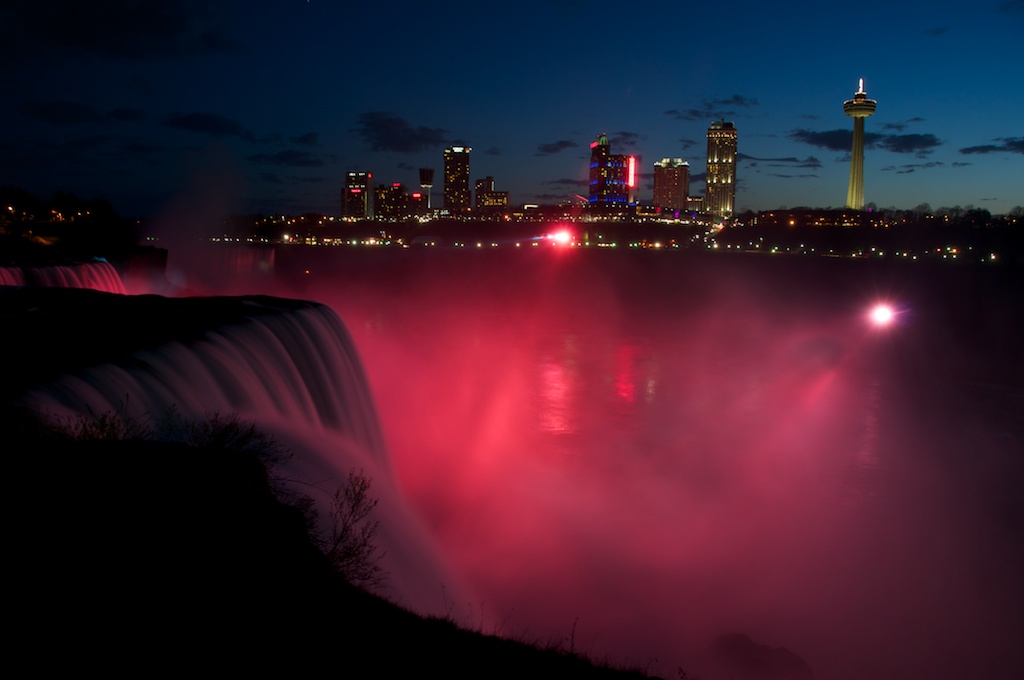
From the first moments of our arrival, it was clear Niagara Falls was not all we had been led to believe, though it has kept a few of its maidenly virtues intact.  Sadly, the “Honeymoon Capital of the World” has lost much of its business to the meretricious development across the river on The Canadian Side.  It seems to be sad days for the U.S. portion of Niagara, but maybe that’s about to change???….

….More on that Hard Rock Border War and the Lack of a Honeymoon “There” There when next I post….stay tuned!

Made Of The Mist? The Canadian Side Beckons

Off The Rails: Driving The South

If you’ve read Samuel’s rant at the beginning of this blog about the impossibility of the Amtrak booking system, you know that we couldn’t make a complete circuit of the U.S. by train because Amtrak no longer operates the Southern Line east of New Orleans (though it appears on all their schedule maps.)

So we rented a car and lit out, trying to drive from New Orleans to Jacksonville FL in one day–about  550 miles–planning to find a random hotel, and then driving another 150 miles to Savannah the next morning.

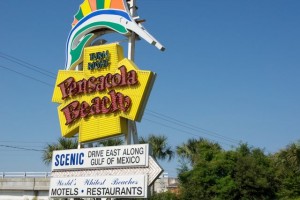
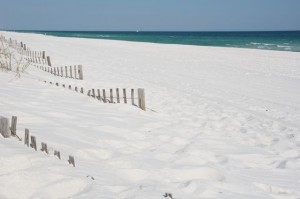
Vroom!  We barreled through four states–LA, MS, AR, and most of FL in about twelve hours, but took a detour down to the Florida portion of the Gulf Shore near Pensacola Beach (paying the kingly sum of $1 to take the toll bridge there) stopping to touch the water in the Gulf of Mexico and take some photos of the beautiful white sand beaches.  It’s mid-April and spring breaks are over so the resort and beach preserve were fairly empty–very beautiful and almost desolate now, but I’ll wager a crowded nightmare in summer.  We were glad we took the time to meander down to see it though, and you might want to do the same some day.

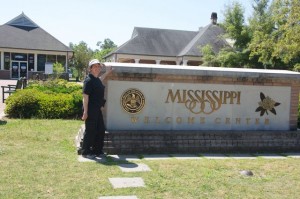
Welcome To Mississippi!

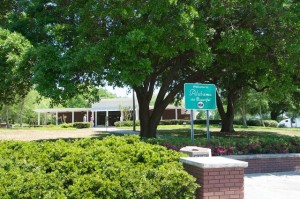
Welcome To Alabama!

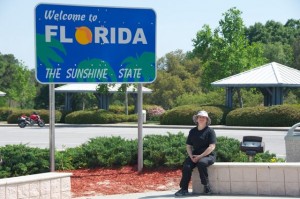
Welcome To Florida!

Welcome To The Gulf Of Mexico!

White sand beach, Florida's Gulf Island National Seashore

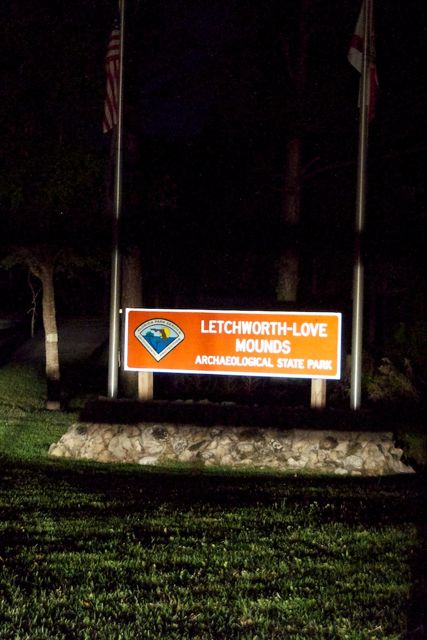
By the time we got done with our Gulf Shore visit it was late afternoon and I wanted to hammer through to Jacksonville before it got dark, but we decided to cut back to Interstate 10 through Niceville–which BTW, wasn’t–and once we were back on I-10 and night had fallen Samuel exclaimed, “There’s a place here on the Florida map called the Lech Worth Love Mounds” and I said, “THERE IS NOT!!” and he bet me there was, right near “Lake MicoSucky.”

He was having me on, of course.  When challenged, he waffled by claiming it was tiny print/hard to read/not too sure but we were in a trapped-in-the-car-too-long punchy mood so in the middle of the night we drove about 40 miles off highway to check it out.  We couldn’t go into the site, but here’s the sign.

Harumph.

He didn’t mention it was hyphenated, “Letch” with a t, and it’s Lake Miccosukee, but it only goes to show that some people will stretch anything for a punchline.

It was quite late after this diversion so we holed up in a nearby Holiday Inn Express in Madison County, Florida (which worked out nicely due to the Waffle House across the parking lot and a coin-op laundry in the hotel) and then drove through Jacksonville to the Atlantic the following morning.

The "spot" where Interstate 10 ends, Eastern end, Jacksonville FL


Touching the Atlantic (Second Base)

We touched the Atlantic–we figured we might as well touch all four water bases of the U.S. as we go along, just to say we did–then drove up to Savannah.  We slept pretty well–something that wouldn’t happen again for a while–then spent the day on a tourist tram looking at Savannah’s main attractions.  If you like art, architecture, and design, there’s lots to see–the Savannah College of Design, or “SCAD,” has bought and renovated many historical buildings and it’s spiffy to see.  We also went to the famed Mrs. Wilkes Dining Room for lunch, lining up with the other tourists an hour beforehand to obtain a seat at their family-style table.

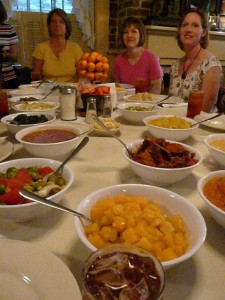
Mrs. Wilkes Dining Room: Table and Tourists

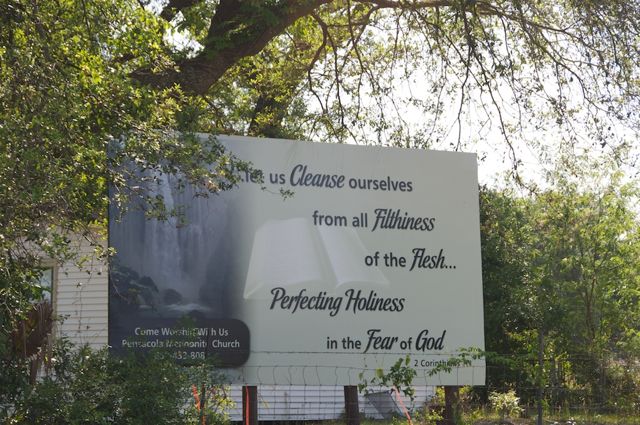
I know everyone raves about it and the food was tasty (and cheap for what you get at $16) but I’m not sure it’s the apotheosis of Southern cooking everyone says it is.  It was educational, a comprehensive layout of all those dishes you’ve read about, and it was an easy and fairly painless way to try them all in one sitting.  Might just be some anticipointment, or maybe just another little discovery tainted by success.  I would also have appreciated knowing up front that they are a Christian organization, and they force a grace in Jesus’ name on you before the meal–that soured things for me a bit, but with the high saturation level of evangelical Christian culture we observed throughout the South it shouldn’t have surprised me. I was tempted to say the Shehechiyanu in response but couldn’t remember all the words, so I just ate my collard greens in Jesus name like everyone else (though Samuel says he silently invoked the FSM as his spiritual antidote.)

You're Going To Hell, Y'all

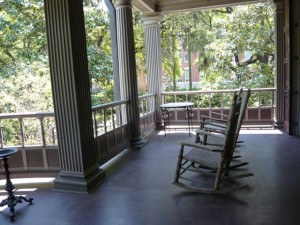
Speaking of swearing to God, we also visited the Juliette Gordon Low birthplace; “Daisy” Low was the founder of the Girl Scouts, who vow at every meeting “to serve God and [their] country” as well as to be helpful, kind, and sell cookies for the cause.  The birthplace is regarded as Mecca for Scouts to this day–registered Girl Sprouts can buy a special Birthplace Badge if  they actually go there, and a Friendship Badge if they couldn’t make it.  Still has many of the original furnishings from the mid- to late 1800s, well-preserved.  Fun to see if you like that period in history, and her story confirms once again that It’s Good To Be Rich.

Southern Comfort--Daisy Low House Verandah

There are dozens of other old homes that are open for tours, and if you’re into antiques and antebellum design Savannah will be a treasure trove.  You can also visit the Mercer House, location of the murder depicted in “Midnight in the Garden of Good and Evil.”  Read the book first before you go–we hadn’t, and they won’t talk about it on the tour.

Returned the rental car and caught the train to Philly.  Strange to be in a warm clime and then one train ride later be in the cold/dark/wet.  More on “Sleepless in Philadelphia” soon…..

Two Non-Day Non-Postcards

We’re sitting in a Wegman’s grocery store café in Buffalo, waiting for midnight to roll around so we can board our next train.

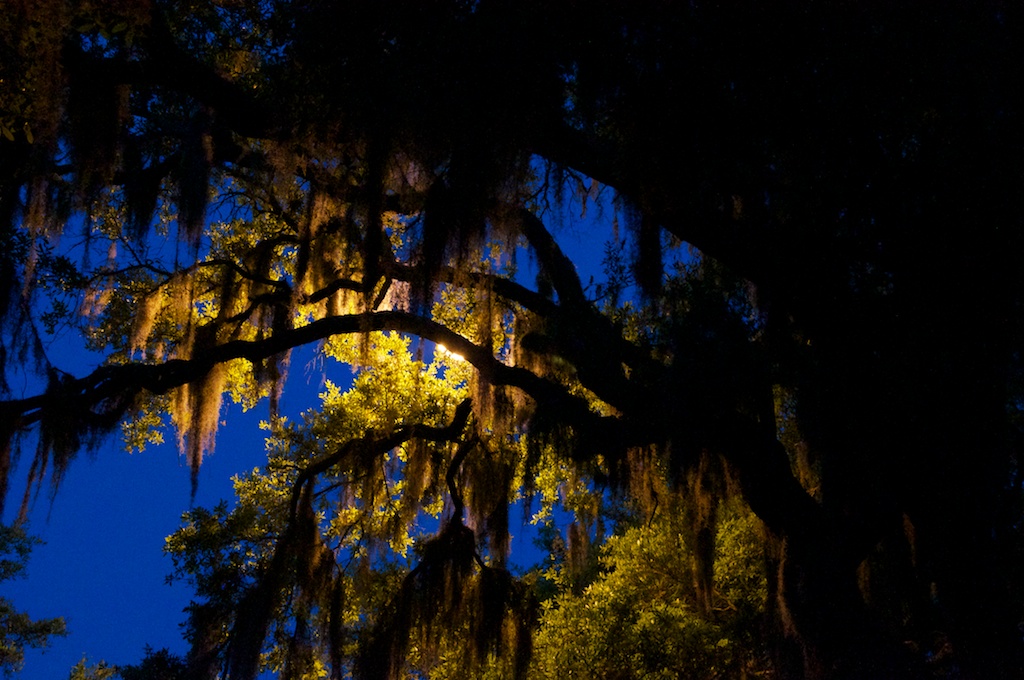
In honor of that late hour, I thought I’d post two non-postcards.

Savannah at Night

Savannah Oak

Niagara Falls

Niagara Falls

A Streetcar Named WTF?!?

So after our day of New Orleans bus tours, we decided to hop the streetcars down to the Garden District–the neighborhood of historic mansions–and City Park, home of the New Orleans Sculpture and Botanical Gardens, an art museum, Storyland (amusements for kids), and other features. We really needed a wandery day after so much bus time and Hurricane Katrina bad news the day before.

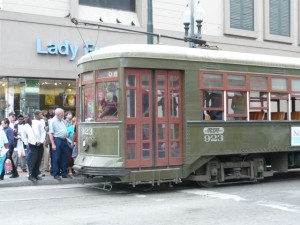
Streetcar Without A Name, New Orleans

New Orleans streetcars run on an overhead electrical pole system and are rumbling, clanking things that sputter and vibrate along their tracks. They are a little bone-jarring, so you can understand how Blanche DuBois arrived in NOLA so discombulated after her journey on the Canal Street line (the streetcars themselves no longer have names like “Desire,” but the route Blanche took to arrive at Stanley and Stella’s house still runs.)

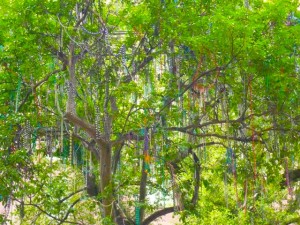
Bead Tree, New Orleans Garden District

We hopped a streetcar to the Garden District in the morning and strolled around taking lots of bad photos of the “bead trees” (almost impossible to shoot well due to the hazy morning light and the tree/bead visual muddle.) We were told if we rode that same streetcar to the end of the line we’d end up at City Park, so we continued on our way but were surprised to end up in Carrollton, nowhere near City Park. However, if we went all the way back to where we started and took the “Carrollton streetcar” off the Canal Street line we’d then get to City Park, nowhere near the neighborhood of Carrollton we’d already inadvertently visited.  Well awright den.

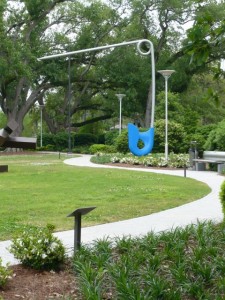
Giant Safety Pin, New Orleans City Park Sculpture Garden

By the time we finally got to City Park, the Botanical Gardens and Sculpture Gardens were closed, but we walked around a bit and took in the air. It was nice to have some decompression time as on our streetcar leg there some goofy negligent kids in love were walking along our streetcar tracks and almost got hit, which greatly upset our driver.

The driver rang and rang the streetcar bell at them to get out of the way, and we all saw the narrow miss. The driver turned around on his seat, a look of anguish on his face, astonished and overwhelmed at how close his car had come to killing them. We’d already seen him get sassed extensively by a woman who hadn’t paid her entire fare (who then gave him even more lip as she left the streetcar.) He had turned to us all after she left and said, “I need a raise.” We all thought it was amusing, but now we all saw how true it was. Clearly streetcar driving in NOLA was a long day abuse and stress.

The driver stopped the car and opened the door, jumping out to chastise those kids for walking on the tracks, to try to make them understand how close they’d come to death, and the boy kid laughed at him, like nothing was the matter. This upset our driver even further–he wasn’t really angry, just so emotional and “WTF?!?!” that a horrific accident had only narrowly been averted–and now this kid was laughing at him with no regard for how such a tragedy would have impacted his life, or any of ours.

The loveydoves scampered off down a side street, hand in hand, an image from a bad Seventies commercial for refreshing minty cigarettes or soda pop or something. The driver closed the door and said to us all in the streetcar, “You laughed when I said I needed a raise….” then sat back down and put the streetcar back into gear.

I felt so awful for him, he was shaking his head and gesturing in frustration for the rest of the ride. I told him when we debarked at the end of the line that even if those stupid kids were too dumb to be grateful to thank him for saving their lives, I appreciated that he had been alert and not killed them since that would have been devastating for every one of us on that streetcar. He seemed sincerely grateful to hear it, and replied that he had to “flush himself” of similar incidents every day after work, and that a cold Heineken usually went a long way helping him do so. His next leg back to town was his last for the day, and you could tell he was grateful for that too.

On the way home from City Park we stopped at Angelo Brocato Ice Cream and Confectionery on North Carrollton Avenue (freakin’ Carrollton again!) but it was well worth the visit–OH MY GOD! See our “Thumbs Up” mini-review on their wares. Great way to spoil your dinner, or to eat dinner anyway like we did.

After our gelato break we freshened up at our B&B (The 1896 O’Malley House–see another “Thumbs Up” mini-review) and got back on the Canal Street streetcar down to the French Quarter for a little dinner and trad jazz, we hoped at Preservation Hall.   It was getting a little dark and we didn’t want to wander too much since the Quarter can get a little seamy at night, but we found a corner cafe that had decent Southern fare (including blackened catfish or “black cat,” a favorite of mine, and crawfish etouffee for Samuel) and then we joined the line for Preservation Hall.

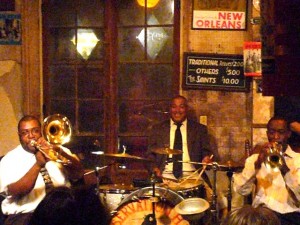
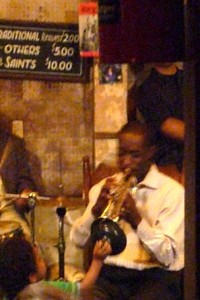
Preservation Hall Jazz Band

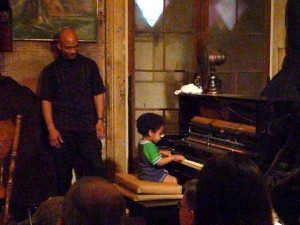
And on piano--Little Deuce!

We were only able to get in for the last set, which was very short but fun to see. The “hall” itself is tiny and decrepit, only 15-20 feet wide max, the walls dinged-up plywood and pegboard, a few pictures of musicians here and there, only a couple benches for seating and some standing room behind. The playing was good, lively, not terribly inspired–it was late and the crowd was all tourists, many Japanese and French (one older French fanguy sat in who wasn’t in tip-top form, if I may say so, but such fanguys are the Hall’s bread and butter.)

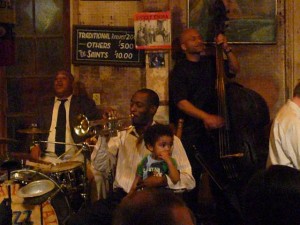
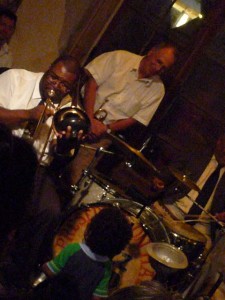
We paid a $10 cover to hear three songs, but the best part of the evening was provided by the newest PresHall musician, a 20-month-old son-of-the-horn-player nicknamed “Little Deuce.” Little Deuce played a piano solo before the official set started, was assisted on drums for “SleepyTime Down South,” and offered some improvisational assistance to both the trombone player and his dad once he observed the plunger being used to mute a ‘bone solo. It was sweet to see how the adult musicians let him play with their instruments even while they were trying to perform, and it was clear that this musical playground was providing the foundation for another generation of Nawlins jazz artists (Little Deuce wasn’t doing bad on that drum solo, either, though he had a little help.)

"Hold That Tiger" became "Hold That Toddler"....

Little Deuce fascinated by the plunger...

....which he then tries to use to mute Dad ....quip about father/son relationships here...

Finally, we decided to gird our loins and run the Bourbon Street gauntlet just to say we did.  As our B&B host told us, “the nasty bars have mostly chased out the jazz bars” and that changeover was clearly in evidence.

A few music joints were wailing, mostly Southern rock–though they seemed to be having a tough time pulling in clients due to competition from the sex joints, their “nasty” offerings displayed out front with photo lightboards that resembled oversized hard-porn Denny’s menus.

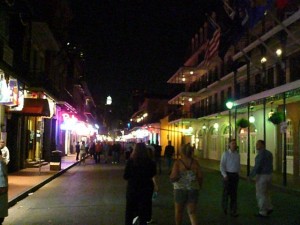
You also had to look sharp to avoid the wide-eyed or near-barfing frat boys who populated much of the street, and there was one Sydney Greenstreet-sized man in a neatly pressed suit and tie who moved a little too smoothly around the crowd for my taste. Maybe I was just too paranoid about grifters and pickpockets or maybe he was a dapper guy just scoping out the porn menus for his brand of action, but he set off my SpideySense so we pushed forward a little faster to get away from him. I only stopped to take this picture of the Bourbon Street neon, so you don’t ever have to.

Bourbon Street, New Orleans

We caught the last streetcar back up Canal Street to our B&B to pack up, prepping to rent a car early and drive the next sector of our trip on Wednesday before continuing to Savannah, GA. Our goal: to cross four Southern states in less than a day and make it to Jacksonville, FL before nightfall, but we got distracted from our stated mission by a little archeological site noted on the Florida State Tourist Board Hospitality Map.  I’ll cover that in the next Rudolph/Rails post, so stay tuned!