Before departing on this journey, I was filled with excitement (yes, and trepidation) by the transportation aspect: what would it be like to travel around the country on Amtrak trains? After all, I’ve traveled on trains throughout Britain and Europe, as well as in India, Thailand, Malaysia, and Japan, and the experience varied dramatically. Train travel can be a futuristic, hi-tech experience (like the Shinkansen in Japan), an interminable, disgusting, crowded, and smoky experience (like a train I once took from Vienna to Beograd), or pretty much anything in between.
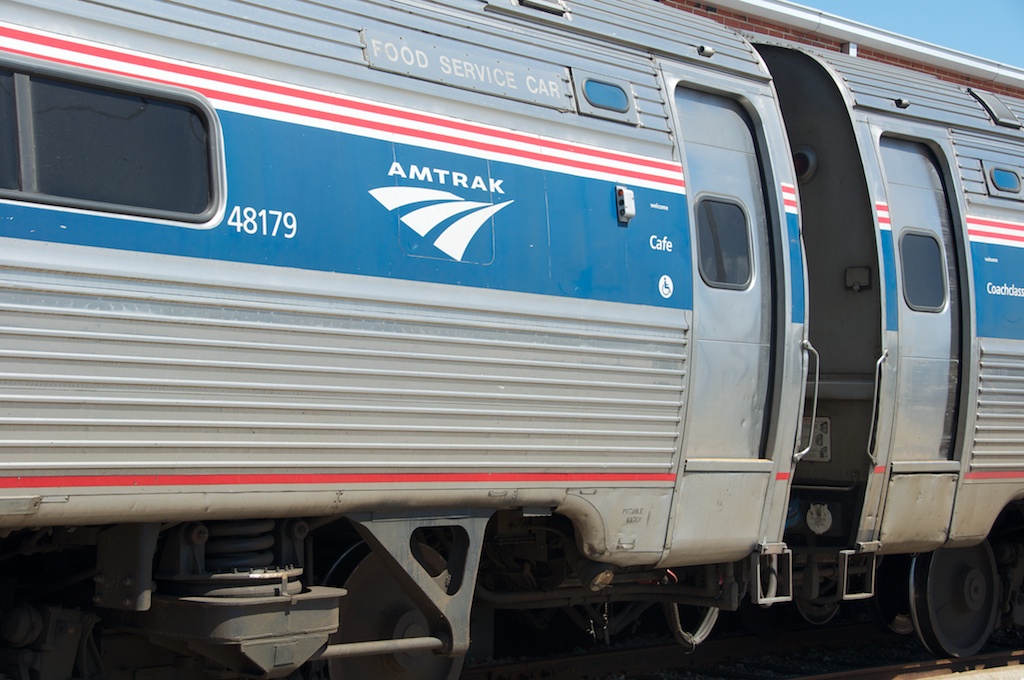
Amtrak Cafe Car
Still, I didn’t know exactly what to expect on this journey. Elizabeth and I had taken a short Amtrak trek up to San Luis Obispo about ten years ago, and enjoyed it, but that was a few hours, while on this trip we’d be spending days on the train. Would we suffer from cabin-fever? Would we get to our first stop in San Antonio, and start the search a divorce lawyer? Or would it be a romantic adventure?
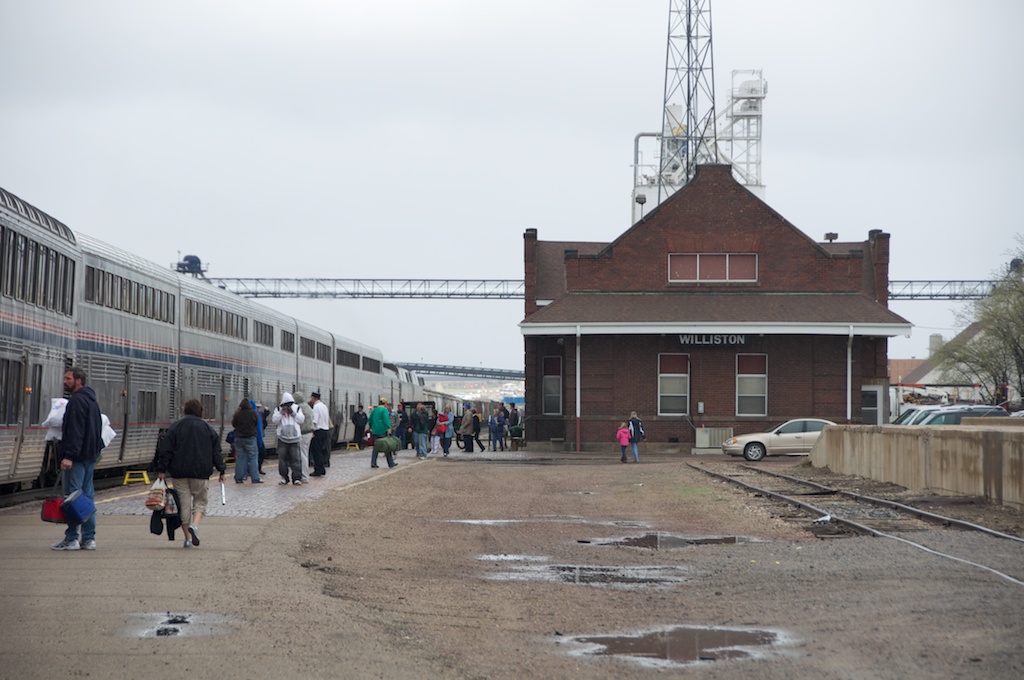
Station Stop, North Dakota
If you’ve been reading this blog, you know the answers to those questions.
We found that traveling by Amtrak is, in many ways, a more civilized means of transportation. You don’t have to go through the abuse that you would at the airport. They dispense with the security theater. As one car attendant said to me “terrorists would have a hard time hijacking a train and crashing it into the World Trade Center”.
Train trips have always been a good source for stories. I think this is a natural outgrowth of the social aspect of trains; somehow, and I don’t really understand how, trains invite social interaction in a much more profound way than airplanes do. I’ve been on many transcontinental flights where I haven’t exchanged more than “excuse me” to any of the people sitting in my row. I don’t think I’ve ever been on a train where I haven’t had at least a short conversation — and often much more than that. I’ve been lectured on the moral imperatives of marriage and personal hygiene by an Indian businessman en route to Agra, and gotten drunk with soldiers on a Thai train. I’ve had strange, laughter-punctuated pidgin communications with people where we shared no language other than hand gestures and simple drawings. I’ve talked tech, compared cell phones, and traded snacks or paperbacks with people on trains. I’ve heard life stories, business tales, political views, and ghost stories.
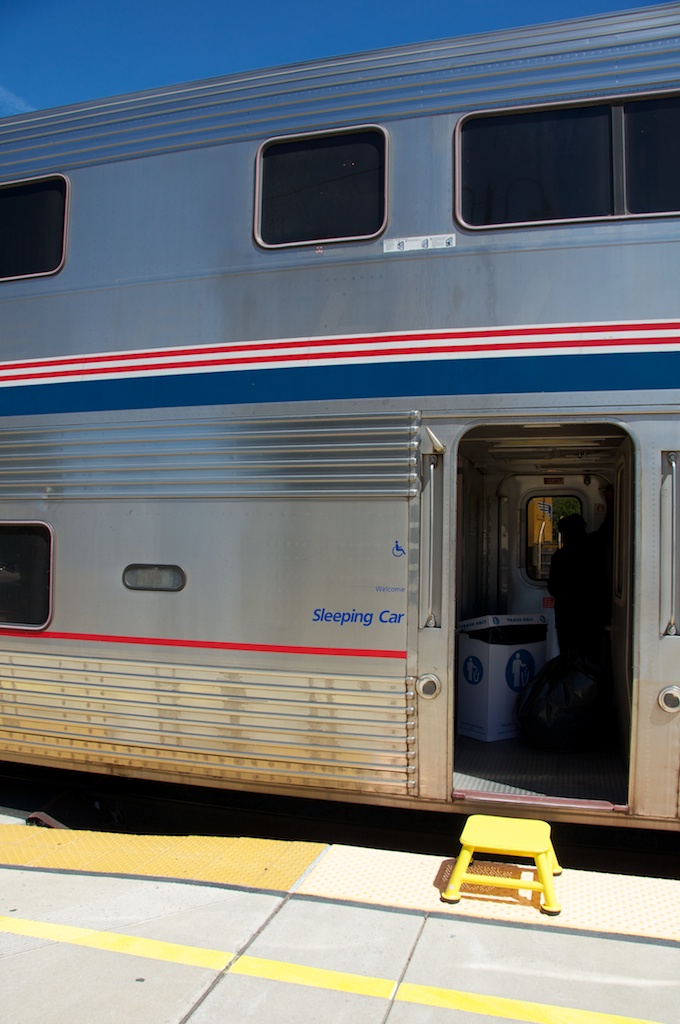
Amtrak Sleeper
On Amtrak, you meet other people in the passageway, possibly in the lounge car, and always if you eat in the dining car. You may get bounced into them as you walk by in the coach car. You find yourself having a lot of conversations.
The slower pace of transport also seems to result in more natural conversation with train employees. There’s not a focus-tested greeting or script for each interaction. Conductors will tell you something about the upcoming station, or talk about the weather. Sleeping car attendants will talk about the circus train that they saw the previous day.
Just as trains are more social than airplanes, they also occupy an interesting place in our national psyche. People love trains. We attach a mystique to them in a way that we do with few other modes of transportation. Some of this is clearly historical: just as we now find horse-drawn hansoms and hackneys romantic, we think of trains as quaint. But there’s more to it than that. People wave to passing trains — all kinds of people, not just children. As we were pulling out through eastern Los Angeles County, we saw a construction worker pause from his labor to wave at us as we went by.
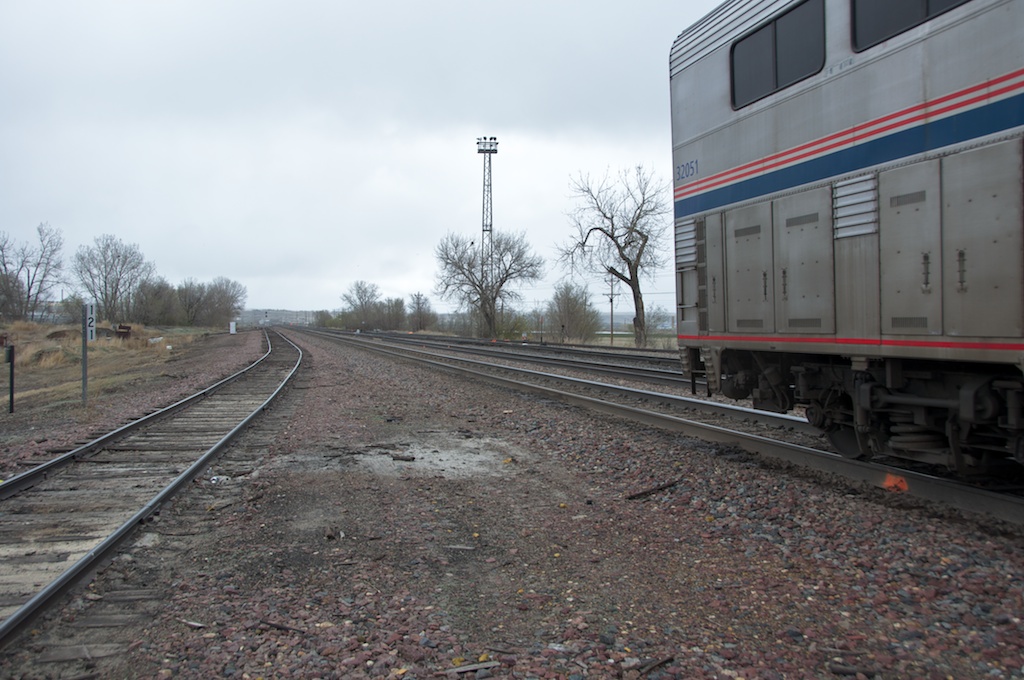
Station Stop, Montana
But what of the nitty gritty details of Amtrak travel? Here’s where there’s both good and bad.
The Ride
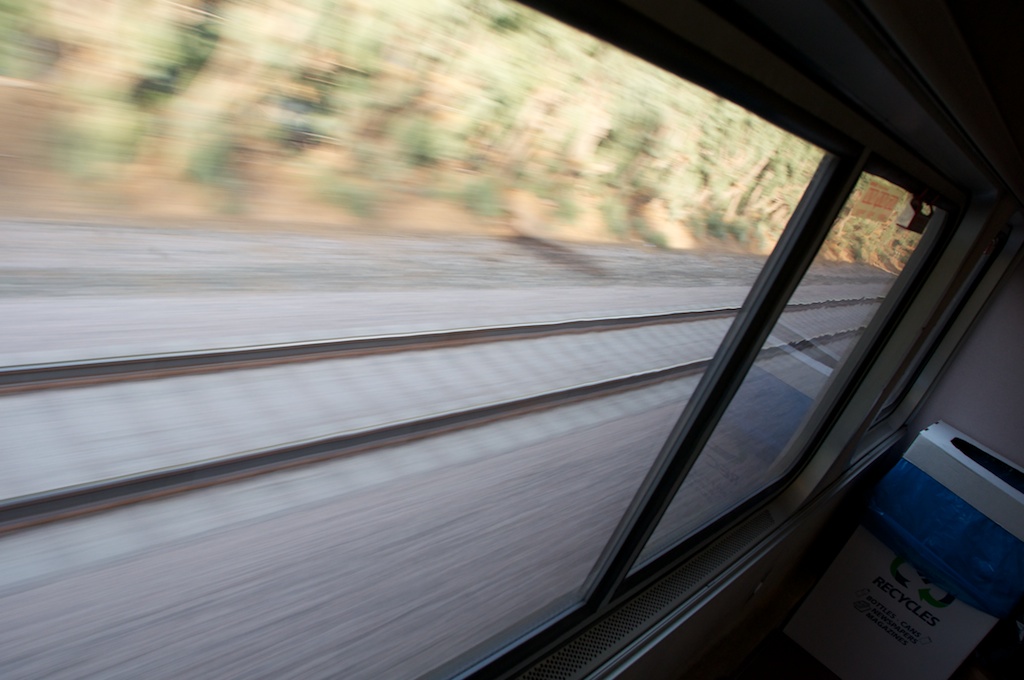
Unlike trains in, say, Japan, there is a lot of physical motion on an Amtrak train. There is side-to-side motion when the train is switching spurs or going over crossings, there is leaning when going around curves or on certain stretches of track, and there is back-and-forth jerking. As far as I know, most of the rails in the United States are still bolted segments rather than the welded track used in western Europe and Japan. This contributes to the roughness of the ride (although, to be fair, there are reported to be as many miles of rail in California alone as there are in Japan).
Depending on which route you’re on, the ride may be anywhere from “mostly smooth” to “roller coaster.” Presumably, this has a lot to do with the quality of the track and the speed at which the train moves. We found that the smoothest route was the Coast Starlight route along the West Coast.
Track
Business Class versus Sleeper versus Coach
On routes that don’t go overnight, trains are generally divided into coach and business class coach. There are evidently also “quiet cars” where conversation, cell phone usage, and probably children are prohibited. We only did a few of these shorter routes, and always in ordinary coach class, so there’s not much I can say about it.
For overnight routes, sleeper cars effectively become the business class. Sleeper passengers have their dining car meals included in their fare, and are given priority treatment. You can opt for a full room (which we did not do) or a “roomette,” which is a mini compartment that has two facing seats that transform into an upper and lower bunk. There are nice touches like bottled water waiting for you in the roomette, coffee and juices available at the end of the car, and, on some of the long-haul routes, a welcoming mini-bottle of champagne or cider.
Sleeper cars have communal restroom and shower facilities. Some sleeper cars have their own, in-roomette toilet and sink, which doubles as the step to the upper bunk. As there is no separation at all in the roomette, using these facilities is contingent upon you being on very intimate terms with your travel companion. They’re also contingent upon you having good balance when over rough track.
Coach cars have rows of seats that are like more comfortable airplane seats and with better leg-room. They often have fold-out footrests, which people try to use as makeshift beds on overnight routes. When the train was not especially full, it appeared that people had reasonable success sleeping by curling up and using two neighboring seats.
Unlike the roomette compartments, which have their own doors and curtains to isolate them from the rest of the train, the coach car has no means of shutting off noise, light, or odors between neighbors.
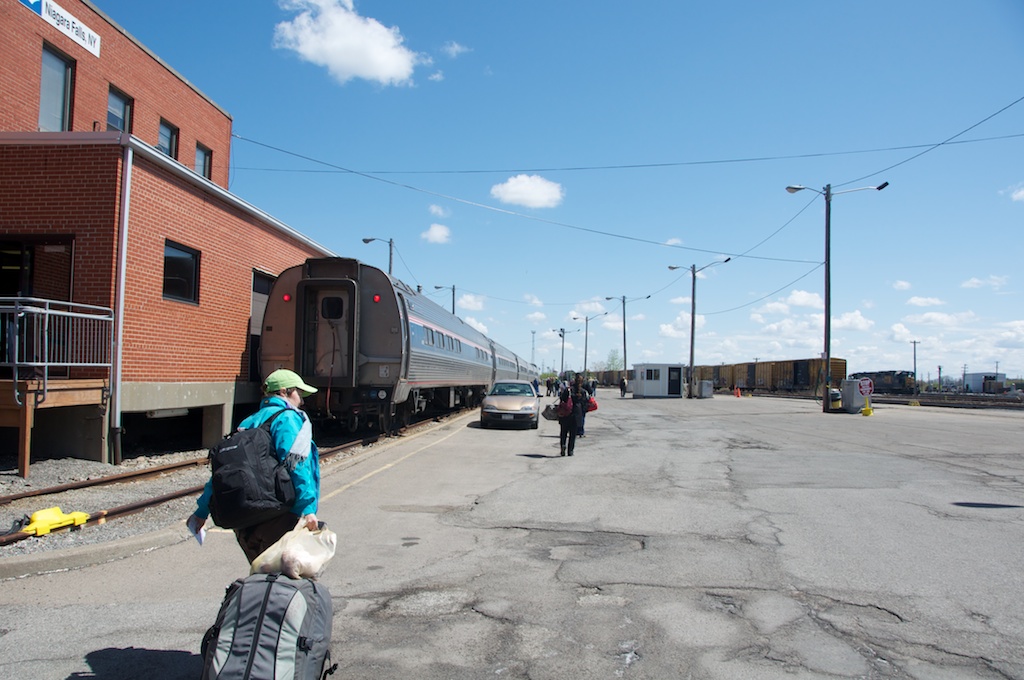
All Aboard
Sleeping
We never tried sleeping except in a roomette on a sleeper car. The fact is you can sleep on the train, but you may not sleep well.
The problem with sleeping is less the motion of the train (although on particularly jerky routes, it may be a factor), but is more to do with the maintenance of the cars themselves. It’s clear that Amtrak tries to keep things in good order, but the cars are heavily used, and many of them are old. As a result, there’s a lot of irregular ambient noise, primarily squeaking and clanking. There’s also squeals of wheels on some curves, the sound of the train whistle (depending on how close to the locomotive you are, and how many roads cross the tracks), and light, noise, and hubbub from station stops. In some cars, the curtains no longer close very tightly, so light leaks in. In other cars, the door latches are broken or worn, so the compartment door thumps around from the motion of the train. And in some cars, the heating/air conditioning is temperamental.
Of course, sleeping is obviously affected by the quantity of wine or coffee consumed in the lounge or dining car.
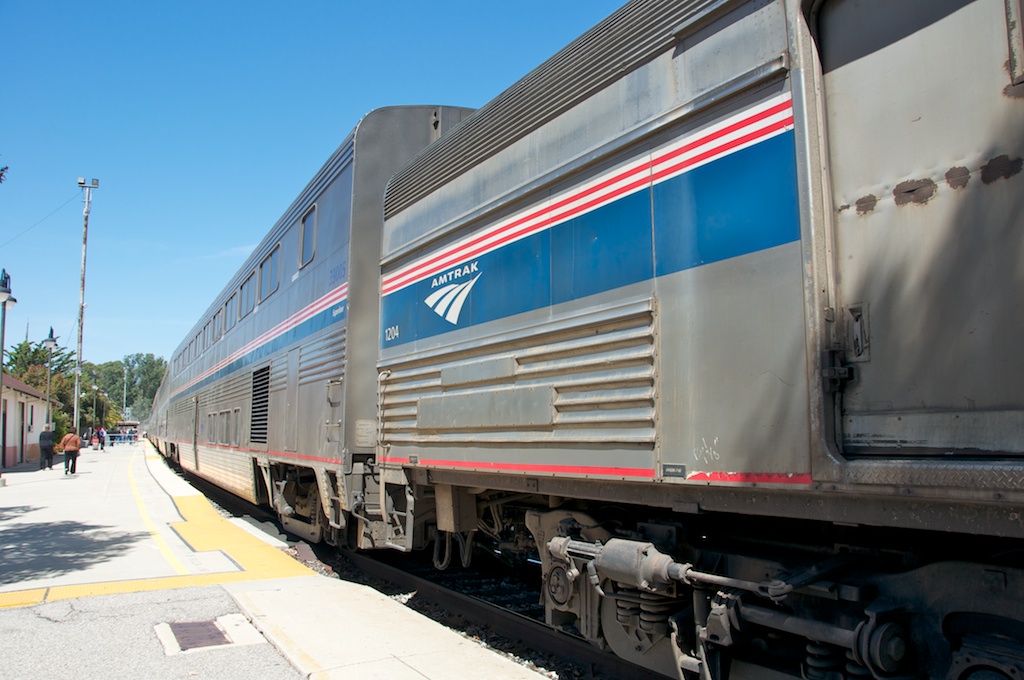
Train
Food
With the sleeper car ticket, meals are free (except for alcohol). You make your lunch and dinner reservations with the attendant who walks through the train; sleeper passengers get priority over coach passengers for making reservations, but you may end up at a table with people from either group.
The dining car has tables with cloth tablecloths and vases with fresh flowers. You get real silverware. On some routes, you get real plates and cups too.
The menu is not exactly the same across all routes, but by and large there is a similar pattern. Breakfasts are eggs, potatoes, toast, and meat or an omelet or famous “railroad french toast” or a continental. Lunch is some hot sandwich, a hamburger, a veggie burger, or sometimes a salad. Dinner is a vegetarian pasta, roasted chicken, some kind of fish or seafood, or some kind of steak. Dinners come with salad and a roll and have an option for dessert (typically cheesecake, brownie, or ice cream). For most meals, there is a daily special as well. You can get a lot more specific detail on the Amtrak site.
Food is institutional, but it’s definitely better than the average airplane meal. Quantities are generous. It’s not gourmet, but it was certainly good enough. In my experience, the less exotic things were the best: the steak was pretty good.
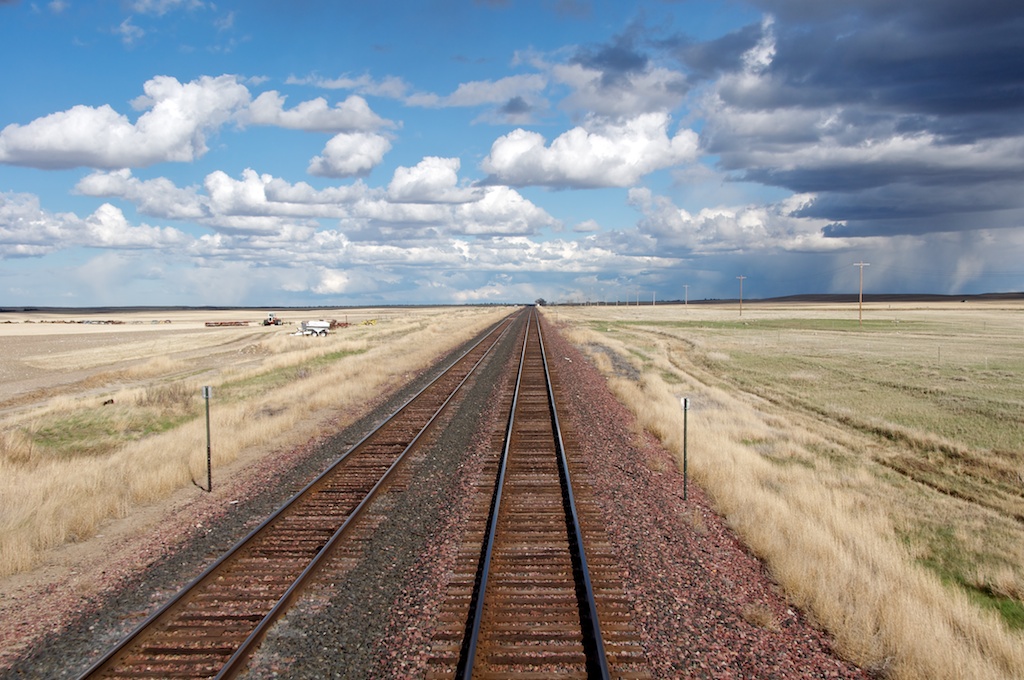
Track
Miscellaneous
As mentioned in other posts, traveling by train exposes you to parts of the country that you wouldn’t see otherwise. It takes you through spectacular scenery, and it takes you through the uglier side of town. I don’t think that there’s any other way of getting an impression of so much of the country in so short a time.
Photography from a train can be frustrating — the windows are not especially clear, there’s a lot of reflection, and you’re often moving too fast to get The Shot.
Amtrak has some nice extras like wine and cheese tastings in the lounge car on the longer routes (Empire Builder from Chicago to Portland/Seattle, Coast Starlight from Seattle to Los Angeles). Elizabeth won a bottle of Pinot Grigio in the trivia contest, too!
I think Elizabeth summarizes it well when she points out that Amtrak has something of an identity crisis. Is Amtrak’s aim to serve tourists and rail aficionados, or is Amtrak a Greyhound bus on rails? There’s definitely an effort to make for a high-quality tourist experience: the routes go to tourist destinations (like Glacier National Park and the Grand Canyon), some routes have guides describing the places you pass through, and the services seem to be designed to cater to tourists. On the other hand, some trains are clearly commuter trains. To some extent, this is an East Coast / West Coast split, with the western trains being more oriented towards tourists and the eastern trains more for moving people efficiently, but it’s not that simple either (for example, the Florida/New York auto-train is definitely for snowbirds).
Amtrak’s fortunes follow politics. One car attendant told me that the Bush administration considered Amtrak an unnecessary expense (effectively subsidizing rail buffs), while the Obama administration sees Amtrak as part of an overall national rail infrastructure which will be increasingly important. Regardless of the reasons, Bush proposed cuts for Amtrak’s budget, while Obama has increased it. Amtrak is not profitable, and the consistent operating losses may be one reason for the continued non-operation of the New Orleans to Jacksonville segment.
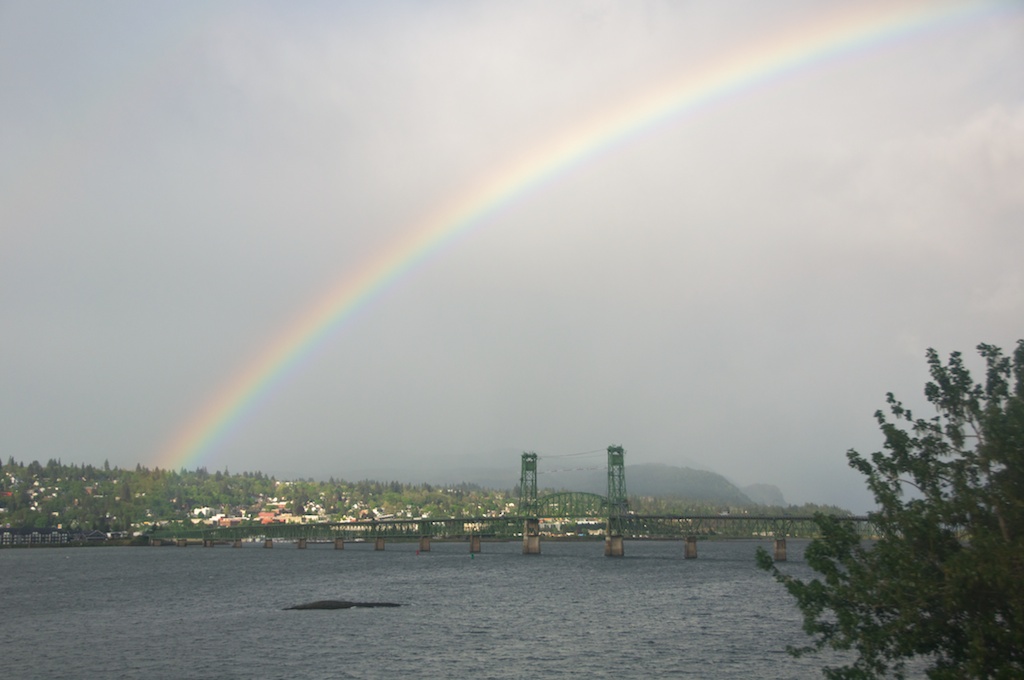
Columbia River Bridge
Bottom Line: Would We Do It Again?
Yes.
We’re already mulling around ideas of a Pacific Northwest journey for some future Summer. We’ll keep you posted!