The Final Summary: Please Wave At Trains, and Other Travel Advice

I like that people wave at trains–not just kids do it, but lots of grown-ups too.  Right after we departed Los Angeles on our first day, a few miles out from Union Station, a construction guy climbing on a cement freeway pylon turned from his work and waved to us.  It made us feel good, and seemingly him too.  It was a sweet thing to do for people who were just passing by.

Waving at trains is a gesture of camaraderie and support, a momentary ticker-tape parade saying “Hooray for Adventure!”  There’s something very companionable about it: a welcome to the community (no matter how quickly the visitor may rumble through) and an expression of good wishes for their journey.  How often do we take a sec to say, “Hello, and best of luck!” to a perfect stranger?  Waving at trains is a way to high-five as we roll along our merry way to the future, whatever it may be.

I encourage you to wave at trains, to take a moment to signal your approval to the lonely traveler.  And who knows? That traveler may stop and become your neighbor–a wave may become a handshake, or something more.

If nothing else, waving at a train is a benediction, a gift; glimpse the lives passing by and raise your hand in peace and solidarity with them.  Life is short and full of trouble, so why not offer as many people as you can this brief blessing as they go by?  It costs nothing, and to quote Langston Hughes (painted on our room wall at McMenamin’s) “dig and be dug in return.”  So bless, and be blessed, as you go on your way.
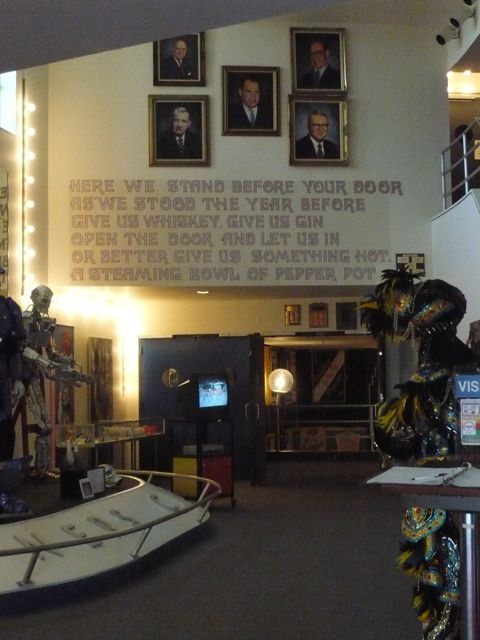
Mummers Museum, Philadelphia PA

DOS AND DONTS FOR TRAIN TREKKING ACROSS THE USA

I’ve made a list of things to keep in mind should you want to take a train trip of your own.  Feel free to drop a line if you have questions….

DO assess what kind of weather, events, and level of population density you like before you block out time and make your plans.  We thoroughly enjoyed empty towns in the cold weather of April, even if we missed a few cool attractions that weren’t open for high season yet.  We dug the rough weather and came prepared for it, but if you’re a “Spring Break in Fort Lauderdale” type, the cold, rain, and snow we deliberately encountered might be your nightmare.

If you’re going to want to be in the heat and the thick of offerings like Mardi Gras, Riverwalk, and The Dells, find out when big events are happening and plan around them.  Bear in mind that the North stays cold longer than the South, so their events and attractions don’t get rolling until June.  Obviously you won’t be the only one who enjoys summer fun, so book well in advance (and take sunscreen.)

DON’T try to book your Amtrak schedule online!!!   The interface is a malinformative, frustrating mess.  Call the Amtrak phone reps (and call back, if you get someone inexperienced) to make your reservations and purchases by phone.  It’s the least agonizing way but still won’t be easy.  You have to book EACH PERSON’S TRAVEL SEPARATELY! even if it’s the same itinerary.  Moronic, yes, but what it is.  Be patient and eventually you’ll get ‘er done.

DO stay at inns, B&Bs, and mom ‘n’ pop joints instead of big hotels if you want the full-on American immersion experience.  TripAdvisor.com is useful in figuring out the locations and amenities, though be prepared to spend substantial time researching and emailing.

If you prefer to be far from the madding crowd rather than part of it, you might want to make reservations at the larger, more impersonal hotels (or just have your travel agent do it for you if you don’t have time to investigate other options.)

DON’T expect a luxury experience with Amtrak.  It’s not an elegant way to travel–in fact, in some ways the opposite, kinda downmarket, and the bathrooms get kind of gross on the second day of a segment.  Trains aren’t a good choice if you’re a germphobe.

However, if immersion is what you’re looking for, you’ll get it–both in the landscape of our country and the people that live there.  You’ll see the poor side of town from your train window, and you will have to socialize with other train passengers during meals unless you invest in a roomette and order your meals “to go” from the dining car (which you can do, and your attendant can even deliver them on request.)

If you dream of the luxurious days of wood-paneled railroad cars with buckets of champagne and caviar inside, skip Amtrak entirely and contact one of the private railcar associations: http://www.aaprco.com/ or http://www.rpca.com/, or search for one of the many historical train enthusiast societies.  You may be able to hitch a ride on an antique traincar or even charter one for yourself; otherwise, you’ll have to content yourself with a copy of your favorite train porn, be it “Murder on the Orient Express” or “On The Twentieth Century,” while squirreled away in a corner on the Amtrak train.

DO bring “train shoes,” i.e. slip-ons with rubber soles.  Amtrak requires that you wear rubber-bottomed shoes while walking around the train, but it’s likely during a long segment you’ll want to get out of your street shoes into something more comfortable.  Train shoes let you walk to the restroom or cafe car without having to lace up the boots again; I bought some slippers at a CVS in New Orleans that worked just fine as an alternative to my high-tops.

DO bring healthy snacks and think about alternate meals if you’re not into eating the way America eats: that is, high-fat, high-salt, high-sugar cafeteria-style food.  That’s what Amtrak will give you three times a day–it’s included in your fare if have a roomette or suite–and on long segments it’s hard not to eat the stuff just out of boredom.  Plan ahead if you have special dietary needs, because Amtrak can’t accommodate much deviation from the pre-processed microwaved meals it serves.

DON’T pack your schedule.  Give yourself ample time to arrive and settle in at each destination, and take a few hours to wander around in your surroundings.  Some of the best stuff we saw was off the beaten path and FREE (like the Forevertron.)  In most towns we enjoyed hanging out just having coffee and people-watching–well, if it was good coffee, like in New Orleans or Portland–much more than we enjoyed some of the much-vaunted “must-see” tourist rip-off sites.

DO invest in good wireless technology if you need bandwidth, or leave the gadgets at home if you can get by with intermittent stops at internet cafes at your destination.   Our cellular USB modem thingy by BroadbandToGo worked great on the train when there was cell network available outside, but there was NO connection in most of Texas, Alabama, Mississippi, North Dakota, Montana, or while traversing mountain ranges or expansive nature preserves.  Amtrak doesn’t offer wireless, sorry–and the way their budget is, they won’t be anytime soon.  Amtrak roomettes do have an AC plug though, so at least you can charge your phone or laptop while you’re traveling.

BTW, general travel note: we found out a lot of the smaller hotels/inns that offer free wireless as part of their amenities also block Port 25 so you can’t retrieve email (and they often will have no clue what you’re talking about if you mention it.)  Fortunately I brought my tech support with me and he was able to tunnel into my email account when the need got urgent, but don’t expect to be so lucky if you need email access while you’re out of town.

DO bring all necessary drugs, even over-the-counter ones, since you may not be able to go purchase them when you need them (Amtrak’s cafe car has aspirin and Pepto Bismol for sale, but that’s about it.)  Be sure to stock up on girl-meds and allergy reducers, and also your chosen caffeine.  You get spoiled here in L.A. when it comes to joe (and super-spoiled in New Orleans and Portland if you like wicked dark and gritty high-octane coffee like I do.)  Be forewarned you’ll get paltry, headache-inducing coffee on the train as well as most train stations, small towns, and all of Texas.  Pack your own brewsticks if good java is important to your well-being; sleeper cars have hot water available (though don’t expect ceramic cups anywhere onboard except the Coast Starlight line.)

And smokers beware: Amtrak trains are smokefree, and you can only smoke on SOME station stops, normally only once or twice a day.  Nonsmokers beware too: if you step off the train to get a breath of fresh air during a stop, you’ll get a dose of second-hand smoke instead.  You’ll have to breathe when you get to your destination, so be sure you plan accordingly if you like clean, pure O2.

DO tip your porter–excuse me, railcar attendant–and dining car servers. Though don’t ask us how much….this came to us as a bit of a surprise and we probably way overtipped because that’s how we roll.  At least I hope we did.  We didn’t get negative feedback about it, anyway.

The attendants vary in how attentive they are; they will help you stow your luggage when you get onboard and normally convert your roomette into nighttime bunks, and will get you meals or water if you ask.  Some travelers tip when they first meet the attendant (I guess to assure prompt service) and some when they deboard.  Your call.

So enjoy your journey along with your vacation, and here’s the entire “Motto” by Langston Hughes, thanks again to the artists at McMenamin’s:

I play it cool
And dig all jive
That’s the reason
I stay alive.

My motto,
As I live and learn,
is:
Dig And Be Dug
In Return.”


Great advice for living both on and off the rails, don’t you think?
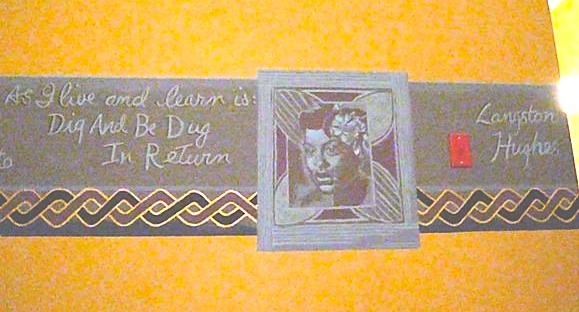
"Motto" @ McMenamin's

Safe travels, y’all….and don’t forget to wave.

Elizabeth Oakes

May 9th 2010, Los Angeles, CA

PS Love and props to Samuel, who planned this trip and without whom it would have been a meaningless morass of miles.  xoxxo <3
Portland Envy; Cascading Home

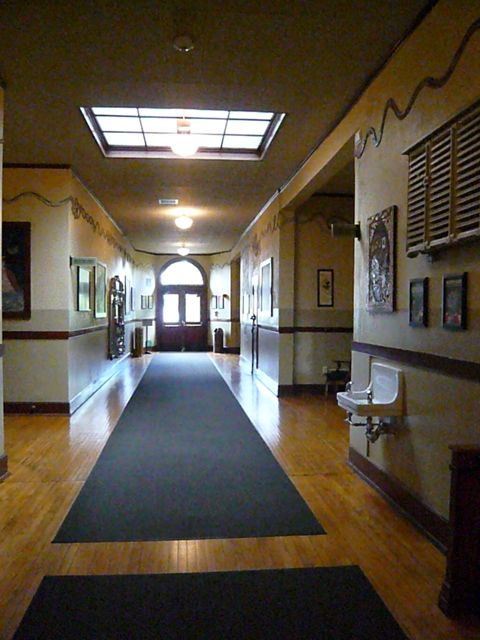
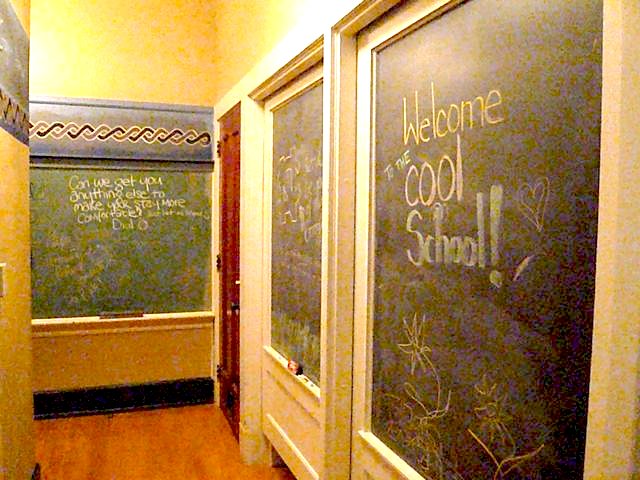
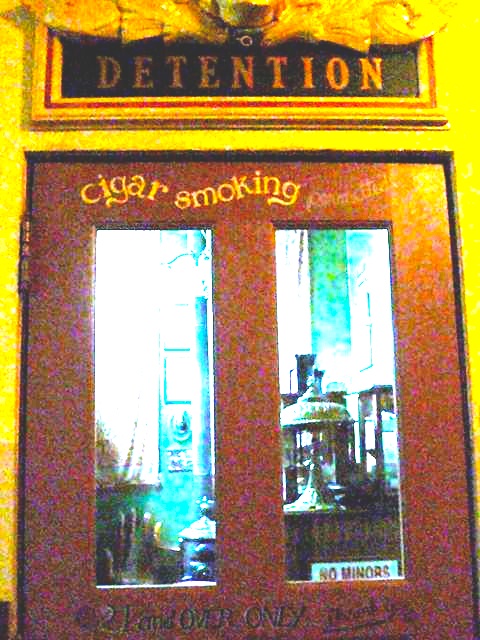
We stayed at one of the many McMenamin’s inns in the Portland/Greater Oregon area; these crazy brothers have made a mint buying historic buildings all over the Northwest (like the Kennedy Elementary School where we stayed, or Masonic lodges or movie theatres or castles) and repurposing them into event/traveler complexes with microbrew pubs, movie theatres, live music, cafes, hotel rooms, and all sorts of artistically arrayed nooks and crannies.  The vibe is casual and social; the rooms are artful and fun–our “classroom” entry hall was lined with chalkboards upon which the staff had scrawled hotel messages and doodles.  Not luxuriously appointed (shower was a plastic cubicle, no TV so you go and socialize at one of the minimicropubs) but quirky and comfy.  There were six micropubs at the Kennedy school, a couple of which only seated five or six people each, my favorite being the converted principal’s office where one could go for “Detention”:

Detention Micropub at McMenamin's: Where the Bad Kids Go

McMenamin's Kennedy School, South Hallway

Entry to our room @ McMenamin's Kennedy School Inn

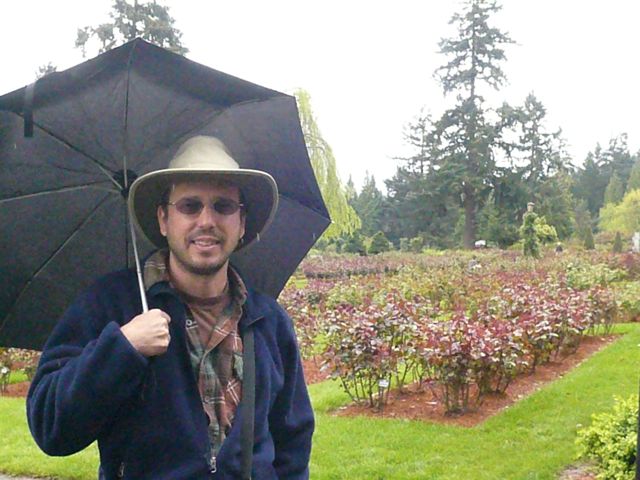
We had resolved to take it a little easy and not run around too much.  After some consternation we figured out Portland’s intricate but comprehensive bus/train/trolley system and made a pilgrimage to Powell’s Books, then to the huge Washington Park, home of the International Rose Test Garden where they were testing almost exclusively closed rosebuds at the moment….that is to say, we were a little early for the annual blossom explosion, but we knew we might be.

International Rose Test Garden, Portland OR

It’s a huge and beautiful city park and we could have easily spent the day there despite the non-performing roses, but we had a coffee date with an old friend who had moved up to Portland six years ago.  It was a great convo–he loves it up there, as do I…I am always filled with regret when I have to leave the Northwest.  We have many friends who feel the same way, who would move up to Oregon or Washington in a heartbeat if they could find a way to make a living there.  Portland is a wonderful, livable city, but it’s a comparatively small city (why it remains livable, you see) and not the economic engine most of us require to pay the bills.  Ah well.  It’s nice to know it’s there, waiting for us, when we finally retire to wear flannel and write novels while drinking thick black coffee while the dousing rain batters the rhododendrons outside.  Sigh.

The next morning, after one last breakfast and deep draught of McMenamin’s French press coffee–dark and gritty as mud and full of motivating caffeine–we boarded the train for home, the renowned Coast Starlight (where your coffee and wine are served in real glasses and mugs!)  From Portland it would be an overnighter to L.A. through the Cascades and into California’s Central Valley to home.

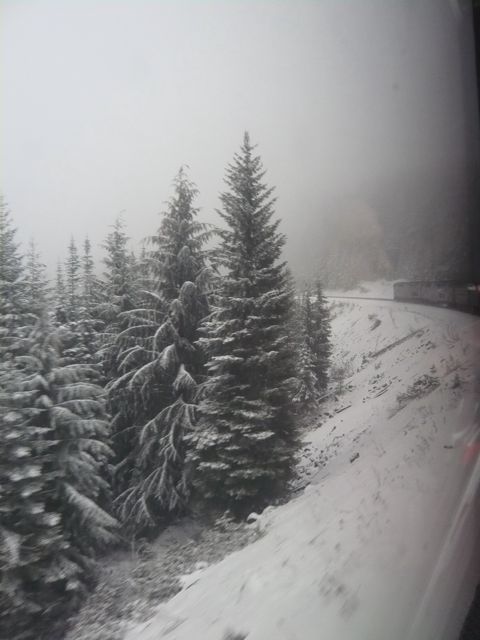
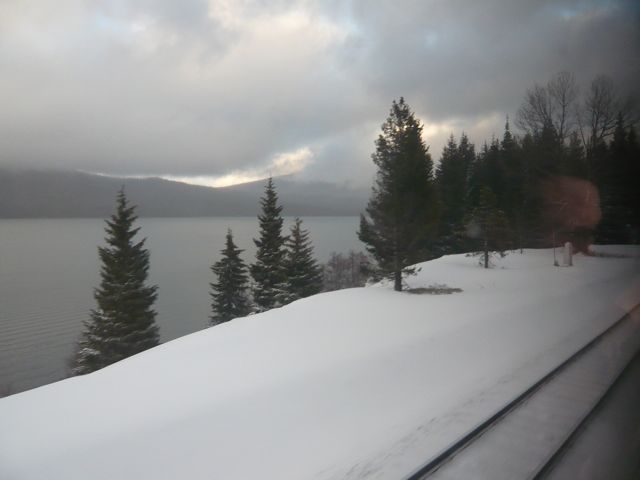
And it was splendid, real ceramic mugs notwithstanding.  The Cascades were rugged and as we ventured higher in altitude the world went all Christmas, white-out snow along the tracks, caught in the arms of the sharply-etched trees.

Our train chugging through a Cinco de Mayo snowstorm high in the Cascades

Klamath Lake, from the window of the Coast Starlight

I had been hoping to have some wireless connectivity during this last leg of our journey since I had articles to post, but thankfully there was none through these majestic mountains.  Samuel and I huddled together and enjoyed the view (when we weren’t trying to frantically photo the otherworldly snow tableaux that emerged at every turn of the tracks.)

There was a snowy sunset, and we slept.

Coming home through California the next day was a bit of a downer, the journey drawing to an end and the realization that a frantic Re-Entry Mambo would start as soon as we got home from the station.  There was haze in the air, starting pretty much in Northern California, and the sprawl began spreading into the horizon as we drew further south.  I had pretty good connectivity though (except through Vandenberg Air Force Base, where they nix that) and got some work done–my way of being in denial that Playtime Was Over.

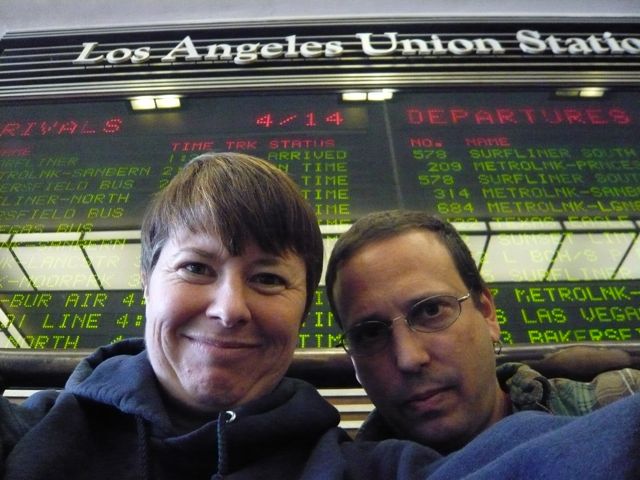
When we got to Union Station, we detrained and were met (surprise!) by Samuel’s parents, whom we didn’t know were planning to pick us up.  We had already made arrangements with another friend for transport, so we all hung out in the loading zone and tried to acclimate to the L.A. high-blood-pressure pace once again.

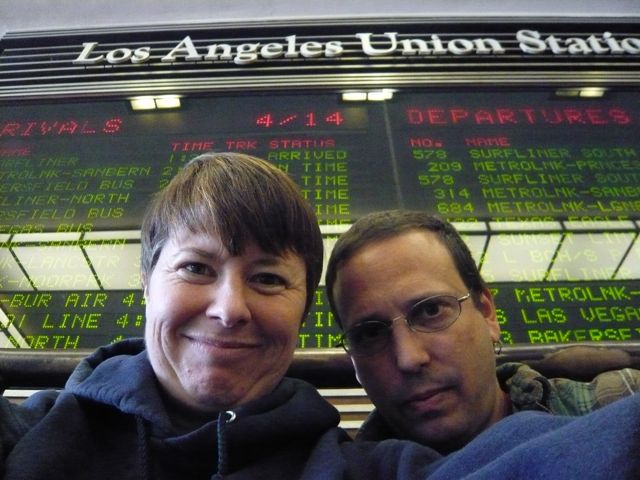
Oddly, some production company was shooting a TV thang in Union Station when we arrived and they had changed the signs to say, “Le Havre, France.”  Would that it were so and the journey were starting anew! except there was like, a mime in a beret.

(…..guess….I’ll….be…..heading…..home…..then…… Run away, run away!!)

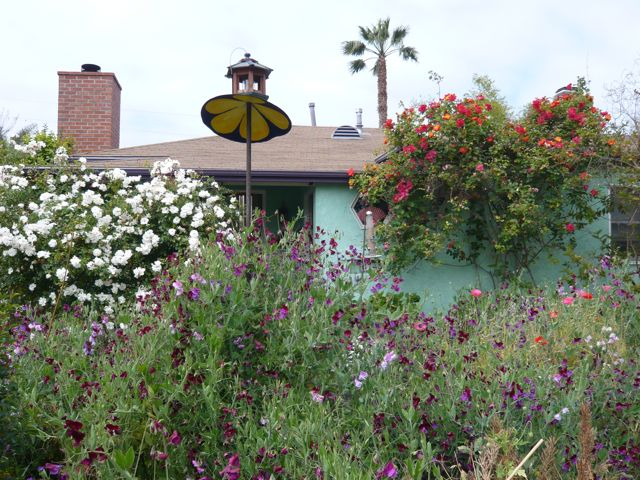
So we got to the house about 10 p.m. and it was bit of a shock–all was well, no house fire this time–and the sweet peas and poppies and roses and grape vines were so overgrown we could hardly see the front of the house (which was a little wonderful.)  Walking into the house and seeing the scene we left behind three weeks ago, strewn with signs of frantic repacking and last-minute trip prep, seemed incongruous and surreal once the ride was over.  We put our packs down, started hooking tech devices back up, culling email, piling laundry, etc.   We were home and needed to massage some life back into our L.A. existence before we went to bed, with much more to be done the next day/weekend/week, and so on.

The trek is over but the journey continues–stories and scenes still being pondered, digested, and contextualized.  We thank you for letting us share our rail adventure with you, and for being part of our greater adventure in life.

The ultimate journey is return, they say.  We have returned for now.

Home, Overgrown

Thoughts on Traveling with Amtrak

Before departing on this journey, I was filled with excitement (yes, and trepidation) by the transportation aspect: what would it be like to travel around the country on Amtrak trains? After all, I’ve traveled on trains throughout Britain and Europe, as well as in India, Thailand, Malaysia, and Japan, and the experience varied dramatically. Train travel can be a futuristic, hi-tech experience (like the Shinkansen in Japan), an interminable, disgusting, crowded, and smoky experience (like a train I once took from Vienna to Beograd), or pretty much anything in between.

Train

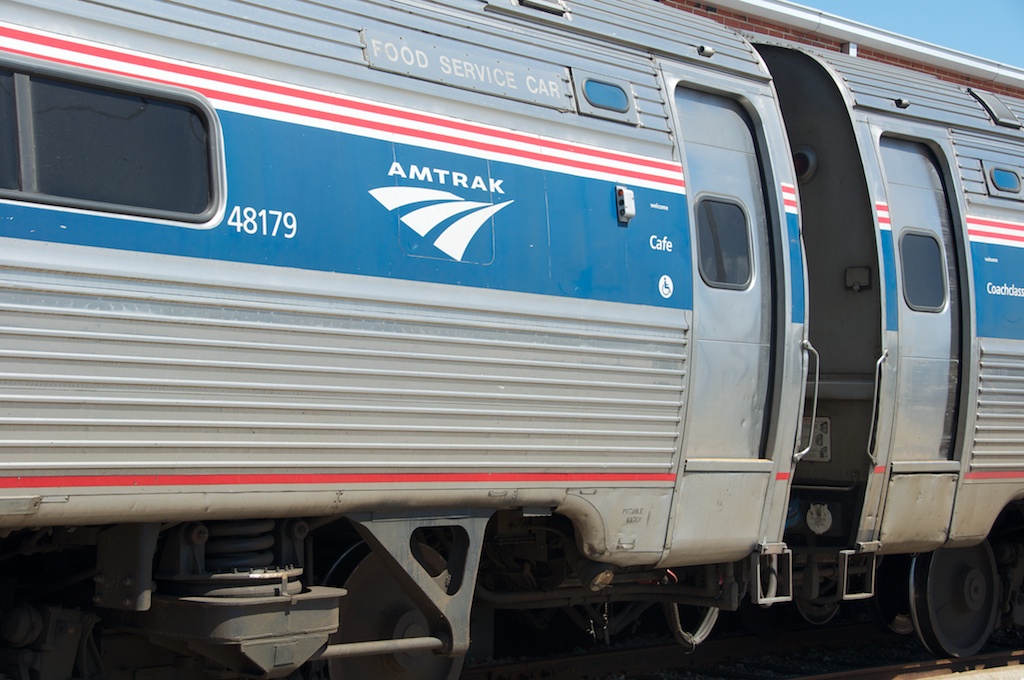
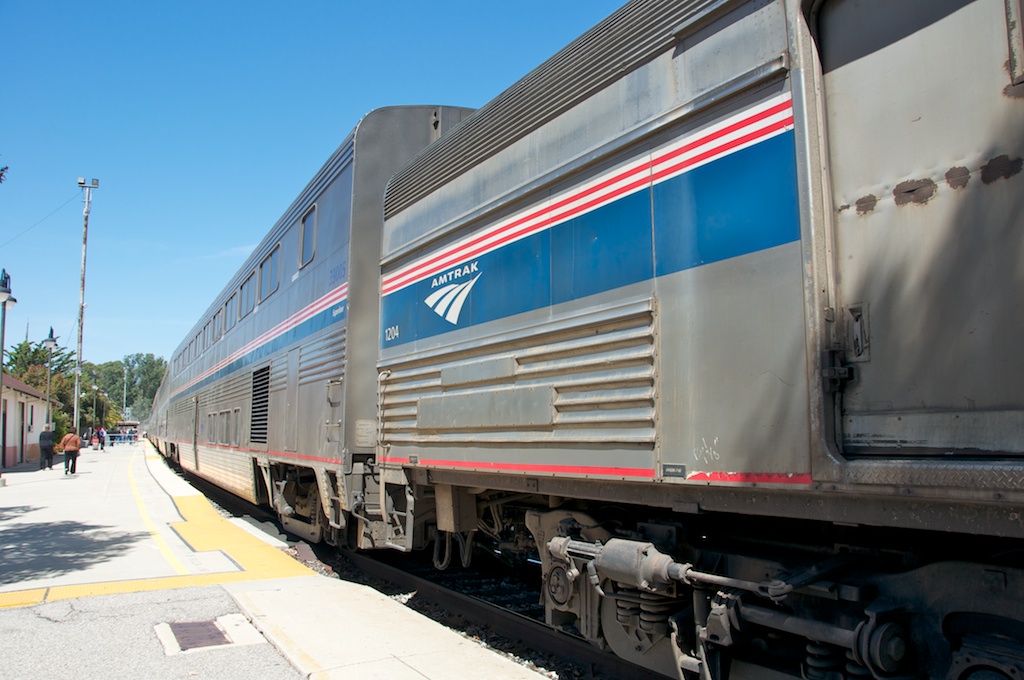
Amtrak Cafe Car

Still, I didn’t know exactly what to expect on this journey. Elizabeth and I had taken a short Amtrak trek up to San Luis Obispo about ten years ago, and enjoyed it, but that was a few hours, while on this trip we’d be spending days on the train. Would we suffer from cabin-fever? Would we get to our first stop in San Antonio, and start the search a divorce lawyer? Or would it be a romantic adventure?

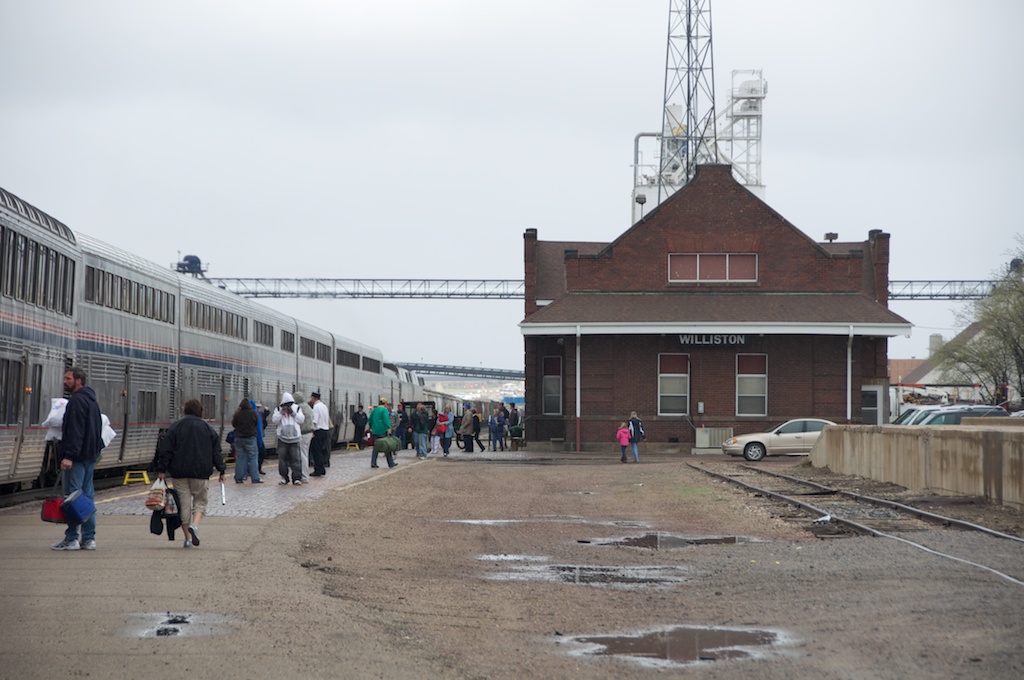
Station Stop, North Dakota

Station Stop, North Dakota

If you’ve been reading this blog, you know the answers to those questions.

We found that traveling by Amtrak is, in many ways, a more civilized means of transportation. You don’t have to go through the abuse that you would at the airport. They dispense with the security theater. As one car attendant said to me “terrorists would have a hard time hijacking a train and crashing it into the World Trade Center”.

Train trips have always been a good source for stories. I think this is a natural outgrowth of the social aspect of trains; somehow, and I don’t really understand how, trains invite social interaction in a much more profound way than airplanes do. I’ve been on many transcontinental flights where I haven’t exchanged more than “excuse me” to any of the people sitting in my row. I don’t think I’ve ever been on a train where I haven’t had at least a short conversation — and often much more than that. I’ve been lectured on the moral imperatives of marriage and personal hygiene by an Indian businessman en route to Agra, and gotten drunk with soldiers on a Thai train. I’ve had strange, laughter-punctuated pidgin communications with people where we shared no language other than hand gestures and simple drawings. I’ve talked tech, compared cell phones, and traded snacks or paperbacks with people on trains. I’ve heard life stories, business tales, political views, and ghost stories.

Amtrak

Amtrak Sleeper

On Amtrak, you meet other people in the passageway, possibly in the lounge car, and always if you eat in the dining car. You may get bounced into them as you walk by in the coach car. You find yourself having a lot of conversations.

The slower pace of transport also seems to result in more natural conversation with train employees. There’s not a focus-tested greeting or script for each interaction. Conductors will tell you something about the upcoming station, or talk about the weather. Sleeping car attendants will talk about the circus train that they saw the previous day.

Just as trains are more social than airplanes, they also occupy an interesting place in our national psyche. People love trains. We attach a mystique to them in a way that we do with few other modes of transportation. Some of this is clearly historical: just as we now find horse-drawn hansoms and hackneys romantic, we think of trains as quaint. But there’s more to it than that. People wave to passing trains — all kinds of people, not just children. As we were pulling out through eastern Los Angeles County, we saw a construction worker pause from his labor to wave at us as we went by.

Montana

Station Stop, Montana

But what of the nitty gritty details of Amtrak travel? Here’s where there’s both good and bad.

The Ride
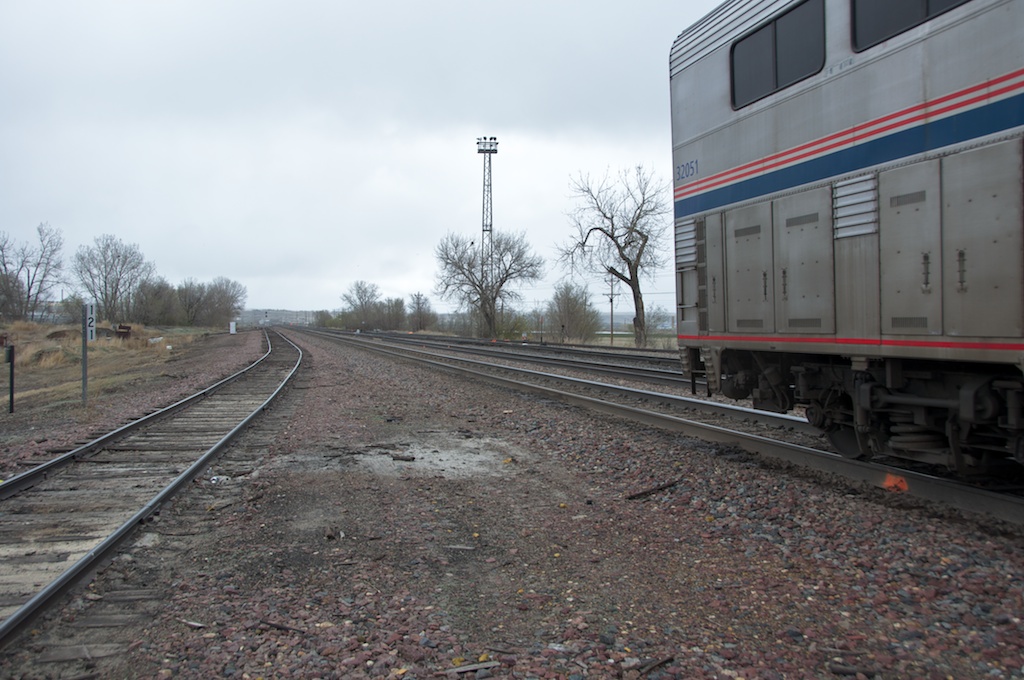
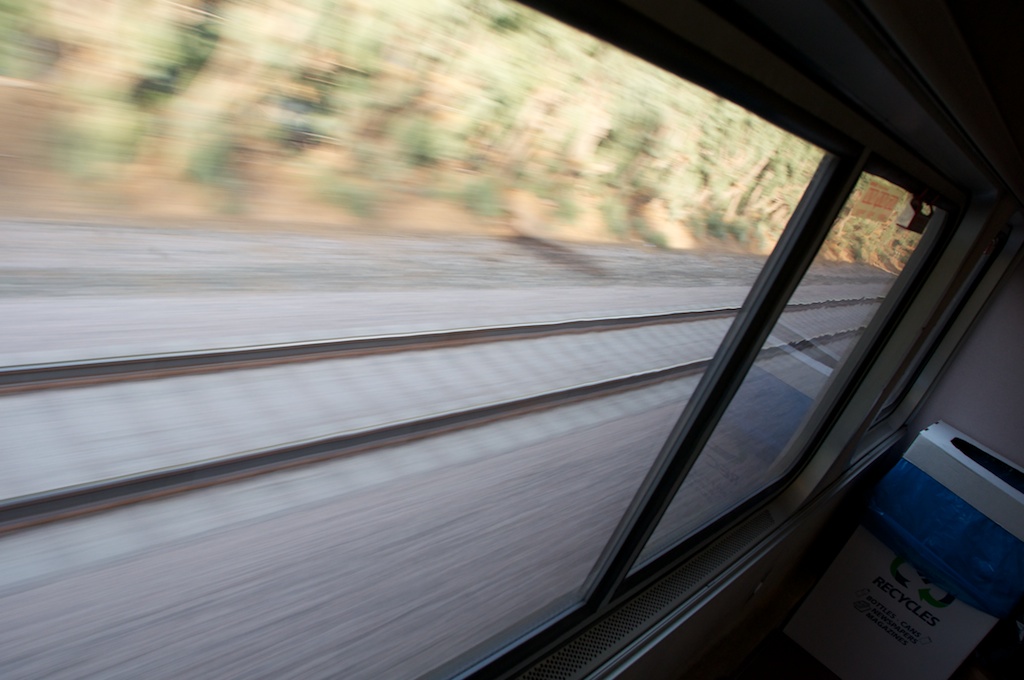
Unlike trains in, say, Japan, there is a lot of physical motion on an Amtrak train. There is side-to-side motion when the train is switching spurs or going over crossings, there is leaning when going around curves or on certain stretches of track, and there is back-and-forth jerking. As far as I know, most of the rails in the United States are still bolted segments rather than the welded track used in western Europe and Japan. This contributes to the roughness of the ride (although, to be fair, there are reported to be as many miles of rail in California alone as there are in Japan).

Depending on which route you’re on, the ride may be anywhere from “mostly smooth” to “roller coaster.” Presumably, this has a lot to do with the quality of the track and the speed at which the train moves. We found that the smoothest route was the Coast Starlight route along the West Coast.

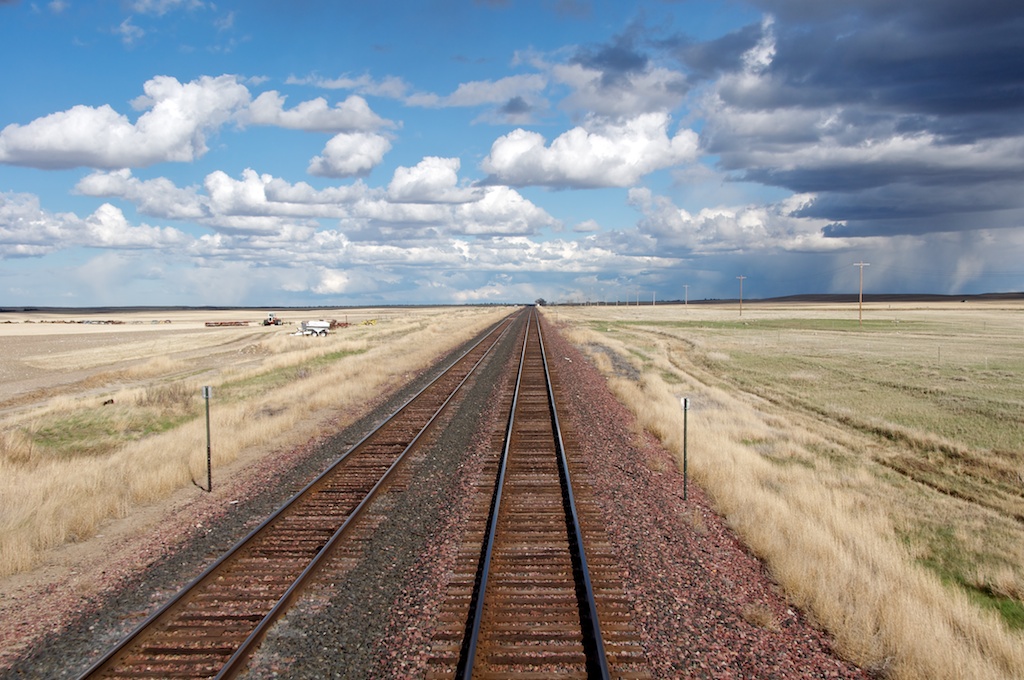
Track

Track

Business Class versus Sleeper versus Coach
On routes that don’t go overnight, trains are generally divided into coach and business class coach. There are evidently also “quiet cars” where conversation, cell phone usage, and probably children are prohibited. We only did a few of these shorter routes, and always in ordinary coach class, so there’s not much I can say about it.

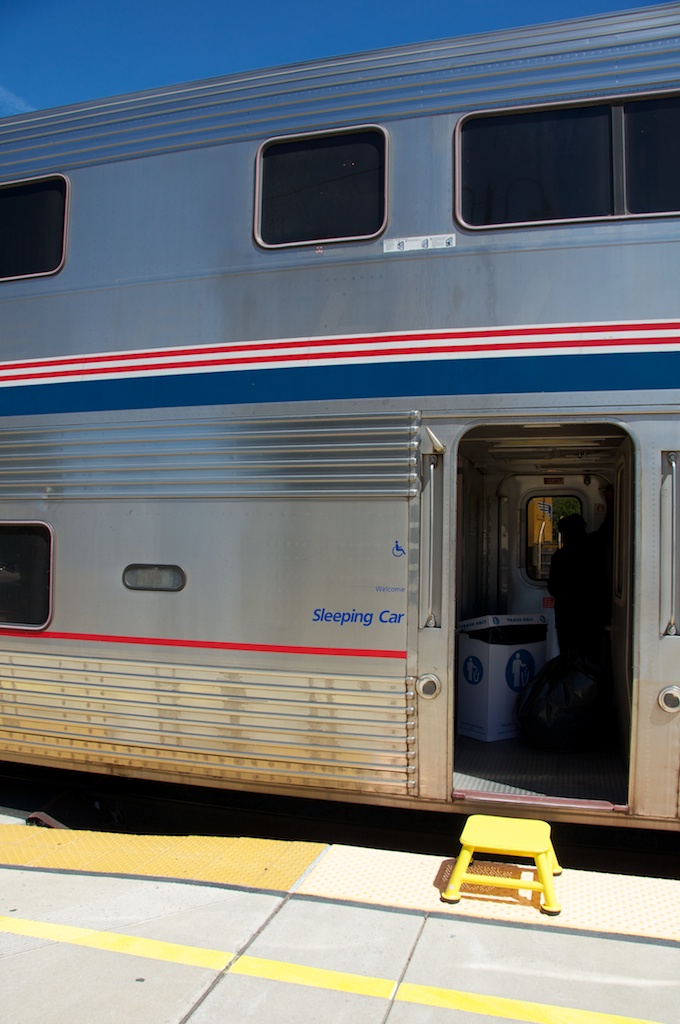
For overnight routes, sleeper cars effectively become the business class. Sleeper passengers have their dining car meals included in their fare, and are given priority treatment. You can opt for a full room (which we did not do) or a “roomette,” which is a mini compartment that has two facing seats that transform into an upper and lower bunk. There are nice touches like bottled water waiting for you in the roomette, coffee and juices available at the end of the car, and, on some of the long-haul routes, a welcoming mini-bottle of champagne or cider.

Sleeper cars have communal restroom and shower facilities. Some sleeper cars have their own, in-roomette toilet and sink, which doubles as the step to the upper bunk. As there is no separation at all in the roomette, using these facilities is contingent upon you being on very intimate terms with your travel companion. They’re also contingent upon you having good balance when over rough track.

Coach cars have rows of seats that are like more comfortable airplane seats and with better leg-room. They often have fold-out footrests, which people try to use as makeshift beds on overnight routes. When the train was not especially full, it appeared that people had reasonable success sleeping by curling up and using two neighboring seats.

Unlike the roomette compartments, which have their own doors and curtains to isolate them from the rest of the train, the coach car has no means of shutting off noise, light, or odors between neighbors.

All Aboard

All Aboard

Sleeping
We never tried sleeping except in a roomette on a sleeper car. The fact is you can sleep on the train, but you may not sleep well.

The problem with sleeping is less the motion of the train (although on particularly jerky routes, it may be a factor), but is more to do with the maintenance of the cars themselves. It’s clear that Amtrak tries to keep things in good order, but the cars are heavily used, and many of them are old. As a result, there’s a lot of irregular ambient noise, primarily squeaking and clanking. There’s also squeals of wheels on some curves, the sound of the train whistle (depending on how close to the locomotive you are, and how many roads cross the tracks), and light, noise, and hubbub from station stops. In some cars, the curtains no longer close very tightly, so light leaks in. In other cars, the door latches are broken or worn, so the compartment door thumps around from the motion of the train. And in some cars, the heating/air conditioning is temperamental.

Of course, sleeping is obviously affected by the quantity of wine or coffee consumed in the lounge or dining car.

Train

Train

Food
With the sleeper car ticket, meals are free (except for alcohol). You make your lunch and dinner reservations with the attendant who walks through the train; sleeper passengers get priority over coach passengers for making reservations, but you may end up at a table with people from either group.

The dining car has tables with cloth tablecloths and vases with fresh flowers. You get real silverware. On some routes, you get real plates and cups too.

The menu is not exactly the same across all routes, but by and large there is a similar pattern. Breakfasts are eggs, potatoes, toast, and meat or an omelet or famous “railroad french toast” or a continental. Lunch is some hot sandwich, a hamburger, a veggie burger, or sometimes a salad. Dinner is a vegetarian pasta, roasted chicken, some kind of fish or seafood, or some kind of steak. Dinners come with salad and a roll and have an option for dessert (typically cheesecake, brownie, or ice cream). For most meals, there is a daily special as well. You can get a lot more specific detail on the Amtrak site.

Food is institutional, but it’s definitely better than the average airplane meal. Quantities are generous. It’s not gourmet, but it was certainly good enough. In my experience, the less exotic things were the best: the steak was pretty good.

Track

Track

Miscellaneous
As mentioned in other posts, traveling by train exposes you to parts of the country that you wouldn’t see otherwise. It takes you through spectacular scenery, and it takes you through the uglier side of town. I don’t think that there’s any other way of getting an impression of so much of the country in so short a time.

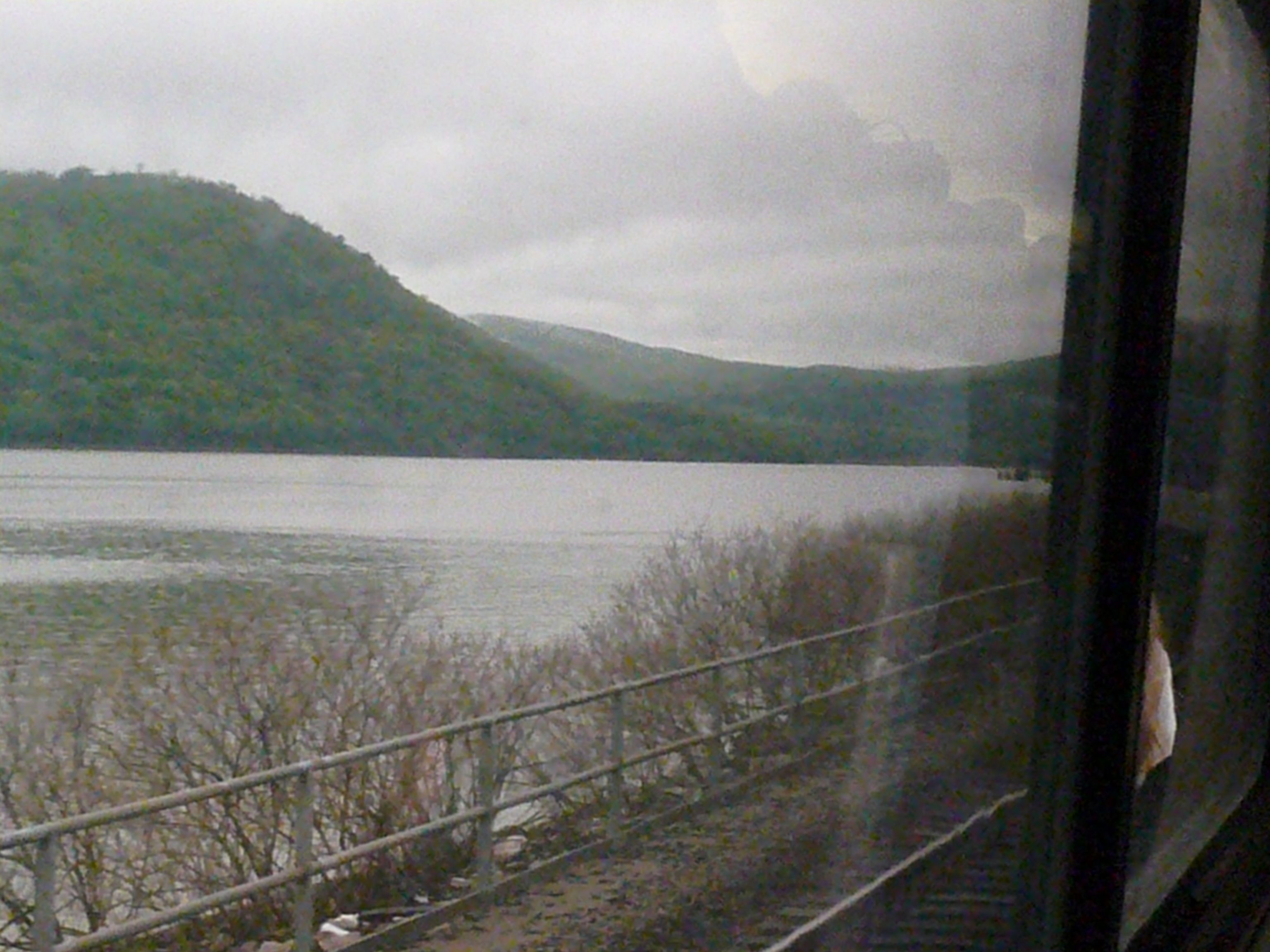
Photography from a train can be frustrating — the windows are not especially clear, there’s a lot of reflection, and you’re often moving too fast to get The Shot.

Amtrak has some nice extras like wine and cheese tastings in the lounge car on the longer routes (Empire Builder from Chicago to Portland/Seattle, Coast Starlight from Seattle to Los Angeles). Elizabeth won a bottle of Pinot Grigio in the trivia contest, too!

I think Elizabeth summarizes it well when she points out that Amtrak has something of an identity crisis. Is Amtrak’s aim to serve tourists and rail aficionados, or is Amtrak a Greyhound bus on rails? There’s definitely an effort to make for a high-quality tourist experience: the routes go to tourist destinations (like Glacier National Park and the Grand Canyon), some routes have guides describing the places you pass through, and the services seem to be designed to cater to tourists. On the other hand, some trains are clearly commuter trains. To some extent, this is an East Coast / West Coast split, with the western trains being more oriented towards tourists and the eastern trains more for moving people efficiently, but it’s not that simple either (for example, the Florida/New York auto-train is definitely for snowbirds).

Amtrak’s fortunes follow politics. One car attendant told me that the Bush administration considered Amtrak an unnecessary expense (effectively subsidizing rail buffs), while the Obama administration sees Amtrak as part of an overall national rail infrastructure which will be increasingly important. Regardless of the reasons, Bush proposed cuts for Amtrak’s budget, while Obama has increased it. Amtrak is not profitable, and the consistent operating losses may be one reason for the continued non-operation of the New Orleans to Jacksonville segment.

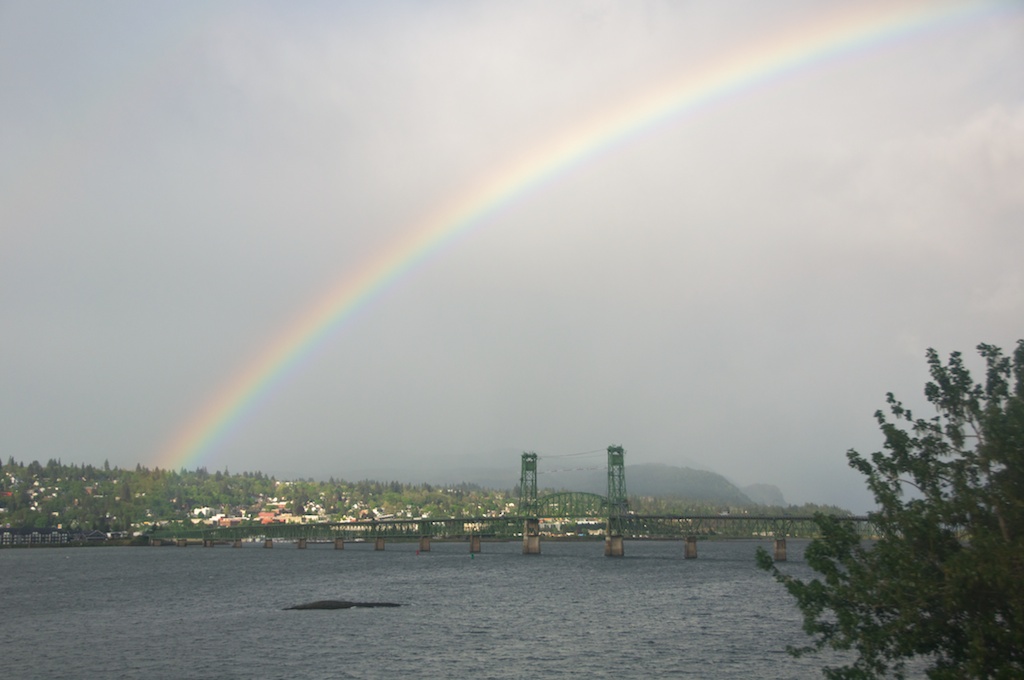
Columbia River Bridge

Columbia River Bridge

Bottom Line: Would We Do It Again?
Yes.

We’re already mulling around ideas of a Pacific Northwest journey for some future Summer. We’ll keep you posted!

Slowly We Turned….Heading West via Niagara Falls, Wisconsin, and the Empire Builder

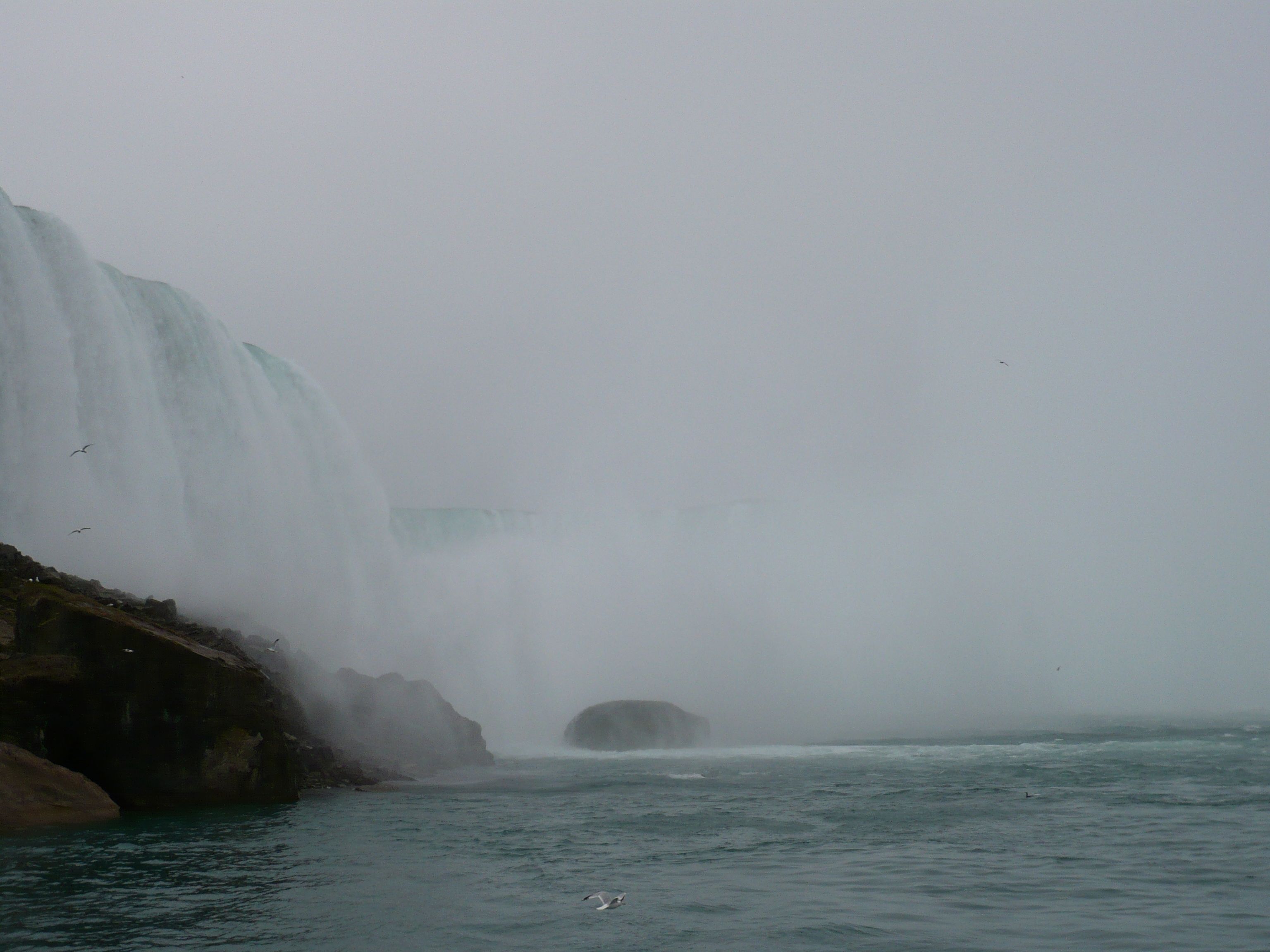
After our sleepless night in Philly we boarded an early train and went up the gorgeous Hudson Valley to Niagara Falls, which I was shocked to find lacked the quaint honeymoon cottages and culture I had been led to expect by recent puff pieces in the national press.  In fact, we were doubly shocked to see how much of the town was derelict–empty storefronts and huge malls, empty.

In contrast, the Canadian side looked like Las Vegas and was thrumming with tourist activity.

Made Of The Mist? The Canadian Side Beckons

We had a good time bumming around in spite of this–the Falls and the park were still beautiful though overcast–we did finally see a rainbow over Niagara in our last hour before leaving.

Touching Water , North Border-View from the deck of The Maid of The Mist (four of the five Great Lakes contribute water to Niagara Falls)

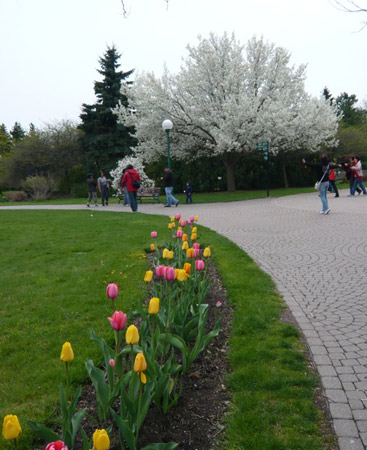
Great Lakes Garden, Niagara State Park

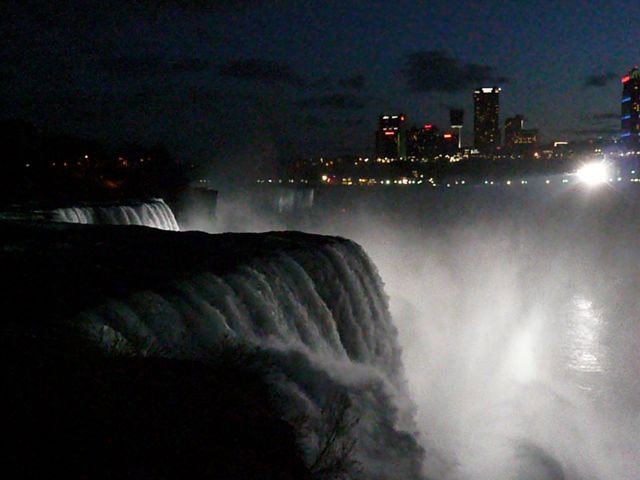
Illuminated Falls At Night

I spoke with a few locals and wrote my first Examiner piece on the town; I ended up discovering a lot more about the region with just a few conversations than I thought I would.  Niagara is experiencing some complex political and economic issues right now, and its survival depends on either a radically improved economy right away or some smart, rapid action on behalf of the state and local authorities, neither of which seems forthcoming.  It’s sad–there’s a lot to enjoy there, potential wasted mostly by political in-fighting.

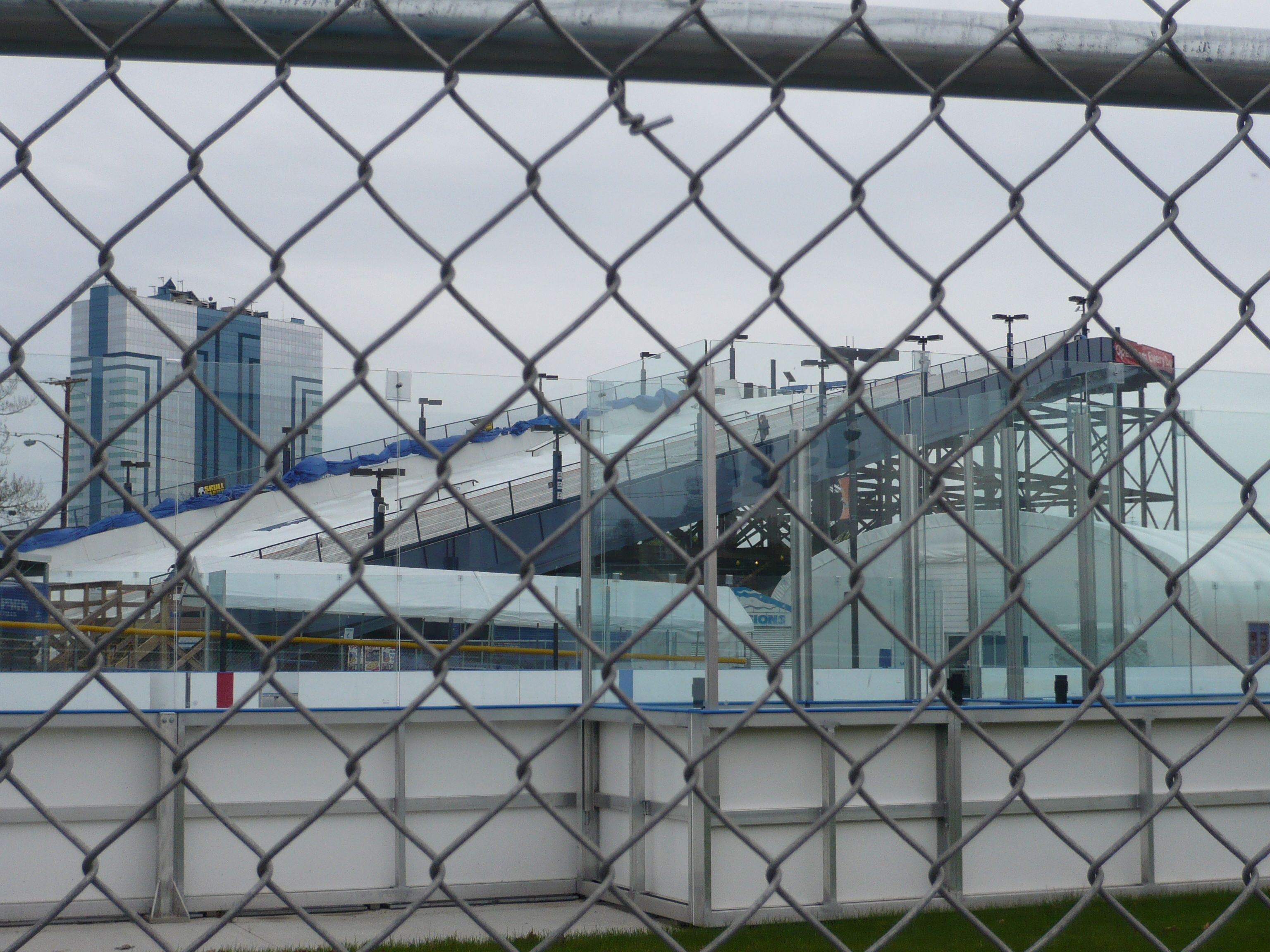
Sad Empty "Snow Park," Niagara Falls

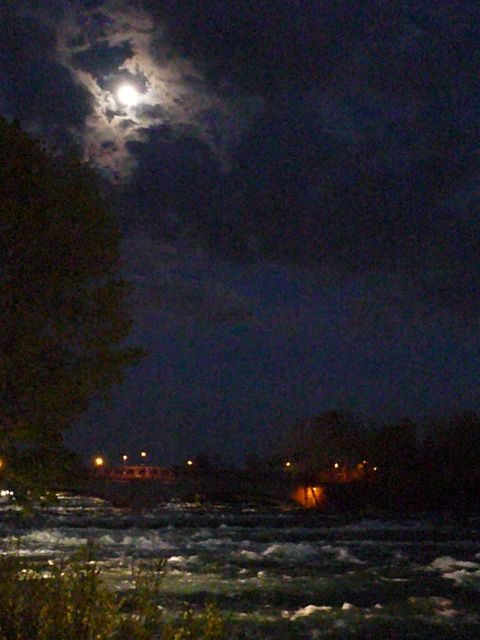
Full Moon Over The Niagara Rapids, Near The Red Coach Inn

We stayed at the Red Coach Inn, a last-renovated-in-the-1950’s red-velvet funky theme joint–a little dusty, but the staff was friendly and they had an old school menu in the restaurant, e.g. steaks served with a pat of butter on top.  You could hear the Niagara rapids from our room, which was really nice, sound like steady rain.

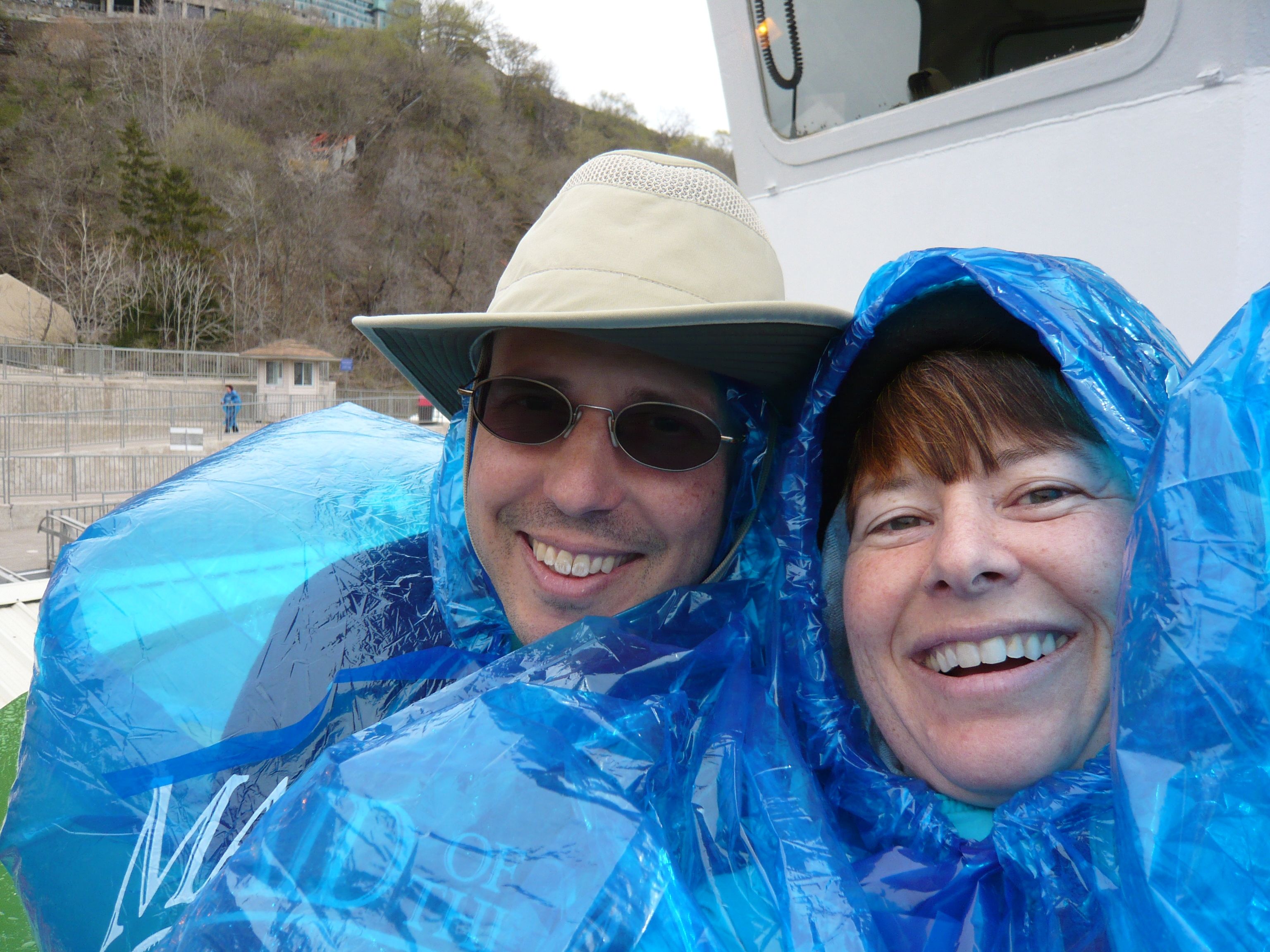
Modeling "Maid Of The Mist" Blue Ponchos

We did the Maid of the Mist and walked the Falls Park; on our last day, we visited with the Niagara area jeweler that made my wedding band (I’m working on an Examiner piece about him and his work) and he was hilarious and really fun to talk to, but we had to dash to make our next train.

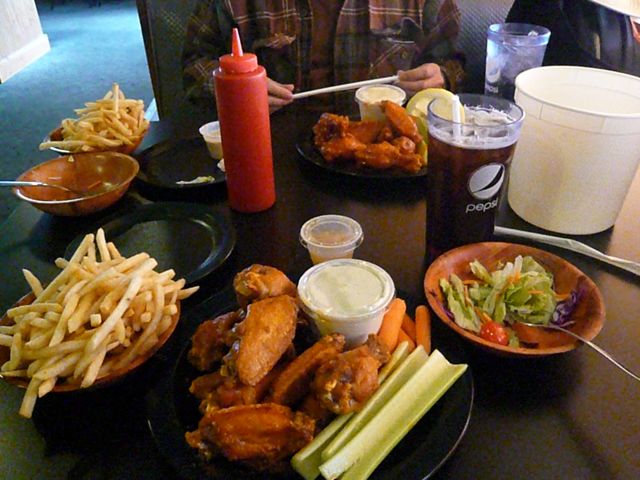
Buffalo Wings At Duff's--Buffalo, NY

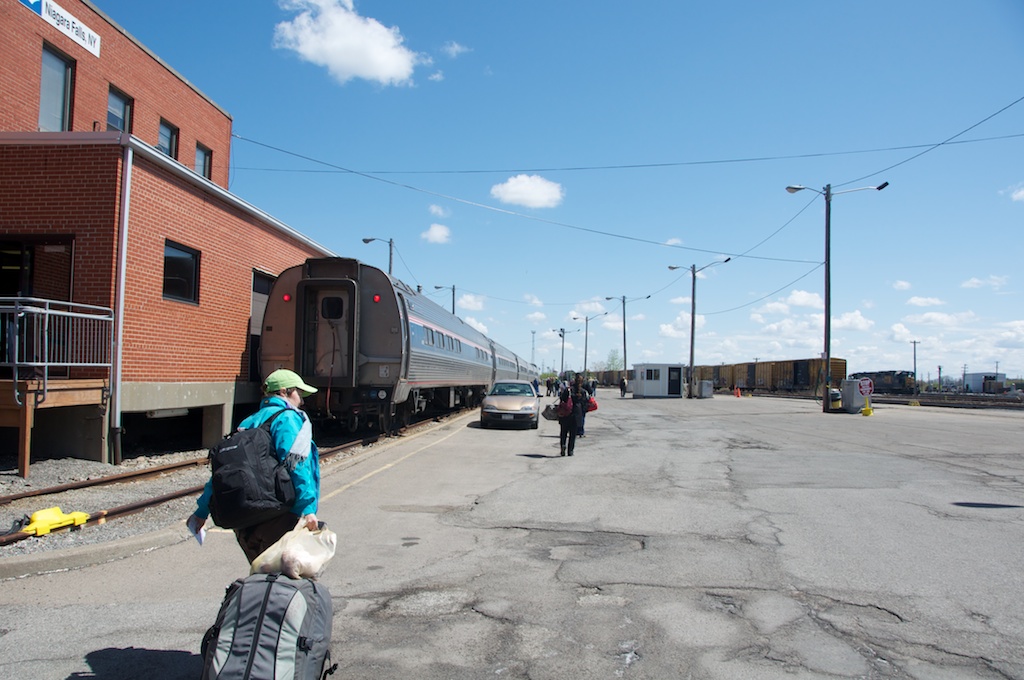
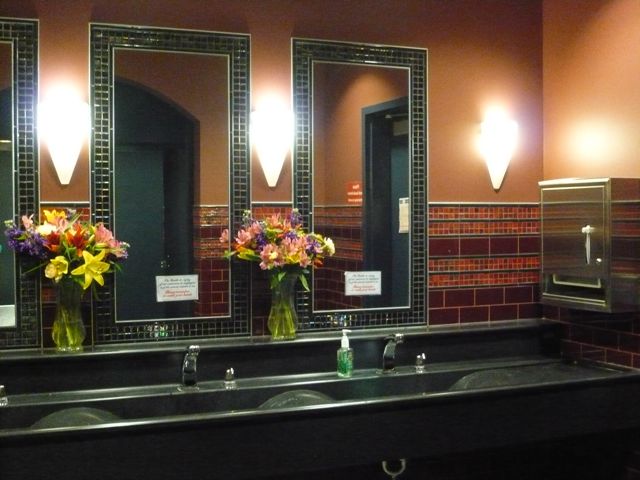
We had to change trains and kill about ten hours in Buffalo, which was FREAKIN’ COLD!!  We walked around and a) ate authentic Buffalo wings at purportedly-top-rated-wing-joint Duff’s, which were spicy, greasy, and made us slightly nauseated, and b) found the coolest grocery store on the planet, Wegman’s–better stocked with fresh-prepped, interesting food than Bristol Farms or Whole Paycheck, with FREE WIRELESS IN THEIR CAFE!!!  We ate lunch like, three times during the five hours we were there, stocked up on snacks for the train, internetted, and then went back to the Amtrak station to set off for Milwaukee and points west.

I mean, they had FRESH FLOWERS in the RESTROOM! WEGMAN'S ROCKS!!!

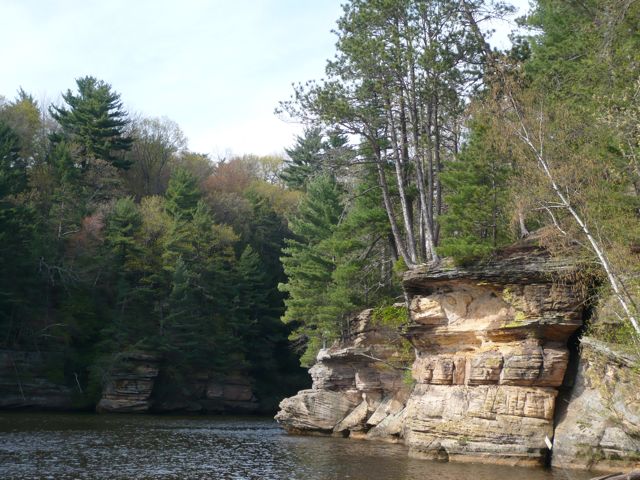
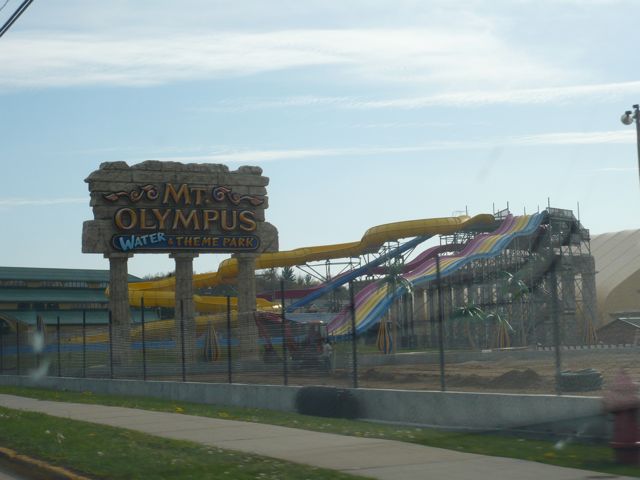
We rented a car and drove from Milwaukee through, YES–WAUKESHA, WISCONSIN!!! HOME OF SPIDERCOW!!! on our way to Baraboo, WI.  We made good time so we drove over to the Dells, which we had been told were “really beautiful.”  They were “really” piled high with Vegas-style waterparks and amusement complexes and moose-and-bear themed restaurants, though we did take a nice hike to the water through the woods only to encounter teens talking on their cell phones and some guy with his boat radio cranked up.  Ah, the sweet sounds of nature.

The Dells

The Dells

At Baraboo we stayed at another funky inn run by a funny retired couple–birdhouses that were little models of the inn and crazy cut-out cows everywhere–but we were skunked by the non-open Circus World, to which we had expressly traveled to Baraboo to see.   Our best guess was that we had obtained their schedule from an old website–there was a newly renovated one when we checked again, and this one said they weren’t going to open until May 22nd.  But we were already there.  Bara-BOOOOOO.

You Know You're In Wisconsin When You See These Next To The Cheese

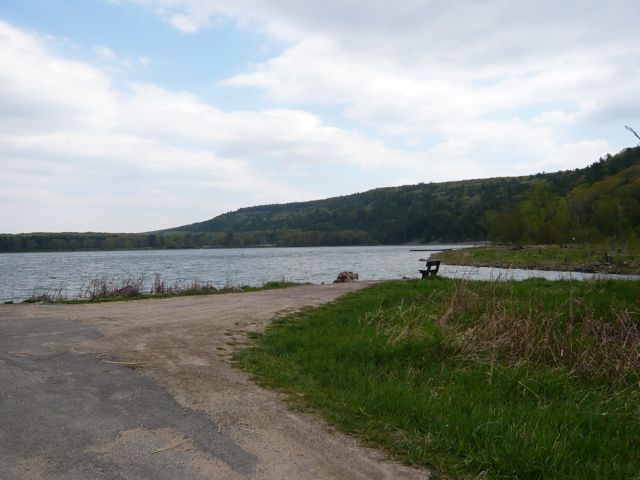
We went instead and picnicked here at Devil’s Lake–not very circusy but we made do.  There were turtles.

Our Picnic Bench, Devil's Lake, WI

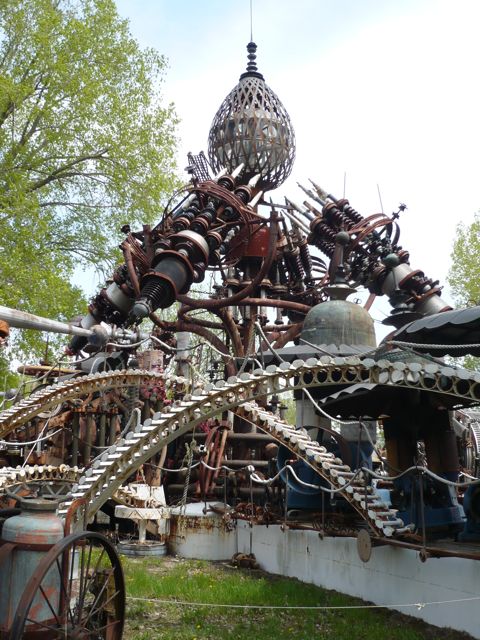
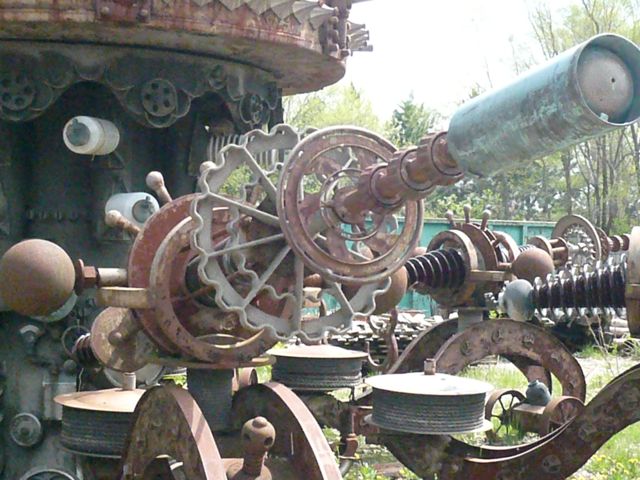
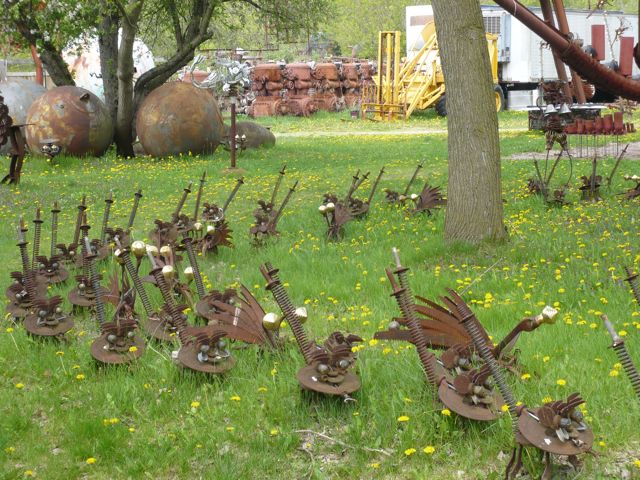
And the Forevertron made the entire Wisconsin junket worth it.  See Samuel’s post and our “Thumbs Up” for more.

The Forevertron

The Forevertron's Love Beam

Other Defenders Of The Forevertron

More in Part II–stayed tuned for House On The Rock!

Sleepless in Philadelphia; Niagara Falling

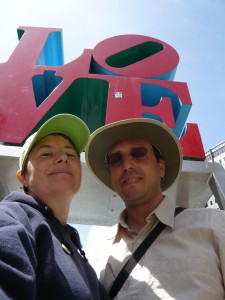
Love Park, Philadelphia

Friday morning we took the train overnight from Savannah to Philly, where we beheld a sunny morning.  We checked our luggage and our reservation at Club Quarters Philadelphia, and set out for the Mütter Museum (see “Thumbs Up”) and the Mummers Museum later that afternoon.  Both are worth seeing, but don’t confuse the two or you will be permanently messed in the head.

Like the Mütter Museum, the Mummers Museum is not for everybody.  I was drawn to it because I am fascinated by community-created rituals, and Philadelphia’s New Year’s Day Mummer Parade is a bizarre and wonderful example of how folk traditions are initiated, institutionalized, and passed down to new participants.

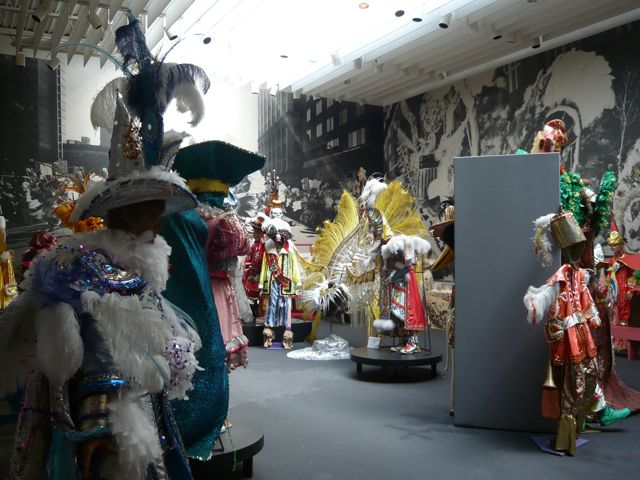
Philly is home to several Mummers “clubs” (which resemble New Orleans Mardi Gras krewes) that march and dance in a garish New Year’s Day parade, replete with “comics” (clowns), “string bands,” “wenches,” and “fancy brigades.”  The clubs can spend $100-$200k outfitting their membership in fantastical costumes (properly called “suits”) and they compete in themed choreographic presentations that are rehearsed for months on a volunteer basis.

This is a five-minute documentary featuring a champion mummer club, the South Philly Vikings.  (Note: as of 2009, there are no more cash prizes…these folks are mummers for love and bragging rights, and spend much of the year fundraising to make their show possible.  Shades of SpiderCow!!)

The Mummers Museum documents the evolution of the parade from its roots in ancient mummer traditions to its modern regulated state. The museum itself is a little dusty and many of the exhibits are aging and nonfunctional, but we found a few bits of history to enlighten us–the archive photos of early parades are fantastic.  It’s clear the parade was once a subversive romp by a mostly immigrant population–Samuel likened it to the “Burning Man” of its time–but now it is a big money establishment-run affair, and the Mummers Museum helps one understand this evolution from high-spirited improvisational mischief to manic civic competition.

The volunteers who run the museum–members of mummers clubs themselves–will enthusiastically talk your ear off about the Mummer phenomenon.   One is left wondering if there’s a kind of wonderful antic madness running through Philly, or if there just aren’t enough other activities to keep people gainfully occupied.  It’s easy to forgive them for oversharing their excitement though–lots of sparkles for New Year’s Day, a massive and serious contest, and an even more massive and serious party afterwards!!

Mummers Museum, main hall

The Mummers Museum is outside the main tourist area of town where I guess rent is cheap for non-profits–we had a nerve-wracking walk through a rough section of Philly to get back to our hotel.  That tired us out so we opted to have dinner close by at a cloyingly hip place on Chestnut called Continental Midtown, a “global tapas” diner (which translates as small plates, but you can’t say “small” in these recessionary days, even around foodie types who should know better.)

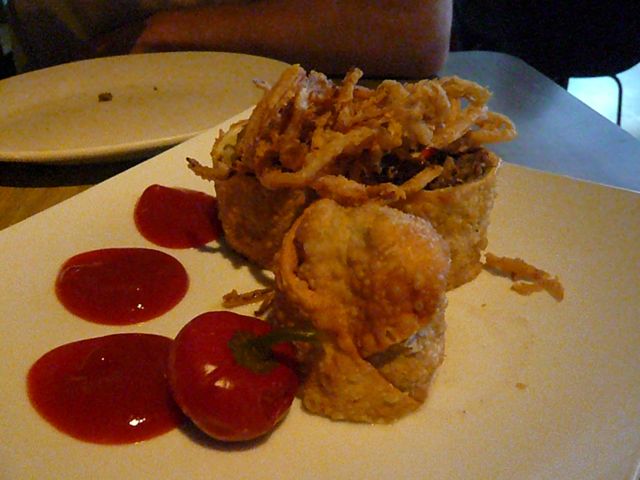
We had our Regionally Required Dish–Philly Cheese Steak–in a won ton wrapper, and it tasted pretty good, if lacking in Philly street cred.

Philly Cheese Steak Wonton, Continental Midtown Restaurant

Sadly, Philly street CRUD was all we had that night at our hotel, Club Quarters Philadelphia.

About one-thirty in the morning, the nightclub downstairs spawned what Samuel dubbed a “horn artist,” i.e. some schmuck who leaned into his/her car horn for about two hours.  That, the shrieking and yelling from the clubgoers, and the consequent sirens two hours later kept us stone awake until about four a.m.  So lovely, as we had to get up at 5:30 a.m. to make our train to New York.

We were beyond zombied and miserable when we went downstairs that morning–mind you, we were on the NINTH FLOOR and the ruckus sounded like it was just outside the window–and Club Quarters gave no quarter when I complained upon check-out.  “Oh yeah, that’s the club downstairs” was all they said, politely, and our only recourse was to write a ruthlessly truthful review on TripAdvisor about our night there.  They didn’t even have their lobby coffee ready.  We were traumatized but too exhausted to actually freak out on it.

It’s really too bad–Club Quarters could have been a nice experience if they had made some attempt to deal with the situation, or with us.  As it is, if it’s a weekend–run away, run away!!

Six a.m. Breakfast of Champions, Philly departure lounge

At six a.m. we slogged onto the train to Penn Station, NYC, where we transferred to the Amtrak Empire State up the Hudson River Valley to Niagara Falls.  It was a packed train, which surprised us, but the scenery was beautiful.

Hudson Valley, from train window

We arrived in Niagara in the late afternoon and were driven to our inn by an Indian taxi driver who drove like Batman having a panic attack (as it ended up, all our taxi drivers were Indian; apparently in Niagara there are a substantial number of immigrants and tourists from India, who often come via Canada.)

From the first moments of our arrival, it was clear Niagara Falls was not all we had been led to believe, though it has kept a few of its maidenly virtues intact.  Sadly, the “Honeymoon Capital of the World” has lost much of its business to the meretricious development across the river on The Canadian Side.  It seems to be sad days for the U.S. portion of Niagara, but maybe that’s about to change???….

….More on that Hard Rock Border War and the Lack of a Honeymoon “There” There when next I post….stay tuned!

Made Of The Mist? The Canadian Side Beckons

Shuffle Off to Buffalo w/Samuel, Elizabeth, and Ruby Keeler

“All aboard the Niagara Limited!”

It’s a grey and rainy Sunday and we didn’t get any sleep last night (more when we catch up about Savannah and Philly) but for now we’re Shuffling Off To Buffalo on Amtrak’s Empire State to Niagara Falls.  We’re going up the river and the scenery is splendid if wet (I kinda like it that way) and we’ll be in Niagara Falls by nightfall, which promises to be wet, too…I mean rainy, you dope.

In the meantime, here’s the famous 1933 “Shuffle Off To Buffalo” dance number from “42nd Street” where Ruby Keeler and her Broadway groom Clarence Nordstrom tapdance their way up the train car to their honeymoon cabin. FYI, the conductors still wear the same peaked caps and punch your tickets with a hand punch (remind me to get a darling bias cut dancing dress and flowered beanie cap the next time I board this train!)
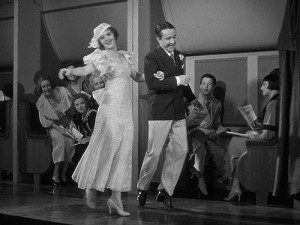
The reveal of the train interior is fantastic and keep an eye out for the young Ginger Rogers and Una Merkel in a top bunk eating bananas and waxing cynical about matrimony.

The clip is prefaced by Warner Baxter’s impassioned speech to Ruby Keeler, which has become a much-lampooned trope but here’s the original in all its melodramatic glory. “You’re going out there a youngster, but you’ve GOTTA come back a STAR!”

Enjoy!

Union Station, lunch and departure–San Antone, yeehah!

Didn’t sleep much the night before departure–I always have a panic attack before I leave town for a while–having the house burglarized twice eight years ago traumatized me, but since we’ve had the alarm installed theft hasn’t been a problem, so I know it’s just neurotic to worry as much as I do but I still do–not a rational thing.  We have all the neighbors watching the house and folks to take the mail in etc., but leaving still makes me twitchy.  Plus, this year’s rains have made the roses come out in force, and they were just starting to burst open in multitudes as we left, so we’ll miss it.  I hope the mail-bringer-inner accepts my invite to take tea in the garden while we’re gone, as my garden is unhappy unless it is admired….like me, I guess.

We enjoyed lunch with Karl, our chauffeur, in the grand, elegant part of Union Station, then departed through the gritty, dingy platform tunnel.  We took our first day on the train to adjust–this is a working vacation for me, so figuring out how and what to cram into our “roomette” and which connectors would fit where took the better part of the afternoon and evening.

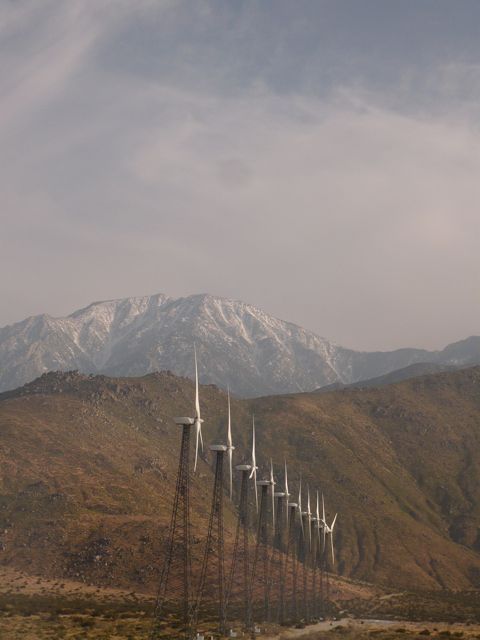
Outside Palm Springs, CA

After dinner at our communal tables–thus far our meal partners have been pleasant–we retired to our roomette, clicked off the lights, got a couple of those little airplane bottles of rough Scotch from the club car, toasted the launch of our adventure, and watched the desert twilight of Arizona whiz by.  When we finally figured out how our bunks folded out (with the help of our car attendant, who set up a little mattress pad, sheet, and blankie on each bunk), Samuel volunteered for the upper (complete with catchnet to keep you from falling out) and I got the lower bunk and window.  I kept the curtains open and watched the sprinkling of stars and airplanes over the dunes; each time the train hit a rough trestle or went around a curve, I could see them shudder and curl around as if the sky were a dark, waving flag.  I’m moving, I’m on a train; as I move, the cosmos moves too.  It’s all a matter of perspective, of course, just in my head….or is it?

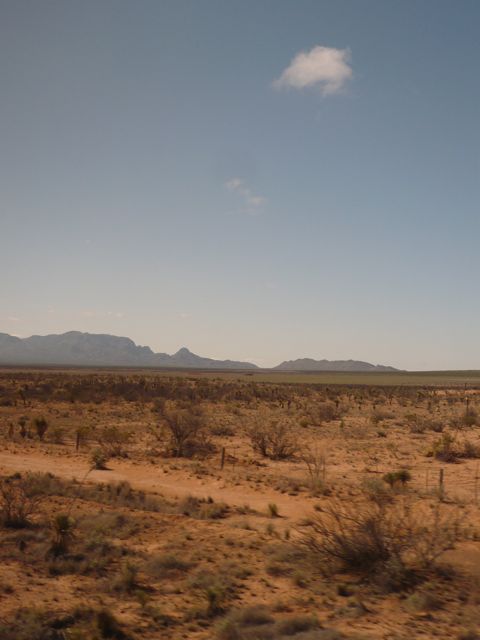
Little cloud over big desert

Sunset, Arizona

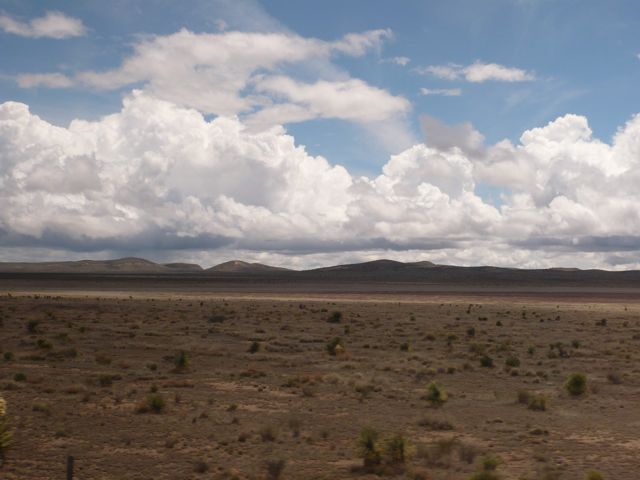
Slept fairly well despite long late night stops at Tucson and Maricopa that kept me awake and some rough track as we entered West Texas in the early morning hours. I liked seeing the sunrise, usually miss it at  my house.

Sunrise, West Texas

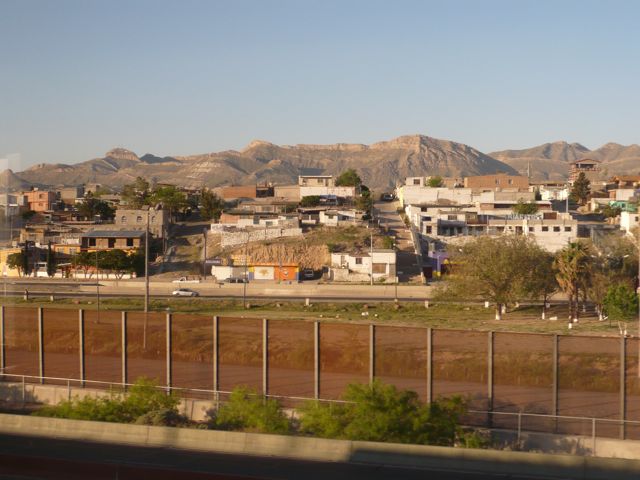
Our lunch companions pointed out the border fence as we went through El Paso/Juarez–the brick station was cute, small and stately, in contrast to the chaotic landscape of sheds and tin huts beyond.

The Border (fence), near El Paso/Juarez

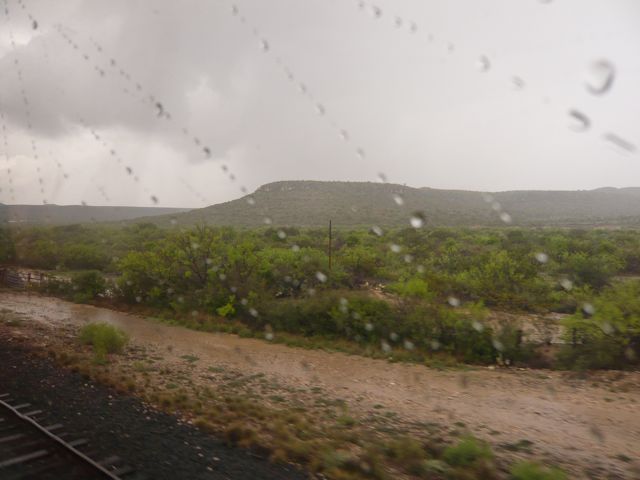
Storm a-coming, TX

Storm's a-here, TX

Tonight we detrain in San Antone, yeehaah (we’ve made it a rule that if you say, “San Antone” instead of “San Antonio” you have to say “yeehaah!” afterwards.)  Last we heard there might be rain and heat; that’s some Texas high humidity for y’all.

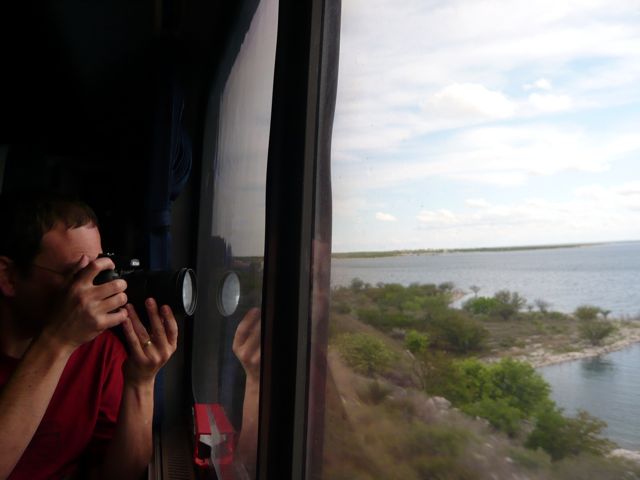
Samuel and Amistad Reservoir, TX

Here’s a rockin’ little version of the San Antone (yeehah!) hometown tune–enjoy!

San Antonio Rose, 1962

Yeeeee-haaaaah!

Planning with Amtrak, Part III

SO the last two portions of this sad tale were about anger and frustration. This last part, however, is where it all comes together.

Now that I had our rail passes, I called the Amtrak reservations number, and reached a representative who very helpfully went through our entire travel plan, made all the reservations, and emailed me a copy of the itinerary. She was pleasant, efficient, and friendly. There was only one snag:

Amtrak lies about its routes.

Specifically, the Sunset Limited, the train joining New Orleans to Jacksonville, Florida is on all of the maps, but it is not running. From what I’ve been able to glean (from Wikipediablogs, and newspapers), the track was damaged by hurricane Katrina, which caused Amtrak to stop service on that route. Six months later, when the track was all safely repaired, Amtrak failed to re-initiate travel on that route. Even Congress can’t seem to get them to reopen it (according to an expired article in the LA Daily News, copied on this anti-Amtrak-or-any-government-service site run by Randists).

So to get from New Orleans to Savannah, Georgia, what should have taken on the order of one day would take us three days — because we’d have to go by way of Washington DC. That’s like going from Los Angeles to San Francisco by way of Salt Lake City.

In the end, we made the decision that our Great Train Adventure would not lose its essential “traininess” if we did one stretch by car. So a quick visit to Avis’ web site, and the major transportation planning portion was complete.

At this point, planning came down to finding places to stay. Summon the mighty Internet! My approach was to find an area using Google Maps, and then going through endless linked reviews on TripAdvisor.com, keeping in mind that online reviews often tell you more about the reviewer than the place being reviewed. I tried to avoid chain hotels, opting instead for local institutions, B&Bs, and Mom ‘n’ Pop places.

Over the next few weeks, you’ll be able to read more about these places… stay tuned!

Planning with Amtrak, Part II

As I started to describe in my previous post, the proper way to deal with Amtrak is to call the phone center. If you reach someone who seems clueless, hang up, and try again. Words to the wise, my friends, words from experience.

So, from last time, I had our rail pass numbers, and I needed to reserve the individual segments. On the Amtrak web site, I couldn’t find a way to reserve against a rail pass, so it was back to the telephone.

I called the Amtrak phone center, and got an agent who happened to be a trainee (no pun intended). Had I hung up, I would have saved a lot of time. But I didn’t. After discussing the first leg of the journey, the trainee agent determined that the two rail passes were not associated with one another, so each reservation would need to be done twice. When I asked if he could associate the two, he put me on hold while he talked with the support desk. This process was repeated several times during the call. But, to make an hour call shorter, he was able to merge the rail passes and reserve the first segment, but I would need to go down to the station within a week to pick up the passes.

So, the following Saturday, I once again found myself at the ticket office. There was a much shorter line this time. I explained the situation to the ticket agent, who wrote up my pass and had me show ID and sign for it. Then she processed the ticket for the first segment, and I signed that as well. “Where’s your wife?” she asked me. At home, of course. “I can’t issue her pass or ticket without her being present, or at least presenting a valid government ID” was the reply. I tried arguing, but she switched into a full-on flat-affect blankly-hostile bureaucrat face. “I’m sorry, I can’t help that.”

It was only when I threatened to start crying on the spot that she fetched her manager. The manager at least smiled at me, and started typing into the computer terminal. Well, evidently the phone agent who had merged the passes incorrectly, and undoing the damage was difficult. At one point, four separate agents were gathered around the terminal, pointing, typing, looking confused, typing more, and arguing with one another. I had to return the rail pass I had just received, and then the ticket reservation. Several different passes got printed then torn up, but after fifteen minutes, I finally had passes and tickets to San Antonio. The manager smiled pleasantly, and wished me a good journey.

So I returned home, and decided to put off the rest of the reservations for another day.

(To Be Continued Again…)

Planning with Amtrak, Part I.

Every time I mention Amtrak, people seem to reflexively wince or shrug and make some comment about government inefficiency. The initial reaction has been universally negative. Not a single person starts with an “I love trains!” or “rail trips are great,” although some have gotten to that point after the requisite Amtrak bashing.

If you read the Wikipedia page (or numerous other online sources) The National Railroad Passenger Corporation (a.k.a., Amtrak) was formed in 1971 because of declining private rail routes and availability. Ever since, Amtrak has been an institution everyone loves to hate, whether because it’s socialistic and therefore a priori evil, or because it covers insufficient routes, or for myriad other reasons.

Despite myself, I find myself with additional ammunition for the haters.

While planning our journey, I wanted to purchase rail passes for Elizabeth and me, and to make reservations for the various segments. The way the rail pass works is that you have (in this case) thirty days and/or twelve separate rail segments paid for by the pass, but you need to reserve your specific seats separately and/or upgrade to sleepers or roomettes. I had planned out a route that used up eleven of those twelve segments.

So, first step, I tried to buy the passes through the web site, but couldn’t find a way to buy two of them. I called the support phone number, and talked to someone who didn’t seem to know much about rail passes. Had I just hung up and tried again, everything would have been fine, but instead I asked if I could make arrangements in person down at Union Station. “Of course,” I was told.

So I drove down to Union Station over that weekend, and waited in line at the ticketing office. There was some chaos because the LA to San Diego line was undergoing repairs, and thus part of the journey needed to be taken by bus, which was confusing large numbers of people. After finally reaching the head of the line,  the agent told me I was out of luck. “This is for ticketing, not reservations. There are four of us here to manage all the ticketing, while at the phone center, they have four hundred people to help you. We can’t make all those people ” — he indicated the line behind me — “wait while we do all your reservations. Call the phone center.” When I asked where I could fill out a complaint, since I had been given bad information, he told me that complaints were handled — you guessed it — via the phone center.

So, when I got home, I bit the bullet, and (foolishly, once again) ordered my rail passes through the web site. This involved going through the order process twice. But, in the end, I had my Rail Pass numbers. I decided to put off actually reserving the eleven legs of the journey until another day.

(to Be Continued)